• Skip to main content
  • Skip to footer
Green Jay Landscape Design

Green Jay Landscape Design

Green Jay Landscape Design

(914) 560-6570
  • Design
  • Installation
  • Portfolio
  • Pricing
  • About
    • Service Area
    • Meet Our Team
    • Our Process
    • Our Promise
    • Mission, Vision, & Core Values
    • FAQ
    • Press & Events
    • Blog
    • Reviews
    • Careers
    • Affiliations
  • Contact

greenjayadmin

10 WAYS TO A HEALTHY BEAUTIFUL LANDSCAPE

  • Take the pledge – No more toxic pesticides
  • Reduce your lawn area
  • Go organic for your lawn, trees, shrubs and gardens
  • Recycle yard waste into brush piles and compost
  • Mulch leaves and grass clippings
  • Plant native plants and natural landscapes
  • Grow your food – fruit, herbs and vegetables organically
  • Bring back the birds, bees and butterflies
  • Trees for clean air and soil conservation
  • Create a rain garden for water conservation

VIEW THE “10 WAYS” VIDEO SERIES AND LEARN HOW TO ACTIVATE THESE IDEAS IN YOUR OWN LANDSCAPE.


Jay Archer, President

914-560-6570

jay@greenjaylandscapedesign.com

Filed Under: Ecological Education, Gardening & Grounds Maintenance, Landscape Design, Organics - Lawn, Tree & Shrub Care Tagged With: ecological landscaping, green landscaping, healthy yards, landscape designer, landscape maintenance, organic gardening, organic landscape

Planting Flower Bulbs: Pure Joy

There’s only one thing more rewarding than watching your garden come to life in a blaze of color after a long cold winter–it’s seeing this all happen without any effort on your part over the last few months.

Flower bulbs placed in the ground are like little time-activated capsules, and now (fall) is the time to set your automatic spring garden in motion. Gardening in the fall is cooler, requires less watering…there’s almost no down-side to bulb planting. And the cold months that bulbs spend buried in your garden “wintering over” actually make for a more brilliant display in the spring.

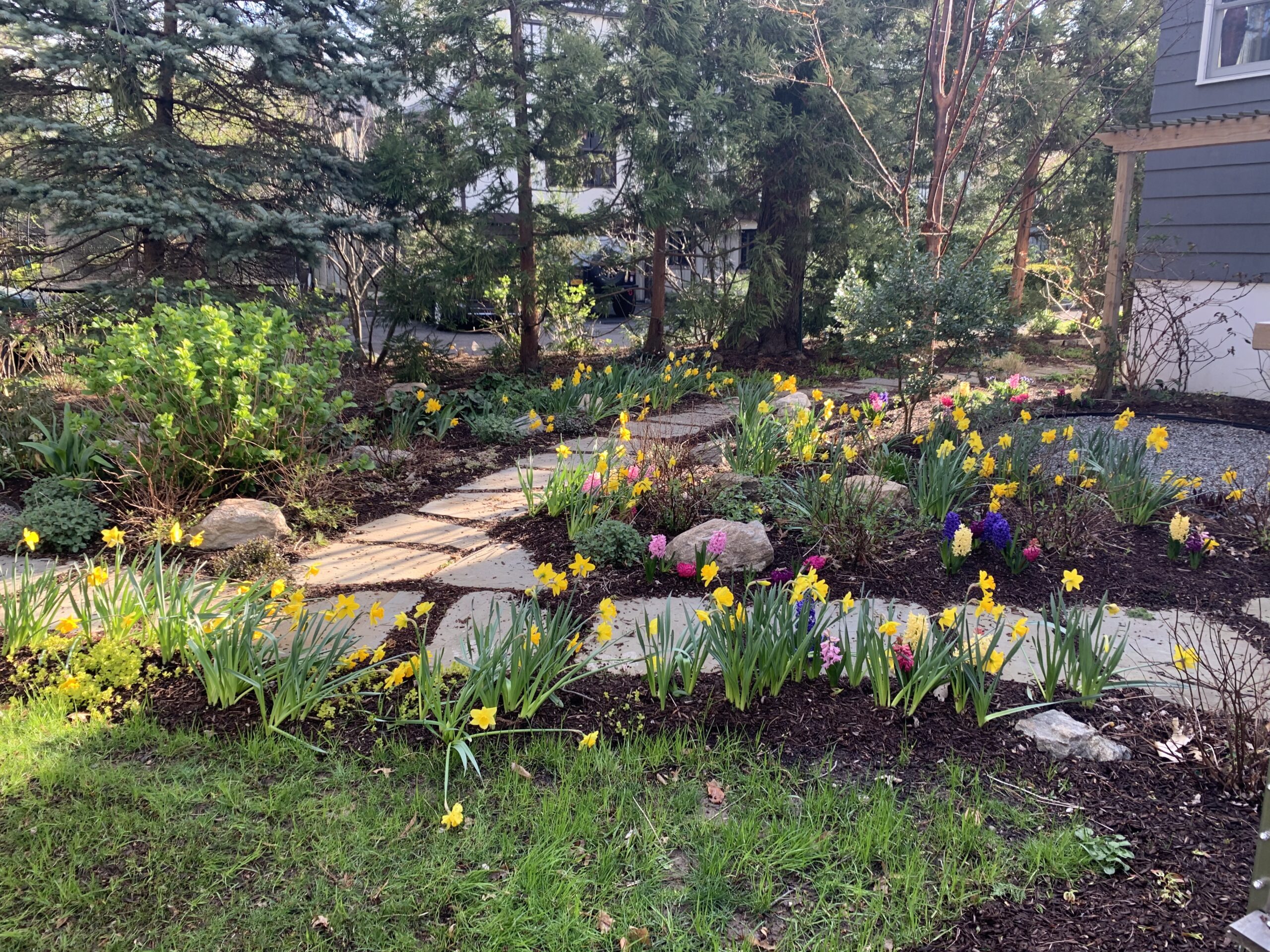
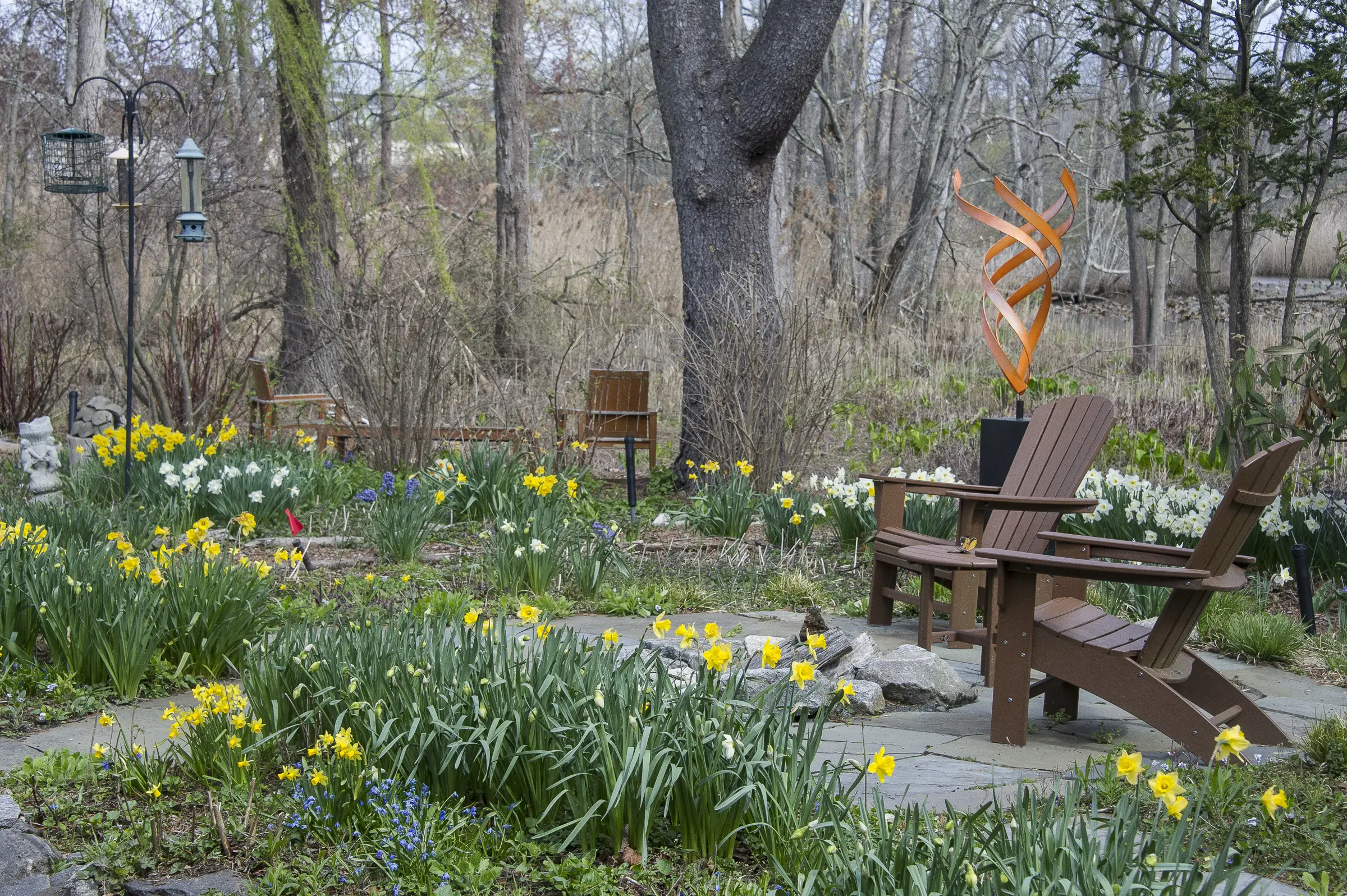
Flowering bulbs are a great way to add early spring color to your landscape.

Planting Flower Bulbs: When to Plant

The best time to plant bulbs is from the beginning of October until about 6 weeks before the ground freezes. Wait until the night temperatures average between 40 and 50 degrees Fahrenheit.

Plant New Flower Bulbs

Be sure to get new bulbs. Those bulbs that never got planted last year and have spent a year in the garage are long gone. It will be a waste of time to put them into the ground. Don’t even think about it! And, be sure to plant all the bulbs you get this fall. They won’t have a second chance.

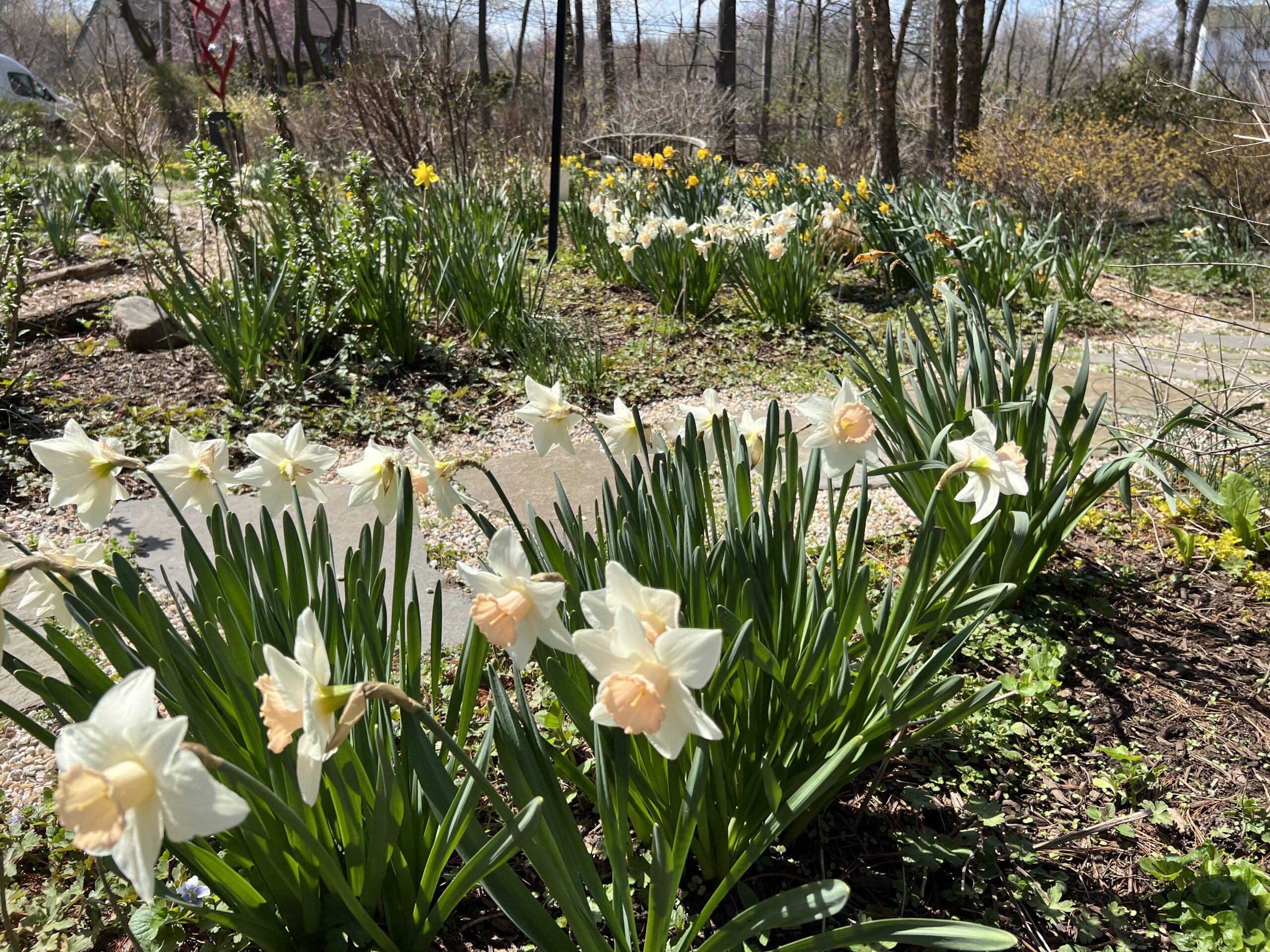
White daffodils brighten up any spring landscape!

Planting Flower Bulbs: Don’t be too quick to throw out the package!

Here’s a little problem to avoid: Try not to separate the bulbs from their packaging until they’re in position ready to plant in your garden. Various colors of the same variety (tulips, daffodils…) have bulbs that look exactly the same. You’re a goner if you throw out the label before planting!

Where Do Your Flower Bulbs Love to Grow?

And, if you want your bulb garden to flourish, don’t plant it under your favorite huge shade tree. Most bulbs do best when they’re planted in a sunny spot. Remember that label you saved? It probably says something about the amount of light those particular flower bulbs need.

Here’s a curious fact: Plants that come from a location in the world that’s below sea level (Holland) don’t like to grow in soggy soil. Imagine that! So, make sure the place you plant your bulbs has good drainage.

Planting Flower Bulbs: Prepare the Soil

Take time to prepare the soil so that your flower bulbs have a fighting chance to work their way to the surface. Loosen the soil to a depth of about 8 inches. If you really want to be kind to your bulbs, mix in a little organic matter. Those leaves you shredded (see below) would make excellent organic compost mixed into the soil. Your flower bulbs will richly reward you next spring. If you add a little fertilizer, perhaps bone meal, your bulbs will worship you as king of the universe.

And, don’t forget to remove rocks from the garden. How would you like to come to life, thinking everything was amazing, only to hit your head on a rock? Bad Bad! There’s only one thing worse: Never, never plant the bulbs with their heads facing down. They’ll try to get to China, but alas, they’ll never make it. The pointy side, as with many people you know, is the head. If you’re not sure which end is the head, plant the bulb on its side. Most bulbs are smart enough to figure out what to do in that case.

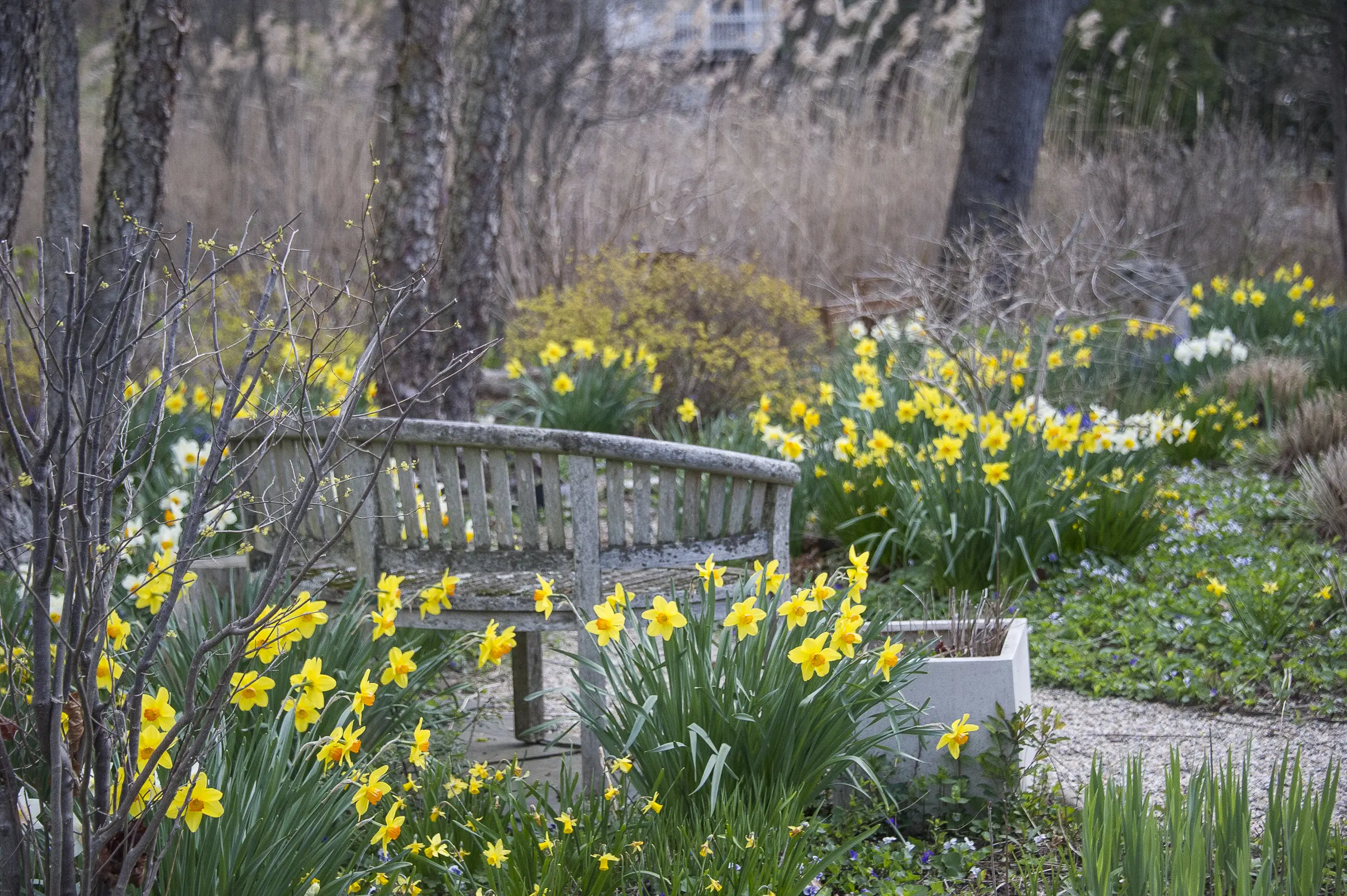
Daffodils surround a garden bench in Rye, NY.

How Deep Do You Plant Flower Bulbs?

How deep to plant your flower bulbs? As a rule, the smaller the bulb, the closer it needs to be to the surface. Plant larger bulbs (allium, iris, tulips, daffodils…) about 8 inches deep. Plant smaller bulbs (crocus, grape hyacinth…) about 4 inches deep. If in doubt, be sure to read the label you saved for this important moment.

Bulbs successfully planted? Now LOOSELY fill in the space above the bulb. Don’t pack the soil down (refer to our discussion about rocks above).

Watering Your Flower Bulbs

At this point every gardener wants to water the little guys. That’s okay. It actually helps activate them. However, remember what we said about too much water. The northeastern U.S. is fairly moist in the Fall, so unless we’re in some kind of weird climate-change drought, an occasional watering after a few sunny days will probably do the trick.

Daffodils are an excellent choice for a part shade landscape.

Where To Get Free Mulch For Your Flower Bulbs

Oh yes, about that mulch: Those leaves falling from your favorite shade tree (mentioned above) are meant to fertilize the ground they land on rather than going into some far away land fill. It’s pretty easy to help that process along. Here are some ideas:

Use a mulch mower rather than bagging the leaves and having them hauled off.

Pile the leaves in some forgotten corner of your yard and let them mulch for about a year, then dig them into your bulb garden next fall.

Instant Gratification Method:

Hire us to come over with our awesome Bear Cat Shredder (one of the few such shredders in Westchester County) and turn brush and leaves into instant mulch that you can use this fall!

Call Green Jay Landscape Design: 914-560-6570


Victory! You’ve Successfully Planted Your Flower Bulbs. Now What?

Now that you’ve successfully planted your flower bulb garden, sit back and expect a dazzling display of color and beauty next spring. Nearly zero effort! Would that raising kids could be this easy!

The only thing easier than planting a brilliant bulb garden is hiring a professional to design and plant your spectacular bulb garden, timed to bloom throughout the spring, summer and fall months.


Jay Archer, President (and Bulb Enthusiast)

914-560-6570

jay@greenjaylandscapedesign.com


Filed Under: Gardening & Grounds Maintenance, Landscape Design, Organics - Lawn, Tree & Shrub Care Tagged With: alliums, crocus, daffodils, gardening how to, organic gardening, spring bulb recommendations, spring flowering bulbs, spring flowers, spring garden, trout lily, tulips

Why have an article about rhododendron pruning in October when the best time to prune a rhododendron is late winter/early spring while the plant is dormant? We just wanted to get this information out to those ready to do an October pruning, and perhaps cause you to consider waiting.

Rhododendron Pruning for a Sustainable Garden is an art form. Learn how to prune a rhododendron plant sustainably, taking out dead and dying material and submitting diseased portions for testing to determine the cause. Remember to sterilize your pruning shears. When finished, you’ve enabled the plant to focus its energy on the living material, contributing to healthy, beautiful growth and awesome blooms.

Video Transcript

“Welcome to Green Jay Landscape Design. Here we are inspecting one of our estate management projects. So, here we have some dieback on one of our rhododendrons. Now these old plants, and all the other plants seem reasonably healthy, but we see some dieback here. However, there’s also some new growth here, so what I’m going to do is prune the rhododendron to take out that dead and damaged material.

Rhododendron With Cigarette Burns

We also see some discoloration of leaves. Something that we want to look for is cigarette burns in the leaf. This may be due to over application of fertilizer. This is a classic indication. One thing we could do is send a tissue sample out to Rutger’s Plant Diagnostic Laboratory for an evaluation. We’re going to look at this and, once again, this is completely shot. I’ll take this out. Now if this was much thicker I would need loppers. This will give it a better appearance and also reduce what I’m seeing as potential damage. It looks better already. Here’s another dead stock. I’m going to remove that. And here’s some other dead stuff, but there’s a flower here.

One thing you want to do in pruning is to be sure you’re using sharp shears that have been sterilized in a 5% Clorox solution so that you’re not taking plant pathogens and disease and transporting it from one plant to the other.

Once again, here we have some dieback, but at the same time we have some green. We’re going to remove those dead parts. We want all the energy to go to the healthy tissue: Healthy flowers, healthy stem stalks, roots. We’re going to remove any dead, dying and diseased components of our plant—as much is possible. And that’s a little example of proper rhododendron pruning technique. Thank you.”

Rhododendron Pruning Tips

RHODODENDRON PRUNING: THREE OF THE BASIC REASONS.

  • Supporting the health of the plant
  • Shaping the plant for aesthetic reasons
  • Trimming the plant back to prevent overcrowding

The second two occasions for pruning can largely be avoided if the plant has been placed in a location that supports its growth to full size. For example, if the location is too close to other plants, too close to the house or perhaps in front of a window, it’s best to select a smaller-leaved dwarf variety of rhododendron. Otherwise, as the plant grows you’ll find yourself needing to drastically trim it back to prevent overcrowding. This is not the healthiest, most sustainable way to maintain a rhododendron.

Rhododendron Pruning: Growth Cycle & Best Timing

You can prune large-leaved rhododendrons at any time of year without harming the plant. However, the best time to prune large-leaved rhododendrons is late winter/early spring when there are no flower buds, just before the plant’s annual growth cycle begins.

The annual growth cycle begins with a flush of growth that terminates with a rosette of leaves (a truss) that averages around 6 inches in length. Younger rhododendrons will produce 2 flushes per year, older plants produce one flush followed by a flower bud. Rhododendrons retain their leaves for 2 years.

RHODODENDRON PRUNING: REMOVE DEAD AND DISEASED PLANT MATERIAL

When pruning, the first step is to remove all dead and diseased wood. Follow any dead or diseased portions of the plant to where the healthy living tissue begins and make the cut there. Remember to disinfect the sheers in a 5% Clorox solution between cuts so that you don’t transfer disease from one cut to the next.


RHODODENDRON PRUNING: DEADHEADING – REMOVE THE OLD FLOWER TRUSSES

Snip the truss off about ¼ inch above the new growth (the truss is the remaining flower structure of the recent blooms after the pedals have fallen off). You might be tempted to just break the truss off, but the break could inadvertently take some of the new growth material with it. It’s safer to use pruning shears.


Some rhododendrons don’t need to be deadheaded. If the flower stalks shrivel up and disappear on their own, you don’t need to deadhead that variety of rhododendron.

RHODODENDRON PRUNING: SHAPING YOUR RHODODENDRON (BEST TECHNIQUE FOR SMALLER PLANTS)

You’ll notice rhododendrons produce a new whorl of leaves each year. Follow the whorl clusters on a branch down to the cluster you want to keep, then prune the branch about ¼ inch above that whorl cluster.

The best time for shaping is late winter while the rhododendron is still dormant.

RHODODENDRON PRUNING: REJUVENATION PRUNING (BEST TECHNIQUE FOR LARGER, LEGGY, OVERGROWN RHODODENDRONS)

Here, you’re going to remove most of the branches of your rhododendron. Cutting at strategic points will promote a flush of new growth that you can shape over the coming years.

Each rhododendron has a few primary branches. Pruning the primary branches at different heights will create a natural looking plant as the new growth emerges. Where to make the cut? Notice that each branch has tiny, pin head sized pink dots along its surface. Each dot is a tiny bud. Make your cut ½ to ¾ inch above a healthy bud (one of the larger, firmer, fuller buds). Pruning above a cluster of multiple buds will produce new growth of multiple branches. That creates a fuller, more beautiful result.

As with shaping (above), the best time for rejuvenation pruning is late winter while the rhododendron is still dormant.

RHODODENDRON PRUNING: CONCLUSION

A thoughtful, strategic pruning program is not very time consuming and will result in beautiful rhododendrons with awesome blooms!


Jay Archer, President

914-560-6570

jay@greenjaylandscapedesign.com


Filed Under: Gardening & Grounds Maintenance, Organics - Lawn, Tree & Shrub Care Tagged With: grounds maintenance, organic gardening, rhododendron, rhododendron pruning

Wetland Restoration

Wetland restoration is normally thought of as something that happens in some “other”, far away place like a nature preserve or a national park. However, a huge percentage of our wetlands exist on private property–in our own backyards. This means that the individual property owner has the ability to make a great impact on regional and national wetlands restoration simply by preserving and restoring the wetlands in their own backyard. Of course, not many people actually have a wetlands area on their property, but if there is a wetlands area included in your residential or business property, or you know someone in this situation, you’ll find this article packed with valuable help and guidance in restoring your wetlands area to its natural beauty.

A Recent Green Jay Landscape Design Project

Wetland Restoration – Why is this important?

WETLAND RESTORATION PRESERVES OUR COASTAL AREAS.

Do you enjoy a day at the beach? Thank the upstream wetlands. Rivers transport water, sediment, and nutrients from the land to the sea, play an important role in building deltas and beaches, and regulate the salinity and fertility of estuaries and coastal zones.

WETLAND RESTORATION CREATES HABITAT FOR PLANTS AND ANIMALS.

Do you enjoy observing wildlife, or just knowing that your property is a bio-friendly zone? The presence of wildlife is a sign that the land is also healthy to humans. Rivers serve as corridors for migratory birds and fish, and provide habitat to many unique species of plants and animals, including federally endangered and threatened aquatic species. Wetlands provide food, protection from predators, and other vital habitat factors for many of the nation’s fish and wildlife species, including endangered and threatened species. If you’re fortunate enough to have a wetlands area in your own backyard, you have the ability to participate in enriching life by restoring and preserving a bio-friendly area.


WETLAND RESTORATION CREATES COMMERCIAL AND RECREATIONAL VALUE.

There is economic value associated with recreational, commercial, and subsistence use of fish and wildlife resources. Any action you take to preserve and protect the wetlands in your backyard may have an indirect positive effect on our economy.

WETLAND RESTORATION HELPS CLEAN UP POLLUTION.

Wetlands remove pollutants from overland flows before they reach our lakes, rivers and bays. Restoring and preserving the wetlands in your backyard will directly affect the entire water system downstream for miles.

WETLAND RESTORATION PROTECTS OUR LAND FROM SOIL EROSION AND FLOODING.

Wetlands intercept storm runoff and release flood waters gradually to downstream systems. When wetlands are converted to systems without water retention capacity, downstream flooding problems increase.

Remember the devastation wrought by Hurricane Katrina on New Orleans? A major cause of that devastation was the gradual commercial destruction of a natural wetlands buffer between New Orleans and the ocean. With this wetlands buffer compromised, the flood waters had direct access to the city with tragic results.


Wetland Restoration – The Condition of Our Wetlands

THE DAMAGE TO OUR WETLANDS

Over the years, hundreds of thousands of miles of river corridors and millions of acres of wetlands have been damaged throughout the nation. In the 1600s, over 220 million acres of wetlands are thought to have existed in the lower 48 states. Since then, extensive losses have occurred, and over half of our original wetlands in the lower 48 have been drained and converted to other uses. The years from the mid-1950s to the mid- 1970s were a time of major wetland loss, but since then the rate of loss has decreased. Between 2004 and 2009, an estimated 62,300 acres of wetlands were lost in the conterminous United States.

THE MAJOR CULPRITS IN WETLANDS DESTRUCTION

Human Actions

  • Drainage
  • Dredging and stream channelization
  • Deposition of fill material
  • Diking and damming
  • Tilling for crop production
  • Levees
  • Logging
  • Mining
  • Construction
  • Runoff
  • Air and water pollutants
  • Changing nutrient levels
  • Releasing toxic chemicals
  • Introducing nonnative species
  • Grazing by domestic animals

Natural Threats

  • Erosion
  • Subsidence
  • Sea level rise
  • Droughts
  • Hurricanes and other storms

WETLAND RESTORATION PROGRESS

From 1982 to 1992, a total of 768,700 acres of wetlands were gained as a result of restoration activities around the nation (USDA, 1997). Likewise, numerous miles of rivers and streams were restored in our nations watersheds over the same time period. While this sounds promising, the overall percentage of our wetlands continues to decrease. We’ve simply slowed down the destruction.

Wetland Restoration – Back to Your Backyard

Do you have a wetlands area on your property? Consider restoring it and preserving it. Your action will be a part of the overall decrease in wetlands destruction. If enough residential and commercial property owners take action to restore and preserve the wetlands to which they have been entrusted, we can look to coming years where the overall percentage of wetlands in our nation is actually increasing, moving back toward the 220 million acres we had in the 1600s.

WANT TO RESTORE WETLANDS IN YOUR BACKYARD?

CALL Green Jay Landscape Design

(914) 560-6570

Many of the statistics and examples in this article are compliments of the United States Environmental Protection Agency

Jay Archer, President

914-560-6570

jay@greenjaylandscapedesign.com

Filed Under: Consulting & Project Management, Wetland Restoration & Storm Water Tagged With: ecosystem services, water pollution, water purification, water quality, wetland design, wetland restoration

Do you have wetlands on or adjacent to your North Eastern US property? It’s critical to human survival that we preserve our vanishing wetland areas.

A walk through the wetlands areas in the New York Botanical Garden gives creative ideas on how to preserve and protect your wetland area, and re-introduce some of the original plant species native to wetlands in the North East.

Following the video and transcript:

TOP 5 REASONS TO PROTECT NORTH EASTERN WETLANDS

Wetland Landscaping – Educational Walk Through New York Botanical Gardens Wetlands


Wetland Landscaping Ideas – Paraphrased Transcript from Video

“We’re at the wetlands in the children’s adventure garden of the New York Botanical Gardens. Wetlands are critical for our survival as a species. Here is the primordial ooz from which we came, which is critical to nourishing and sustaining us. Embrace and come to appreciate our precious natural resources.”

“John and Meg are responsive for this amazing native garden. Algae removal is a constant issue for aesthetical purposes. The water source for this wetlands area is the Bronx River. We can’t introduce fish into this area because they might make their way back into the Bronx River System. Our goal is to preserve the eco-system. It’s an ornamental garden, not habitat reconstruction as is the adjacent 40-acre natural virgin stand of NY forest. 50/50 mix of native species and cultivated varieties of native species. Come, enjoy, and get ideas for using these native plant species in your own landscape.”

“Black die was added to the water in the Mid Plant Garden to inhibit UV light which creates algae bloom. Some algae growth still occurs and Meg is removing that algae from the pond with a net. They also pump water from the lower level which serves to aerate the water, increasing the dissolved oxygen level.”

Wetland Landscaping Ideas – Top 5 Reasons to Protect Wetlands

Wetlands include wooded swamps, vernal pools, peatlands and marshes. These areas perform 5 valuable functions which are eliminated when we fill in and build over our precious wetlands.

1. FLOOD PREVENTION

Flooding occurs when excess water is not absorbed into the soil. Wetlands slow down and absorb excess water. If this water has no place to go, it may end up in your foundation or basement!

2. WILDLIFE HABITAT PRESERVATION

Wetlands such as marshes, swamps and bogs feed and shelter rare plants and wildlife. These may include deer, waterfowl, songbirds, insects, fish, turtles, salamanders, frog and more. There is a fragile living beauty to this ecosystem.

3. GROUNDWATER RECHARGE

Wetlands are like reservoirs. They hold excess water during the rainy seasons and release it over time into rivers and streams and the ground water system during dry seasons. Without wetlands, the ground water aquifers which supply our well water could go dry.

4. WATERSHED PROTECTION

All the wetlands in a watershed area are interconnected. Water moves over the ground from one wetland area to another, spilling into the areas lakes, rivers and streams. This means that if one body of water is polluted or depleted, other bodies of water in the watershed area will be affected. As the people of New Orleans discovered, wetlands also provide a buffer from the wave action of the sea. When the wetland buffer between the sea and New Orleans was compromised through development, it could not protect New Orleans from hurricane Katrina.

5. POLLUTANT FILTRATION

Wetland soils, due to their porous nature, filter pollution such as heavy metals and other contaminants.


Wetland Landscaping Ideas – Conclusion

If you have a wetland area on your property, you have been given a rare opportunity to help preserve and protect a unique environmental zone. Due to it’s interconnection with other wetland area near you, how you proceed could have far reaching effects on the plant, animal and human life in your neighborhood.

We here at Green Jay Landscape Design look forward to actively preserving, promoting and engaging the wetland areas on your property.

Jay Archer, President

914-560-6570

jay@greenjaylandscapedesign.com

Filed Under: Landscape Design, Wetland Restoration & Storm Water Tagged With: flood prevention, habitat design, pollutant filtration, storm water management, watershed protection, wetland habitat, wetland landscaping

“The Market Garden On the Deck” is a wonderful way to increase your enjoyment of nature and edible plants. Supplement your diet with organically grown vegetables and herbs. You’ll need to provide regular watering, pruning and feeding, but in all, this container garden is simplicity and beauty at its best. Altogether this space accommodates our barbeque, a small café table, 3-4 chairs, intimate dining—all the wonderful aspects of our beautiful world at Green Jay Landscape Design.


Container Gardening Ideas – Unique features of the container garden:

  • Elevated Deck: An elevated deck above the landscape brings nature and our experience of nature closer to the home and to our kitchen.
  • Home-Grown Food: Grow food in proximity to the kitchen.
  • Squirrel-Proof Bird Feeder: The new state of the art squirrel proof bird feeder. A squirrel jumping on the feeder will trigger a cut-off of the seed supply. The cardinal ring is particularly inviting to cardinals. Finches love it.
  • Distinctiveness: The various shapes and sizes of the containers make this garden distinct.
  • Compact: It doesn’t take up much room. The space is designed for 2 people to occasionally entertain.
  • Tower Garden: A tower garden hydroponically grows vegetables and herbs in rock wool from seeds or live plants.
  • Vertical Garden: There’s a vertical garden. The cells enable us to grow basil, herbs, vegetables, annuals, perennials, parsley, red lettuce, petunias, sweet potato vine, black-eyed susan vine, whatever the light allows.
  • Shady “Chi” Corner: We have a shady corner planted with wax begonia, containing a little fountain that attracts birds and encourages positive Chi in the garden area.

Container Gardening Ideas – Some of the perennials and annuals in the garden:

  • Citronellas repel mosquitoes.
  • The red fountain grass is a wonderful addition to our landscape. The blowing wind adds motion and interest.
  • Flowering hibiscus and Siberian Napata add fragrance and repel biting insects while attracting beneficial insects.
  • Myer Lemon produces fruit (needs to be taken inside during cold weather).
  • Bougainvillea creates a wonderful fragrance along with the combination of plants.

    Container Gardening Ideas – Top 7

    1. Know Your Plant Characteristics: Study each plant’s growth habits, needs for light, water, fertilizer, drainage, pruning, susceptibility to pests and disease. Consider the time investment each will require before you begin populating your garden.
    2. Use Complimentary Colors: Select a color scheme that compliments the surroundings including the other plants and even the colors of your home.
    3. Select Appropriate Plants for the Lighting: Assess the natural lighting and select plants accordingly. Is the area shaded? Is it in full sunlight?
    4. Consider Plant Height: Arrange the plants according to height and size. Before you begin, create a plan that includes plants of various sizes.
    5. Seek Complimentary Diversity: Consider the shape of the plant, its leaves and blooms. You’re creating an overall art piece as you carefully place each plant.
    6. Select Appropriate Containers: You can add elegance to a plain looking plant by placing it in an artistic container. You can show off an elaborate, colorful exotic plant by placing it in a simpler looking container.
    7. Properly Space Your Plants: Overcrowding leads to spindly, weak plants. One plant per container is a good basic rule. It not only allows room for the plant’s healthy growth, but showcases that particular plant. Space the containers so that air can circulate between the plants. You don’t want the plants growing into each other.

    Container Gardening Ideas – Final Tip

    CREATE AN ENDURING MASTERPIECE WITH THE HELP OF A LANDSCAPE DESIGN SPECIALIST.

    We’ll design the perfect fit, maximizing your overall landscape design, the look of your home in light of the time investment you want to put into maintaining the beauty of your container garden.

    Jay Archer, President

    914-560-6570

    jay@greenjaylandscapedesign.com

Filed Under: Ecological Education, Featured Work, Gardening & Grounds Maintenance Tagged With: container gardening, container planting, deck garden, ecological landscape design, ecological landscaping, herb garden, tower garden, vegetable garden, veggie garden

  • « Go to Previous Page
  • Page 1
  • Interim pages omitted …
  • Page 53
  • Page 54
  • Page 55
  • Page 56
  • Page 57
  • Interim pages omitted …
  • Page 60
  • Go to Next Page »

Footer

Mailing Address: 222 Purchase Street, #144 Rye, NY 10580
Shop Address: 369 Bradhurst Ave, Hawthorne, NY 10532
(914) 560-6570
  • Facebook
  • Instagram
  • LinkedIn
  • Pinterest
  • YouTube
  • Houzz
  • Slide Share
  • Installation
  • Portfolio
  • Pricing
  • About
  • Contact

Copyright © 2025 · Green Jay Landscape Design. All Rights Reserved · Privacy Policy · Website and Local SEO by Ramblin Jackson