• Skip to main content
  • Skip to footer
Green Jay Landscape Design

Green Jay Landscape Design

Green Jay Landscape Design

(914) 560-6570
  • Design
  • Installation
  • Portfolio
  • Pricing
  • About
    • Service Area
    • Meet Our Team
    • Our Process
    • Our Promise
    • Mission, Vision, & Core Values
    • FAQ
    • Press & Events
    • Blog
    • Reviews
    • Careers
    • Affiliations
  • Contact

greenjayadmin

This project was truly a highlight of the 2019 season. After buying their dream home – a gorgeous Tudor in Rye, NY – this client wanted a total renovation of the backyard to reflect the interests of their large family and their appreciation for nature, gardening and food production.  The design had to be playful, wild, and elegant – appealing to a range of ages and social settings.

This project, dubbed ‘The New Garden of Egalitarian Gentility’ is part of our 2019 Green Jay Landscape Design Design Highlights series (#2!).  Check back for a discussion of the rest of our favorite projects of 2019! Read about projects 3, 4 and 5. 

[Above: BEFORE photo]

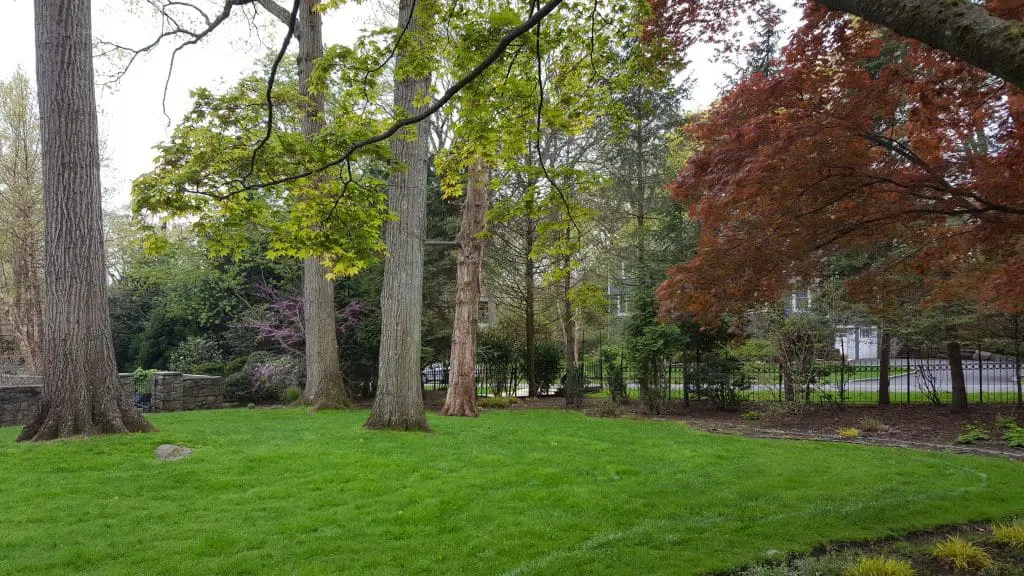
The existing landscaping was dominated by a mature evergreen tree and shrub border. GJL took advantage of the good bones of the property – mature trees have tremendous ecological and ornamental value! – and designed a meandering woodland walking path around the North and East perimeter of the property, culminating on either end in a secluded forest-like seating area, underplanted with a mix of native and exotic woodland perennial species. The path was designed for both children (the client even added their own fairy houses!) and adults; suitable for a playful dash or a reflective stroll.

At the center of the Eastern border, directly across from the patio area, we created a “Avian Bird Haven” berm garden.  Elevating that section to a berm provided another element of seclusion and intimacy from the woodland path, and from the yard created a strong focal point. We planted it with sun/shade perennials, selecting as always for species that provide the most ecological value for pollinators and birds. We firmly believe that nature is the best teacher and creating natural landscapes provides endless teaching opportunities for our children.

This home had a fabulous pool, patio and outdoor kitchen area. The landscaping around it was quite predictable. GJL expanded beds along the outer wall, planting with a tapestry of summer-dominant perennials (Agastache, daisy, coneflower, lavender, blackeyed susan, to name a few) that counterbalance the adjacent Avian berm.

The interior poolscape also received a new bed, dividing the kitchen area from the pool, with a new walkway to a sodded poolside area. The planting bed became a living fence of textured dwarf ornamental grasses and perennials for a modern, California poolscape feel.

All planting areas were amended with organic compost, biochar, and biostimulants and the lawn was aerated and treated with our organic Magic Wand program.

Another favorite element of this Playscape was the trampoline. A toy perhaps equally entertaining and unsightly… we designed a solution by installing it in-ground and planting native shrubs – clethra, viburnum, aronia and dogwood – around it to effectively blend into the landscape and the surrounding woodland garden.

On either side of the trampoline are Rain Gardens, planted with facultative plants that can withstand flooding and drought, making them incredibly valuable during storm events for they can absorb sheet flow and allow it to percolate into the aquifer. Rain gardens are beautiful and effective storm water management solutions; we create one on nearly every property we design!

Circulation and seating areas are incredibly important in a design. They allow the landscape to be accessed, views to be framed, and time to be spent in curated areas of the environment. For this property, we installed a Colonial Garden Path walkway from the front to rear yard, connecting to the pool and lawn area.  We also installed large siting boulders under the mature Oaks at the center of the yard – the perfect 360 viewing area of the surrounding perennial gardens.

This was truly a special project for all involved.  In the words of the client:

“Thank you, Jay because you brought a real passion to this project, to enable me and my family to live my dream in this house and this garden and to be surrounded by nature.” – Dan, Rye, NY

Catch our full video interview with the client in our previous blog post!

Filed Under: Featured Work, Landscape Construction & Installation, Landscape Design Tagged With: ecological landscape design, garden path, garden rooms, landscape desginer, landscape design master plan, landscape designer, native plant garden, organic landscape, playscape, stroll garden, woodland garden, woodland path

We love clients like Dan — those who care enough to know about mycorrhizal networks, microbiomes, and species fragmentation.  From day one during the consultation, just by his vocabulary,  we we knew Dan would be a super star client that deserved an ecological landscape masterpiece.  This was one of our largest and most special transformations of the 2019 season! Dan and Jay reflect on making ecological design choices and why Dan chose to go ecological in his new landscape renovation.


Check out our other A Voice for Nature interviews.

Filed Under: Ecological Education Tagged With: A Voice For Nature, client testimonial, ecological landscape design, landscape ecology, native plant garden, natural landscaping, rain garden, testimonial, why we value nature

It’s officially Fall, and in the traditional landscaping world, that means prime time for lawn renovations.  Most grass species used in American lawns – Kentucky Blue Grass, Perennial Rye Grass, Fine Fescues and Tall Fescues – are cool season grasses.  Cool season grasses grow and look best in the temperature range of 60 – 75 degrees F. During our hot and humid northeast summers, when temperatures get into the 80s and 90s, lawns usually suffer.  This is when you see brown, burnt lawns or lawns dominated by weeds. Excessive heat, drought, compaction and improper fertilization practices stress cool season grasses in summer, reducing their growth rate and allowing opportunistic weeds to take over.  August and much of September are simply too hot and dry to renovate your lawn if it has begun to suffer – the grass won’t grow! Aeration, top-dressing and re-seeding must wait for cooler fall temperatures.

Year after year we see the same seasonal patterns and pour more money and resources into reviving heat-stressed, cool-season lawns. Is it really worth it? Sure, lawn can serve a purpose for play, pets and gathering, but it has become far too ubiquitous in our landscapes. One of GJL’s main tenants in ecological landscaping is to reduce your lawn area! When we stop obsessing over a flawless carpet of green, and really examine how much water (the most irrigated crop in the US!), chemicals (2.4 million metric tons of fertilizer!) and gasoline (600 million gallons for mowing/trimming alone!)go into maintaining our “perfect” American lawns, we can poke holes in convention and design something better.

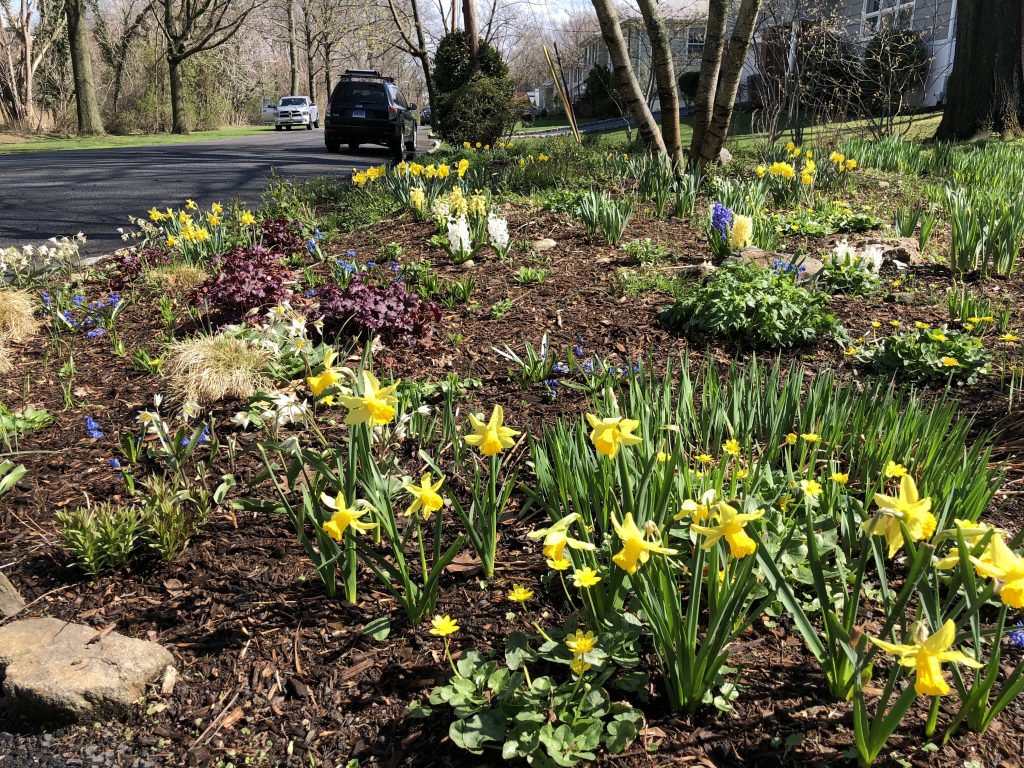
Many of our clients come to us to do just that.  They are tired of the endless cycle of lawn maintenance and want to contribute more positively to their environment.  We’ve ripped out entire front lawns for pollinator-supporting perennial gardens. The final design varies, necessarily, based on site conditions and character, but we always hear the same feedback. Our clients are thrilled to have ditched their one-dimensional, static lawn for something that evolves throughout the year, that brings color to their landscape, and creates a dynamic habitat for bees, butterflies, birds and more – and a great outdoor classroom for children.

These kinds of landscapes are incredibly productive.  We choose our plant palette with the permaculture term “stacked functions” in mind – how many benefits can we derive from one plant or plant community?  What will sequester the most carbon, provide nectar, pollen or berries, and supply shelter to the multitude of organisms we share our slice of the planet with? The planting possibilities are endless, but our native trees, shrubs, perennials and vines all contribute more than imported Eurasian turf grasses.

Maybe you’ve been struggling to get one area of your property to grow lawn that never seems to work. We’ve designed many woodland rain gardens in areas such as these, where grass always seemed bare, damp and scraggly. We take advantage of the hydrology and use it as an opportunity to collect, treat and let percolate storm water that would otherwise become runoff.

So, this fall, instead of scheduling your standard lawn renovation services, consider your landscape. Is it highly functional, productive, beautiful and evolving? Does it better the environment or negatively impact it? Take a step in the right direction and consider reducing your lawn area with an ecological landscape design this fall.

Call us to discuss your ecological landscape design project:  914-560-6570.

—

Kathryn Saphire

VP of Landscape Development & Marketing


Filed Under: Ecological Education, Landscape Design Tagged With: ecological landscaping, fall landscape to-do list, fall lawn renovation, fall lawn repair, front entrance garden, front yard garden, landscape designer, native plant garden, organic garden, organic landscape, pollinator garden, replace your lawn, rethink your lawn

How can we reverse decades of poor landscape practices, like removing leaf litter? GJL’s Organic Plant Health Care Programs include Deep Root Feeding with our mix of microbiology products, molasses, & aeration. Healthy soil microbial populations are essential for breaking down nutrients and making them plant-available. In this symbiotic relationship, the plants strengthen their immune system through a healthy and balanced diet, and the microbes get a host plant and trade sugars from the plant for minerals and nutrients.

Filed Under: Ecological Education, Organics - Lawn, Tree & Shrub Care Tagged With: improving soil biology, instant compost tea, mature trees, organic compost, organic fertilizer, organic soil drench, soil ammendments, soil bio-stimulants, soil biology, soil drench

It’s been a common refrain this season: the mosquitos in my yard are insane. I can’t be outside for more than ten seconds before getting bit. 

As landscape professionals who work outside every day… we believe you. We see it too. But our immense annoyance and frustration with these pesky creatures can lead to some pretty crazy human behaviors.  Daily, we see mosquito-prevention trucks out in our communities, spraying toxic pesticides all over the landscape in hopes that every mosquito in town will come alight on those surfaces and die an instant death. Ha!

Unfortunately, mosquitos fly and can easily avoid sprayed areas. Mosquito spraying is ineffective.

Even more unfortunate are the other, unintended victims – beneficial insects, whose ecosystem value cannot be ignored.  In organic gardening especially, we rely on healthy populations of insects –from pollinators, to pests and the predators that predate them—to stabilize ecosystems in a natural way and produce thriving, beautiful gardens.  More broadly, we are currently facing rapid insect population declines globally– The Insect Apocalypse– as documented by scientists in Germany, Denmark, and the U.S. (and reported by the NY Times).

We simply cannot afford to kill more insects with ineffective mosquito pesticides sprays. So, what are our options? What creative ecological solutions are available?

Mosquito Dunks— a larvicide that only targets mosquito larvae. They should be placed in mosquito breeding habitats – standing water—they will dissolve and kill only the larvae.  This is a very effective treatment that directly targets the vector of the problem.  Tropical regions of the world deal with their intense mosquito pressure by targeting the larvae populations in this same way. Our climate lately, with intense storm events every few days and record temperature heat waves in between, is not far off from the tropical climates that face the worst mosquito pressure in the world. This extreme weather pattern invites standing water and creates ideal conditions for mosquito breeding (it takes four to twenty-eight days for mosquito eggs to hatch in standing water).  Be proactive as you examine your landscape (and your neighbors!) after a storm event and treat any standing water you see with mosquito dunks.

Protect Catch Basins – catch basins are often the perfect breeding grounds for mosquitos. Clean them out often, and ideally, cover with non-woven geotextile fabric and gravel. This covering stops debris but allows storm water to infiltrate into the drain and storm water system. It also keeps mosquitos and light out.


Rain Gardens – Every property could benefit from a rain garden! What is it? A depressed garden filled with a gravel-sand-soil medium and planted with facultative wetland species – plants that can survive both drought and rain inundation.  The planting and soil medium allow for biofiltration of the storm water and percolation through to the aquifer, rather than pooling on the surface, which often happens with lawns. Plus, rain gardens require primarily native plantings meaning they attract hummingbirds, butterflies, native bees, dragonflies, and more!

Invite Predators – As ecological landscapers, we rely on and encourage the natural predator-prey relationships in our local environment. One of the best mosquito predators are DRAGONFLIES! Dragonfly larvae spend their first months (even years!) in water, right alongside a tasty food source: mosquito larvae.  Adult dragonflies also eat adult mosquitos, gnats and other insect pests. The best way to attract dragonflies to your property is to create a pond habitat.  It should have multiple depths, exposure to sun and should not freeze completely over the winter.  Check out our Water Gallery for inspiration! Crucially, to make a hospitable habitat for any insect predator, your property must be maintained organically. Learn more about our Organic Lawn, Tree and Shrub programs.

—

Kathryn Saphire

VP of Landscape Development

914-560-6570


Filed Under: Consulting & Project Management, Ecological Education, Wetland Restoration & Storm Water Tagged With: catch basin, drainage, landscape drainage, landscape ecologist, mosquito problem, organic mosquito solution, storm water management

There are many levels of expertise and experience within the landscape industry.  At Green Jay, we pride ourselves on our ecological niche that takes a holistic view of a property when determining any design or program recommendations.

Simply put, these recommendations cannot be made in a vacuum over the phone.  Site analysis is the first essential step in any of our projects. When we first visit a property, we consider the following:

Client Wishes– this is a pretty obvious step, of paramount importance! What do you like and dislike about your current landscape.  How do you envision your landscape functioning – do you entertain often, have young children, rowdy pets, or do you just need a quiet place to relax outside?

Client Views– sometimes the best inspiration comes from insidethe house – particularly to evaluate and frame views outside from primary indoor living spaces. Getting a sense of the client’s style through their home décor choices also provides valuable insight.

Drainage – we always ask, “do you have water in your basement?”  Often, clients are habituated to their basement sump pump running constantly, not realizing that there are home and landscape improvements that can reduce flooding and ponding. We evaluate gutter and leader sizes, trace where they dump the water, and inspect drains, catch basins, and pipes for debris or signs of degradation. Moss, mold and slimy surfaces are other good indicators of drainage issues.

Plant Health – Maybe you inherited a fifty-year-old landscape of exotic shrubs, now overgrown, and have no idea what’s worth keeping, pruning, or dumping?   Maybe your arborvitaes haven’t grown since you planted them several years ago. Maybe you have shrubs with yellowing leaves and holes.  Our trained horticulturalists evaluate your landscape’s plant health and make recommendations on how to rejuvenate them organically.

Sun / Shade Conditons – Sun mapping is critical in determing planting recommendations.

Lawn – is your lawn organic yet?! What will it take to get you there? Do you have a crabgrass problem? Do you have the right pH and enough organic matter to grow a great lawn? Is your soil suffering from compaction? Our Organic Lawn Care programs are custom designed for each property.

Soil – We evaluate the physical characteristics of your soil (how much sand, silt, and clay) by hand, and take note of coloration (rusty, light brown, almost black).  For clients signing on for a design or organic maintenance program, we alwaystake a soil chemistry test to evaluate pH, micro and macro nutrients, cation exchange capacity, soluble salts, and more.

Circulation– is your landscape accessible from major entry points? Could it benefit from a stepping stone path or stone staircase to guide the visitor?

Repairs & Improvements – We can advise on existing property improvements from masonry work to gutters to rot and mold issues.

These observations and analyses are critical to informing a design plan. If you have a landscape project in mind that could benefit from a professional evaluation and recommendations, give us a call at 914-560-6570.

Filed Under: Ecological Education, Landscape Design Tagged With: design consultation, design professional, design wish list, horticultural survey, landscape circulation, landscape consultation, landscape designer, landscape evaluation, soil evaluation

  • « Go to Previous Page
  • Page 1
  • Interim pages omitted …
  • Page 32
  • Page 33
  • Page 34
  • Page 35
  • Page 36
  • Interim pages omitted …
  • Page 60
  • Go to Next Page »

Footer

Mailing Address: 222 Purchase Street, #144 Rye, NY 10580
Shop Address: 369 Bradhurst Ave, Hawthorne, NY 10532
(914) 560-6570
  • Facebook
  • Instagram
  • LinkedIn
  • Pinterest
  • YouTube
  • Houzz
  • Slide Share
  • Installation
  • Portfolio
  • Pricing
  • About
  • Contact

Copyright © 2025 · Green Jay Landscape Design. All Rights Reserved · Privacy Policy · Website and Local SEO by Ramblin Jackson