• Skip to main content
  • Skip to footer
Green Jay Landscape Design

Green Jay Landscape Design

Green Jay Landscape Design

(914) 560-6570
  • Design
  • Installation
  • Portfolio
  • Pricing
  • About
    • Service Area
    • Meet Our Team
    • Our Process
    • Our Promise
    • Mission, Vision, & Core Values
    • FAQ
    • Press & Events
    • Blog
    • Reviews
    • Careers
    • Affiliations
  • Contact

greenjayadmin

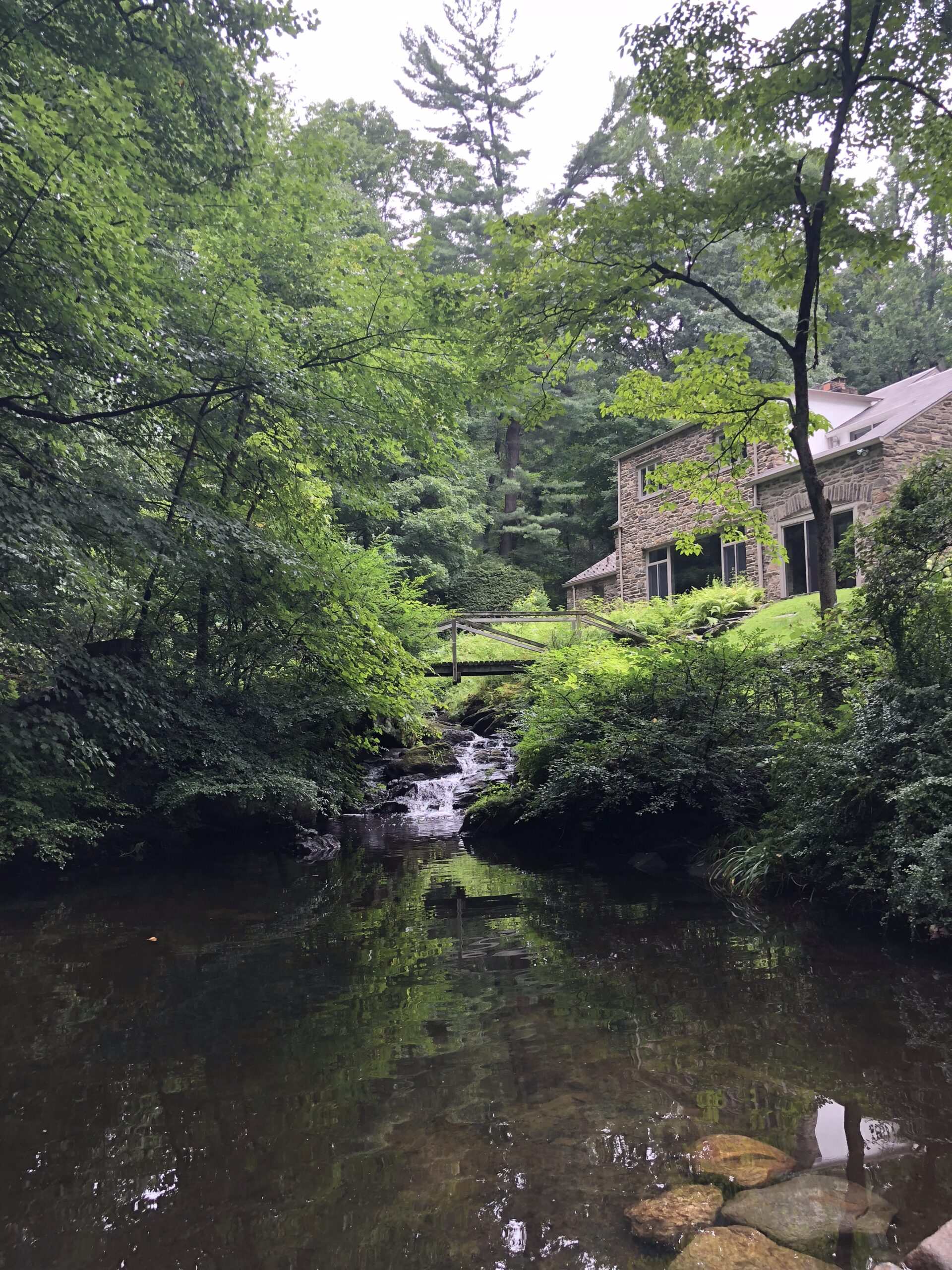
This adorable property features a stream babbling through the backyard.  At one point, probably in the 1930s, a concrete dam was poured to create a “natural” swimming pond that until now, held up fairly well, but had recently begun leaking in several spots.  Given the woodland setting, the pond had also accumulated quite a bit of debris from surrounding trees, which clouded the water and depth of the pond.


The clients wished to restore the pond as much as possible to its swimming pond function.   GJL crew first manually removed large sticks and debris, then we partnered with Cooper Ponds to suction harvest the mud and muck from the pond floor. In the end we achieved a depth of 4’ at the deepest point, and a great increase in water clarity. Jay was swimming by the last day…but that’s nothing new.

We also repaired the leaking stone wall with hydraluic cement to ensure that water flow was constrained to the desired inflow and outflow areas, preserving overall depth in the swimming pond.

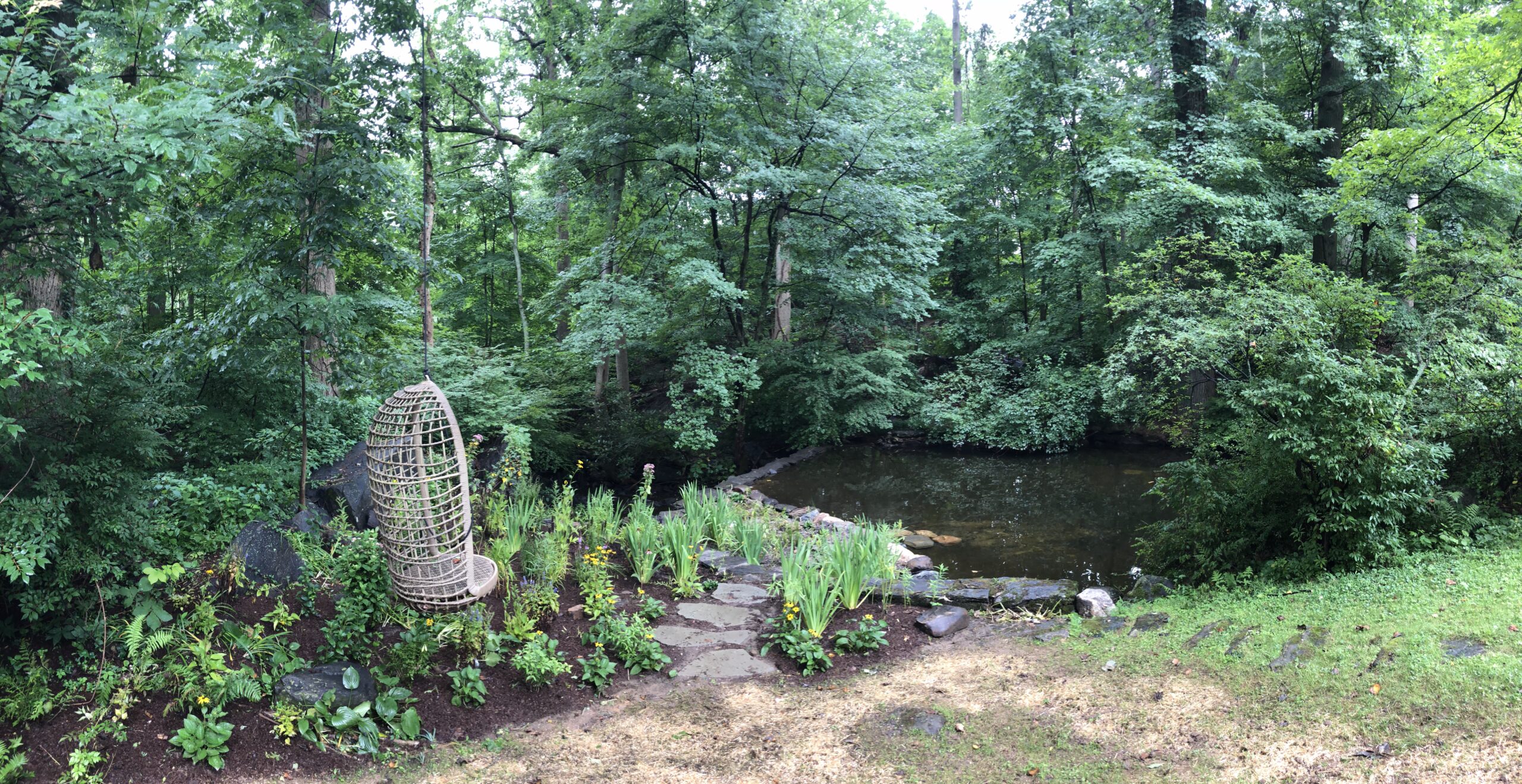
To promote lasting water quality, GJL also constructed two retaining walls, one forming a semi-circle within the pond, and one across a vacant area between the pond and bank. Both areas were filled with the extracted pond muck, and used as the foundation for planting beds. The bed within the pond became a bog garden, planted with native aquatic plants that help to clean the water when the bog is flooded. The second wall-turned-planting-bed became the terrestrial continuation of the bog garden, featuring flowering native perennials and ferns for a flowering forest vibe.


Filed Under: Featured Work, Water Features, Wetland Restoration & Storm Water Tagged With: Cooper ponds, ecological landscape design, ecological landscaping, landscape designer, landscape renovation, masonry repair, natural swimming pond, pond restoration, repurposed materials, suction harvesting, swimming pond, water quality restoration

The APLD International Design Conference (Sept 13th – 17th 2018) is a power-packed weekend to say the least.  Unlike most conferences I’ve attended, we weren’t locked in a lecture hall for four days.  Rather, APLD strikes the perfect balance of specialist speakers and boots-on-the-ground garden tours; seeing theory in action, which is always preferred!

Friday: Lectures, Demos & Networking

On Friday we heard from legend Darrel Morrison, FASLA and senior faculty at University of Wisconsin-Madison. Darrel spoke of teaching and drawing inspiration from naturally occurring Wisconsin plant communities, in both their species groupings and the innate beauty in their natural patterns: Rivers & Drifts, as he so called his presentation.  Below are some fascinating examples of his theory on paper.

We also saw a thematic compilation of landscape styles – traditional, rustic. & contemporary, from Susan Cohan and learned about Green Infrastructure case studies from Sabrena Schweyer. Jan Johnsen delved into the ‘most ancient materials’ –STONE and “stonescaping” – for a delightful preview of her newly released book The Spirit of Stone.  Finally, Toronto Botanical Garden’s own Paul Zammit delighted the room with an energizing container gardening demo.

Saturday: Public & Private Garden Tours

Kim Price

We visited three gardens designed and constructed by Kim Price Landscape Design  and were lucky enough to have her present for two of the tours to field our questions. Kim’s designs consistently used strong architectural elements with clean lines, and an emphasis on structural evergreens and foliage (to withstand Toronto’s half-year winter). I admired her modern blend of materials, especially to disguise unsightly features like A.C. units! The photo above is of a custom water feature of cor-ten steel and stainless steel egg planters; it created such a great focal point for that coveted indoor-outdoor continuum. See more photos of Kim’s work in the gallery below!


Jennifer Hayman

Jennifer addressed a challenging pie-slice lot shape by creating two patio areas on 45-degree angles, effectively elongating the space, increasing functionality and maintaining clean, modern geometry.  The front yard featured textured block plantings of Pervoskia, Taxus, and Pennisetum. See photos below.

Toronto Botanical Garden & Toronto Music Garden

It was a real treat to tour the Toronto public gardens, especially after learning that they have been maintained organically for over a decade! The Toronoto Music Garden, designed by Julie Moir Messervy to reflect Bach’s First Suite, features swirling paths inspired by fern frond for the early sections; ‘performance rocks’ in every gathering space; and spiraling crescendo and decrescendo staircases surrounded by grasses, perennials, and an outdoor grass amphitheater.

Sunday: Private Garden Tours & Sheridan Nursery Tour

We began the day with a tour of Old World Wonder which was a fabulous example of how to design on a tricky site.   Right against the property line is a massive 2.5 story church, which would have dominated previous site views.  In the finished landscape, the church is an afterthought, as is masked by a charming old-world style dual pool house, with green roofs and an antique mask waterfall. Designer Jim Mosher seamlessly melded the clients’ collection of found objects and worldly artifacts.

The next tour was an organic, naturalistic ten-acre beauty. Designer Randy Tumber cut around an existing pool to create a walk-out basement entry, and used the fill to create sweeping berms across the once-flat front yard. Other areas of the property were left un-mowed and allowed to re-vegetate as native meadows with mowed paths for optimal nature walks.

Finally, we ended the day touring one of Canada’s largest nurseries –Sheridan Nursery. 

Monday: Rooftop Garden Tour

Monday’s program featured several public and private roof gardens, each with their own inspiring mission and style. First was the Women’s Hospital garden which features raised beds of veggies that serve as an outdoor classroom for at-risk youth. Next was the Native Family Center whose beautiful rooftop was designed to highlight the four sacred plants: cedar, sage, tobacco and sweet grass.  A modern sweat lodge and birch planting accentuates important cultural practices. Finally, a park-like private rooftop for apartment residents proved just how successful of an amenity garden roof space can provide.

We left the conference feeling inspired and energized by our fellow designers and their commitment to elevating our public and private outdoor spaces in a sustainable way.  Learn more about APLD, and especially check out this year’s APLD Award Winners, on their website and in APLD’s The Designer magazine.

—–

Kathryn Saphire

Landscape Development Associate

914-560-6570

Filed Under: Ecological Education, Events & Garden Tours Tagged With: APLD, Association of Professional Landscape Designers, design inspiration, garden inspriation, garden tour, international design conference 2018, landscape designer, organic landscaping, sustainable landscaping

When we first visited this Croton-on-Hudson property, we noticed the unique existing architectural features, including a wooden bridge from the deck to back lawn and a beautifully curving, stacked stonewall that enclosed the rear perimeter.  The rest of the backyard, though, left much to be desired.  One narrow garden bed in front of the deck cut off the rest of the yard visually, and a lack of garden paths further inhibited access.

The lawn in the rear yard was sparse, bordered by patchy pachysandra and few other plants aside from towering Norway maples. \

Working with the existing frame, GJL created a faux riverbed with mixed river rock and boulders beneath the existing wood bridge.  A stepping stone path through the riverbed connects you to the far side of the yard, with steps up to the rear. We reorganized the shrubs and perennials in the existing bed off the deck and expanded it to accommodate more plant diversity.

A circular gravel path was created around a central dogwood and clethra bed, drawing inspiration from native scrub-shrub habitats that support our local bird and butterfly populations. Three large fieldstone steppers on the east side of the backyard improves the transition and access from front to rear yard.

The clients love strolling through their new backyard, resting in the shaded seating nook, and observing the bustle of an organic, ecological landscape at work. #WhereDesignMeetsEcology

Filed Under: Featured Work, Landscape Construction & Installation, Landscape Design Tagged With: backyard renovation, before and after, bird habitat, certified wildlife habitat, ecological landscape design, habitat garden, landscape design master plan, landscape designer, landscape ecologist, landscape renovation, native plant garden, natural landscaping, organic garden

We received a call earlier this spring from a New Canaan pondowner with a morbid situation. The homeowner was instructed to apply various purportedly natural-source pond cleaning products into the small constructed pond on the property. This pond cleaner cocktail created some unknown reaction, and within thirty minutes, all the fish were belly up.

GJL was hired to restore the pond’s water quality; create a cascading stream into the pond; replant the adjacent hill with native perennials; and construct a pathway, staircase, and patio landing aside the pond.

Aerators and biological agents were the key to restoring the pond’s water quality, and the fish have been swimmingly ever since!

The stream waterfall was constructed using as much existing on-site stone as possible. The overall design adds drama and vibrancy to the previously lackluster pond area.

For the hillside adjacent to the stream, we first removed a gang of invasives including the notorious Mugwort, fleece plant, and other opportunistic species. The streambank was dominated by daylilies, which are aggressive self-seeders. We transplanted about 2/3 of them to surrounding beds, and reorganized some of the sedums as well to make way for new plantings.

The plant material was selected for successional blooms from spring through fall (late summer & fall pics to come!). Another criteria, as always, is the plant’s value ecologically for pollinators and other wildlife.

The pathway and grand fieldstone staircase replaced a crabgrass-y slope and makes the pond much more accessible and inviting. Drastic pruning of the lilacs across the pond brightened and opened up the space, making the pond and stream the focal point (if you can rip yourself away from the blooms!). See before & after pictures in the gallery below!

Filed Under: Featured Work, Landscape Construction & Installation, Landscape Design, Water Features Tagged With: backyard pond, backyard stream, backyard water feature, backyard waterfall, earth pond, fish pond, healthy yard, hillside planting, landscape construction, landscape designer, landscape installation, landscaping a slope, native plant garden, organic garden, stream construction

Ever step back and wonder how a trend came to be? Like fat free cookies, shoulder pads, and fidget spinners…were they good ideas that rapidly ran their course, or absolute absurdities that never should have taken off in the first place?

As landscape professionals, we can confidently say the #1 landscape trend in America is… LAWN! Nearly every residential and commercial landscape in America contains lawn. The ubiquitous turf knits together houses and neighborhoods in a bizarre dynamic of unification and cut-throat competition (whose yard most resembles a golf course?!). As journalist Michael Pollan, who has filmed and written about the American Lawn phenomenon, puts it:

“Like the interstate highway system, like fast-food chains, like television, the lawn has served to unify the American landscape; … France has its formal, geometric gardens, England its picturesque parks, and America this unbounded democratic river of manicured lawn along which we array our houses.”

What’s in a lawn? Precious resources.

In blanketing our massive national landscape in a uniform crop, with no regard for the local climate and hydrology, we’ve created a perpetuating cycle of environmental problems. Some staggering lawn statistics:

  • Lawn is the largest irrigated crop in America, occupying 40 million acres of land
  • 30-60% of urban freshwater is used on lawns [source]
  • The typical American lawn uses 10,000 gallons of rainwater annually [source]
  • 80 million pounds of pesticide active ingredients are used on U.S. lawns annually. [source]
  • 90 million pounds of chemical fertilizers are applied on lawns annually. [source]
  • Lawn mowers consume over 800 million gallons of gasoline each year and produced 26.7 million tons of air pollutants annually. [source]

In an effort to homogenize our landscape and keep up with the Jones’, we’re over-nitrifying our waterways, polluting the air, destroying habitat, and by extension, contributing to biodiversity loss. Not to mention, all but squelching creativity and individuality in our landscape.

Or, in a more optimistic view – reducing the amount of lawn has the sunny potential of reversing these negative environmental and ho-hum design trends! That’s why ‘Reducing Your Lawn Area & Boosting Biodiversity’ is part of our 2018 Eco-Resolutions series.

Thankfully we’re not alone in this endeavor! National Wildlife Federation will certify your property as a Certified Wildlife Habitatif you meet certain ecosystem criteria.

To meet the certification, your property must have:

  • At least 3 forms of food:
    • Seeds, berries, nectar, foliage/twigs, fruits, sap, pollen, suet, nuts, supplemental animal feeder
  • At least once source of water for drinking and bathing
  • At least two forms of cover/shelter:
    • Wooded area, bramble patch, ground cover, rock pile or wall, cave, roosting box, evergreens, brush or log pile, burrow, meadow or prairie, dense shrubs/thicket, water garden or pond
  • At least two places to raise young, such as:
    • Mature trees, meadow or prairie, nesting box, wetland, cave, burrow, dead trees, dense shrubs/thicket, water garden/pond, host plants for caterpillars
  • Employ sustainable strategies from two of the three categories:
    • Soil and water conservation
    • Controlling exotic species
    • Organic practices

Is biodiversity decline really such a big deal?

You may be thinking – that sounds like a large undertaking. Can my yard really make an impact?

Yes.

  • The North American Bird Conservation Initiative recently reported that a third of the nation’s 1,154 bird species are considered “most at risk of extinction without significant action.” [source].
  • Additionally, the Xerces Society for Invertebrate Conservation found over a quarter of the nation’s 47 bumble bee species “face some level of extinction risk. [source].
  • Audubon’s 2014 Birds and Climate Change Report concluded that 314 North American bird species could lose more than half of their current ranges by 2080 due to rising temperatures.
  • To suppliment the pollinator decline, we’re now shipping bees from east to west in our country to support our agriculture. A staggering 30 billion per year to pollinate California’s almond crop alone! [source]

This alarming decline of biodiversity is attributed to habitat loss from development and agriculture, widespread pesticide/herbicide use, and global warming. As individuals these may seem like daunting issues to tackle; but with each yard that pledges to go organic and plant native, hardy plants that include a variety of food and shelter sources, a patchwork of habitat weaves together through the path of development, linking ecosystems together and building species resilience.

At Green Jay Landscape Design, we design ecological landscapes, meaning our design decisions are made with acuteness for habitat creation, year-round food sources, plant communities, organics, and storm water management. It is not just about picking the right plants (although that is essential, and we choose bio-regional natives wherever possible), it’s also about locating and grouping them appropriately so that wildlife feel comfortable utilizing them. The components are only as strong as the design!

We won’t hide the fact that we are always encouraging our clients to reduce their lawn area, because it is inevitably replaced with a garden that is more biodiverse and less resource intensive. Ditching the lawn is furthermore a step towards individuality – an opportunity to step outside the cookie cutter mold and design a landscape unique to your property, style, and environment.

Over the years we’ve learned a few things about designing for human and wildlife habitat. Below are our design considerations for each Certified Wildlife Habitat criteria.

DESIGN CONSIDERATIONS:

FOOD

  • Include successional sources of food so wildlife are provided for year round. Perennials may provide pollen, nectar and foliage in the spring and summer; their seed heads another food source in fall, later succeeded by shrub berries to carry through the winter.
  • Group plants in numbers of three or more – insects and birds like to be able to feed at length in one spot rather than flit around to numerous specimen plants.
  • Provide easy transitions from the edge habitat to other areas of your property – this mimics natural and safe environments for pollinators.
  • GJL Favorite Native Plants:
    • Perennials: Wild Geranium, Milkweed, Golden Alexander, Cardinal Flower, Turtlehead, Blackeyed Susan, Goat’s Beard, Butterfly Weed
    • Grasses: Little Bluestem, Big Bluestem, Switch Grass, Pennsylvania Sedge
    • Shrubs: Inkberry, Winterberry, Chokeberry, Clethra, Bayberry
    • Trees: River Birch, Flowering Dogwood, Serviceberry

WATER

Wildlife needs water for drinking and bathing. Adding a water source to your landscape will do wonders for your backyard habitat and create a focal point in your design.

GJL has experience in a wide range of water feature styles:

  • Ponds should have a pump, aerator, or waterfall feature to keep water moving. Stagnant water allows mosquitos to breed and can lead to eutrophication.
  • Create different depths in a pond with rocks and driftwood so birds and other wildlife have something to perch on. Build it and they will come!
  • Waterfalls’ soothing, cascading melodies are pleasing to humans and attractive to birds.
  • Consider a natural swimming pond, purified with bog garden plants, rather than chlorine.
  • For a smaller space, bird baths can have a strong ecological and stylistic impact!

SHELTER

We strive to mimic natural landscapes by creating layers of plant communities. For example, if you have existing mature trees on your property, consider under planting with understory trees and shrubs, to provide transitional plant material that help connect different elements of your garden. From a bird’s perspective, stopping from tree to shrub to perennial is much less intimidating than a long shot from forest perimeter, over open lawn, finally to pollen sources.

  • GJL favorite Native Plants:
    • Maple Leaf Viburnum, Staghorn Sumac, Arrowood Viburnum, American Holly
    • White and Red Oak, Eastern Red Cedar, Sugar Maple, Red Maple

SUSTAINABLE

For more tips on the final NWF criteria, employing sustainable practices, see our previous blog posts on organic yard care and storm water management.

Filed Under: Ecological Education, Landscape Design Tagged With: biodiversity, bird habitat, certified wildlife habitat, designed habitat, eco-resolutions, ecological landscape design, habitat garden, healthy yard, landscape design master plan, organic garden, pollinator garden

Green Jay Landscape Design follows a holistic, organic land management program. Our background in ecology and horticulture guides us to consider the entire ecosystem when caring for plants. We never use synthetic chemicals because of their indiscriminate toxicity, ability to spread easily, and the hazards they pose to human health.

THE ISSUE: SYNTHETIC YARD CHEMICALS

According to the EPA, 80 million US households apply 90 million pounds of pesticides and herbicides to their lawn and yard each year. Lawns require fertilization, but the average homeowner over-fertilizes, using improper timing and application methods. As we discussed in our last post, storm water runoff can accumulate fertilizers, herbicides, pesticides, insecticides and other chemicals as it flows into streams, lakes, and oceans. Harmful Algal Blooms in waterways are a concern, as the toxicity of yard chemicals on aquatic plants, fish and organisms. A USGS survey of 186 agricultural, urban and mixed-use streams found that “three-quarters of urban streams had concentrations of pesticides in water that exceeded one or more benchmarks for aquatic life” and half of all agricultural streams were contaminated.”

PESTICIDES & YOUR HEALTH

There are dozens of synthetic yard products on the market today, and finding accurate information about them can be confusing. A product’s EPA registration does not mean it is non-toxic, nor does it ensure that the effects of the chemical have been thoroughly studied. Often, industry-sponsored studies influence the EPA rulings, despite mounting evidence from universities and non-profits. Furthermore, “inert ingredients” are not required by the EPA to be listed on a product label or included in studies, despite their potentially synergistic, toxic capacities.

Landscape contractors must pass a test, obtain a license, and follow local regulations when applying pesticides. Homeowners, however, can purchase virtually any pesticide product and apply it themselves with no training or oversight. Buyer Beware! Pay close attention to the ingredients, instructions, lethal dose (LD50) and expiration date. Pesticide exposure can occur both dermally and through inhalation.

Here’s a quick overview of the most common yard chemicals and their risks. For a detailed chart, see Beyond Pesticides.

2,4-D: One of the most widely used herbicides ingredients in the world: 11 million pounds per year are used on residential landscapes. Associated with fertility problems, non-hodgkins lymphoma, endocrine disruption, and bladder cancer in pets Learn More.

Glyphosate: Active ingredient in Monsanto’s RoundUp—the most applied pesticide in the world. Acute exposure symptoms include burning, itchy eyes, blurred vision, skin rashes, nausea, sore throat and asthma. Chronic associations include non-hodgkin’s lymphoma, miscarriages, attention deficit disorder, and disruption of sex hormones. Learn More.

Clopyralid: Herbicide found in brand name products such as Transline, Tinger and Confront. Linked to reproductive issues, irritation to the eyes and throat, and permanent vision impairment. Given its water solubility, the EPA concluded clophyralid “has the potential to leach to the ground water and/or contaminate surface water”. Learn More.

Dicamba: Widely applied lawn herbicide, used on 3 million acres in the US. Linked to enzyme disruption (acetylcholinesterase) in humans and reproductive issues in lab animal tests. Learn More and more.

Contact your local Poison Control Center if you think you have symptoms of unsafe exposure to synthetics.

PERSISTENCE IN THE ENVIRONMENT

Most pesticides and herbicides affect more than their target species, killing essential microbiology, fungi and beneficial insects that make up a healthy soil. Chemicals can persist in the soil; in compost composed of a treated plant material; by vaporizing into the air on high temperature days; or by leeching into waterways during storm events. Clopyralid is extremely persistent in soils – the EPA detected it in soils fourteen months after application (bear this in mind when transitioning your yard off its chemical dependence can take several years).

Yellow pesticide warning signs indicate to stay off the sprayed area for 24 hours, however many chemicals remain transmissible for up to 48 hours. Many homeowners do not realize they track pesticides into their home on the bottom of their shoes and on pets’ fur. Once indoors, pesticides can persist for years, because they lack the heat and moisture of the outdoor environment required to break them down. Pets are of particular risk because of their grooming and sniffing habits, as are children because of their developing bodies and tendency to touch everything.

THE SOLUTION: GO ORGANIC!

Yes, you can go organic and still maintain a beautiful lawn and garden. The most important take away: sustainable organics is not merely a product swamp; it is a shift from compartmentalized management to holistic stewardship. That means instead of reacting to a problem, we strive to create the best growing conditions for each plant. When choosing products, look for the Organic Materials Research Institute (OMRI) stamp.

For Your Lawn:

  • Test Soil & Amend: Testing your soil is essential! Cornell, Rutgers and Uconn all perform soil tests through their cooperative extensions. After analyzing the results, we amend as necessary with products such as enhanced gypsum (aids nutrient uptake in clay soils), high calcium lime (raises pH), and green sand (aids in cation exchange of water molecules). Apgar is a local supplier.
  • Aerate – Aeration relives compaction, which occurs when the soil is so compressed that it lacks oxygen and water permeability. Roots cannot develop well in compacted soil. Construction and heavy foot traffic often result in compacted soils.
  • Mow High – 3 ½ – 4 inches is the ideal mow height. This length stimulates root-to-shoot growth and also shades the roots from the sun. Most turf grasses grown in the Northeast are cool season grasses, so maintaining cooler temperatures is essential. Use a mulching mower to mulch grass clippings – we use the Scag Hurricane Mulching system.
  • Fertilize Naturally – Grass clippings are the most natural and cost effective fertilizers for your lawn. The average lawn needs four pounds of fertilizer per year; by leaving clippings on your lawn, you can reduce fertilizer inputs by one lb.
  • Water Long & Infrequently – Most homeowners overwater their lawns (too frequently, for too short of a time). This encourages grass roots to stay shallow, instead of growing deeper to find water. Deeper root systems make your turf more resilient in times of drought and help curb erosion. An irrigation system should be modified to reflect plant maturity and season.
  • Compost & Bio-Stimulants – We choose Natural-Source products such a s bone meal, feather meal, chicken manure, and compost tea. These products are designed to aid plants in their nutrient uptake, by enhancing the soil with enzymes, fungi, beneficial bacteria and hormones. As you get further along in your organic program, you will likely need fewer amendments.
  • Re-Seed Often – We use a top shelf blend of thirteen varieties of Pure Live grass seed. Overseeing allows the hardiest grasses for your soil conditions to flourish, while crowding out weeds.
  • Rethink Clover – Clover naturally fixes nitrogen in the soil. Including it in your lawn mix will further reduce your fertilizer inputs.
  • Natural-Source Bio-cides: Pre-emergent, organic applications of products like ICT Organics Pre-Emerg help suppress crab grass and other broadleaf plants, without compromising the turf grass. Post-emergent products like HALO target dandelion, foxtail, orchard grass and more. Both these products are “EPA-exempt” meaning they are not considered pesticides.

For Perennials, Trees, and Shrubs:

  • Stop indiscriminate spraying of funcides on trees!
    • Fungicides attack mycorhizal fungi which are absolutely essential for trees nutrient
  • Yucca can help with water absorption in clay soils (granular and liquid)
  • Compost & Bio-Stimulants – Choose a high quality compost – we source from Stone Barns Center For Agriculture. Quantum Growth, Plant Magic are great bio-stimulant products for building essential microbiology in the soil.
  • Choose an organic fertilizer like Nature Safe or North County Organics.
  • Transplant help – reduce the shock of transplanting, especially on hot summer days, with products such as Roots and BioPlex.
  • Biocides (granular and sprayed) such as garlic and vegetable oils can deter deer. We like Garden Girls Repellents Deer Free Winter Armor.
  • Prune appropriately – next season’s growth can be drastically affected by this fall’s pruning. Plants should be pruned in accordance with their growth and bloom patterns.

Depending on how long your property has been maintained chemically, it may take several years to completely detox your yard. Be patient, the Earth Thanks You

Filed Under: Ecological Education Tagged With: bio-stimulants, biochar, chemical-free landscape, compost, eco-resolutions, ecological landscape design, ecological landscaping, healthy yard, landscape ecologist, NOFA organic, organic fertilizer, organic garden, organic landscape, pet-friendly yard, pet-safe landscape, soil test, toxin-free landscape

  • « Go to Previous Page
  • Page 1
  • Interim pages omitted …
  • Page 37
  • Page 38
  • Page 39
  • Page 40
  • Page 41
  • Interim pages omitted …
  • Page 60
  • Go to Next Page »

Footer

Mailing Address: 222 Purchase Street, #144 Rye, NY 10580
Shop Address: 369 Bradhurst Ave, Hawthorne, NY 10532
(914) 560-6570
  • Facebook
  • Instagram
  • LinkedIn
  • Pinterest
  • YouTube
  • Houzz
  • Slide Share
  • Installation
  • Portfolio
  • Pricing
  • About
  • Contact

Copyright © 2025 · Green Jay Landscape Design. All Rights Reserved · Privacy Policy · Website and Local SEO by Ramblin Jackson