• Skip to main content
  • Skip to footer

Nassau County Residents

Green Jay Landscape Design is licensed and insured only for landscaping services in Nassau County.

All other services mentioned on this website are performed by independent contractors.

Green Jay Landscape Design

Green Jay Landscape Design

Green Jay Landscape Design

(914) 560-6570
  • Design
  • Installation
  • Portfolio
  • Pricing
  • About
    • Service Area
    • Meet Our Team
    • Our Process
    • Our Promise
    • Mission, Vision, & Core Values
    • FAQ
    • Press & Events
    • Blog
    • Reviews
    • Careers
    • Affiliations
    • Newsletter Sign-up
  • Contact

greenjayadmin

When we think about our landscape what do we think about? It could be a simple as what you might do to make your property look better or be able to entertain outdoors more. It may be something useful and practical, something you need, like a new driveway, a retaining wall, new walkway, a green lawn etc. Maybe it will be something that will increase your quality of life and change or improve your lifestyle, like a swimming pool or a patio, gazebo or pergola. Is this a substantial home improvement (capitol improvement) project which will increase the value of your home and property?

Hopefully you are also thinking about what could enrich your life in terms of your physical, mental and even spiritual health. The desire to improve your overall health and well-being should be a motivation for landscape design as well as maintaining your landscape.

Removing toxic pesticides from your landscape is a healthy start in the right direction. Consider redesigning with a goal to increase the actual, healthy biology of your property. We are exposed to countless chemicals and environmental contaminants in our day to day life. Exposure to dirty air, unclean water, and we now know, pesticides and antibiotics in our food are a modern plague! Our homes and landscape environments, which we may not be completely in our control, can have the largest positive impact on our health and well-being.

Trees, for instance, will offer not only shade and cooling while drinking in air pollution, but will also create habitat and sanctuary for birds and wildlife while providing a peaceful, serene atmosphere for contemplation. Even modern medicine, through Harvard University now recognizes the health benefits from deep breathing, Tai Chi and meditation! Cornell University recognizes the value of nature so much so they are even giving out prescriptions in their natureRx program!

In any case, you should think about what changes you would like to make in your landscape and how your body and mind will react and respond to those changes. The true question is, what is your hope, your expectation from your new landscape? How will that be an improvement over the old? For instance, if you intend to entertain and cook on a new outdoor kitchen or build a fire pit with a patio you will need an architectural plan and permits as well as some lead time for the design and permitting process. You will need to allow for these costs in the budget. Whether your intentions are ecologically based or not really, you will need to consider resource management including land, air, water, plants, stone, wood and don’t forget… (most important of all) …financial!  Who are you going to trust with your money?

What about growing your own organic herbs, fruit and vegetables? Foodscaping is not only popular but it’s fun! Personally everywhere I’ve lived, (I am a client too!), I have designed and constructed a water feature, a fire pit, a living wall or vertical garden and of course, an awesome flowering, colorful, native plant garden / landscape with fragrant flowers, fruit, herbs, trees and shrubs. Keep in mind, everything in life requires maintenance! That is as true of our landscapes as it is of our human bodies! Who’s your doctor, who will keep you well and in good shape …does he make house calls?

I know what these landscape features surrounded by vibrant, abundant healthy biology do for my health and serenity! I wouldn’t want to live any other way!

Since the beginning of time, some people were always blessed to be living with clean air and water and heathy organic food surrounded by nature and beauty.  You don’t need to be rich to deserve and have the best things in life…you have to identify them…recognize what they are…and value them for the gifts of joy, hope and love they offer!

There are people that specialize in many different aspects of landscaping from contracting to landscape designers APLD to landscape architects to ecological landscape professionals (designers, ecologist etc.) to organic landscape professionals.

Many professionals wear many hats and have many overlapping interests. I recommend that you trust your intuition and common sense, after they have been carefully vetted through professional and government agencies such as the Better Business Bureau, Dept. of Consumer Protection, LinkedIn etc.

Plan on enjoying the wonderful experience of metamorphosis and change that occurs when you join your head and heart to begin an exciting, worthwhile journey to Landscapes for Better Living!

Jay Archer, President

914-560-6570

greenjaylandscapedesign.com

Filed Under: Ecological Education, Landscape Design Tagged With: design professional, ecological landscape design, ecological landscaping, landscape consultation, landscape design master plan, landscape designer

What do we do? Why do we do it? How do we do it?

We are in the nature business. We work with nature every day, with plants, soil, water, and countless creatures. We believe nature is an expression of God’s love. We need to appreciate it, love it and value our precious natural resources: the trees, the flowers, the fields and yes, even the lawns of our landscape environments.

How do we do it? We nurture our faith and respect for the land by healing the waters and caring for the land. We accomplish this goal every day by first…Do No Harm.

We tirelessly strive to increase the biology of our landscapes by encouraging life…not killing and destroying it!

We practice humility and acknowledge there is no way for us to know what lifeforms to remove from our landscape ecosystems without upsetting the natural balance.

All our landscape systems are challenged and in need of balance. We firmly believe subtraction is usually not the answer. Improving the  biological health of our landscapes is our proven winner.

By restoring and regenerating the productivity of our naturally beautiful landscape ecosystems, we create and support living landscapes that contribute, conserve, preserve and protect resources. That includes financial resources.

Reducing waste by better management means repurpose, recycle and redirect resources for the best productivity and result. We do this by not looking for a pill, a product, or a switch to pull to effect positive change.

Instead we look holistically at the landscape as a patient in pain.

We strive to correct the ills, the symptoms, which plague the body of the landscape. Using science, art and intuition we develop plans and protocols which may involve cultural practices, design, construction, bioengineering, organic horticulture, permaculture methods, marriage counseling and any therapeutic means necessary that apply to insure our landscapes deliver a pure, wholesome environment for all living things.

Jay Archer

President, Landscape Ecologist

914-560-6570

Filed Under: Ecological Education Tagged With: ecological landscaping, habitat garedens, healthy yards, landscape designer, landscape ecologist, landscapes for better living, organic landscapes, soil conservation

Anne, a beloved client in Irvington, NY shares her perspective on nature in the landscape, and why she chose ecological landscaping for her property.

GJL created a Landscape Design Master Pan for Anne that included removing a small useless strip of lawn along the front walk, and replacing it with native perennials for pollinators.  Her young children especially appreciated watching the birds an butterflies in their new outdoor classroom. GJL also consturcted a flagstone staircase and stepping stone path, laid completely by hand, to increase access to all areas of the property.  The result is a carbon-positive landscape with immense diversity of flora and fauna.

Filed Under: Ecological Education Tagged With: A Voice For Nature, landscape ecology, natural landscaping, nature as medicine, testimonial, why we value nature

Closing one door and opening another! We love the challenges presented by new construction. In this case, a beautiful addition to the rear of our client’s lovely home in Mamaroneck required extensive conventional engineering and drainage construction.

With all the rainfall this year we have to ask…where do we put the water?

When designing storm water systems, we must consider three sources: sheet flow (surface storm water), ground water, and water displaced by impervious space (i.e. house patios, walks, driveways, pools, ponds etc. that prohibit water from infiltrating to the aquifer

Typical of new construction, to conform to building codes and gain architectural review board approval, subsurface drainage systems are designed to contain allrainfall/storm water on site during a specific, extreme storm event. This usually includes solid piping (from gutters/leaders) and/or perforated pipe surrounded by gravel, in conjunction with storm chambers, cultecs , or some form of galleries or underground dry-wells. While highly effective as designed, when constructed and installed they are limited in the ability to accommodate all the surface water. This is particularly true in the case of managing runoff from adjacent properties.

[Above: Rain Water Harvesting Passive Irrigation system overlayed on existing dry well system required by town for the new construction.]

GJL was hired (in part) to optimize the existing system by supplementing with a tile-like piping system, which will deliver roof collection of storm water from gutters and leaders, redirect it to landscape planting beds, as well a rain garden and two gravel surface patios.  An important component of our passive irrigation system is a vertical infiltration pipe connected to a distribution box/clean-out from the system, which insures that surface water reaches the deeply buried dry-wells (~3’ below grade). This is critical to insuring performance and ease of maintenance. Don’t forget to clean your distribution boxes of leaves and debris!

In addition, we find it very helpful to treat the soil to relieve compaction due to construction or the existing soil type (i.e. heavy clay). Sometimes this involves excavating, rototilling, or soil amending with sand, compost, gypsum etc. This pertains to lawn, landscape planting beds and basically all of the 6-8” depth of soil surface.

The next step is to compose the landscape with plants that will improve the natural hydrologic cycle. That is determined by the right soil type, sun/shade, topography and of course the aesthetic style of the landscape design composition and theme. In this case the gardens were named: Health and Healing Garden, Cornucopia of Hope (which includes a water feature, fire pit and living wall) and the Bird and Butterfly Rain Garden. The end result is to create a beautiful and highly ecologically functional landscape in terms of resource management.

A landscape should be beautiful to look at while improving our human health, managing and conserving resources, creating habitat for beneficial species, and critically important: producing a carbon positive landscape environment!

We can make our world more beautiful and healthier by designing and building carbon positive ecological landscapes!

Jay Archer, President
914-560-6570
greenjaylandscapedesign.com

Filed Under: Featured Work, Irrigation & Water Systems Tagged With: landscape drainage, landscape drainage plan, landscape ecologist, passive irrigation, rainwater harvesting, storm water management, storm water management plan

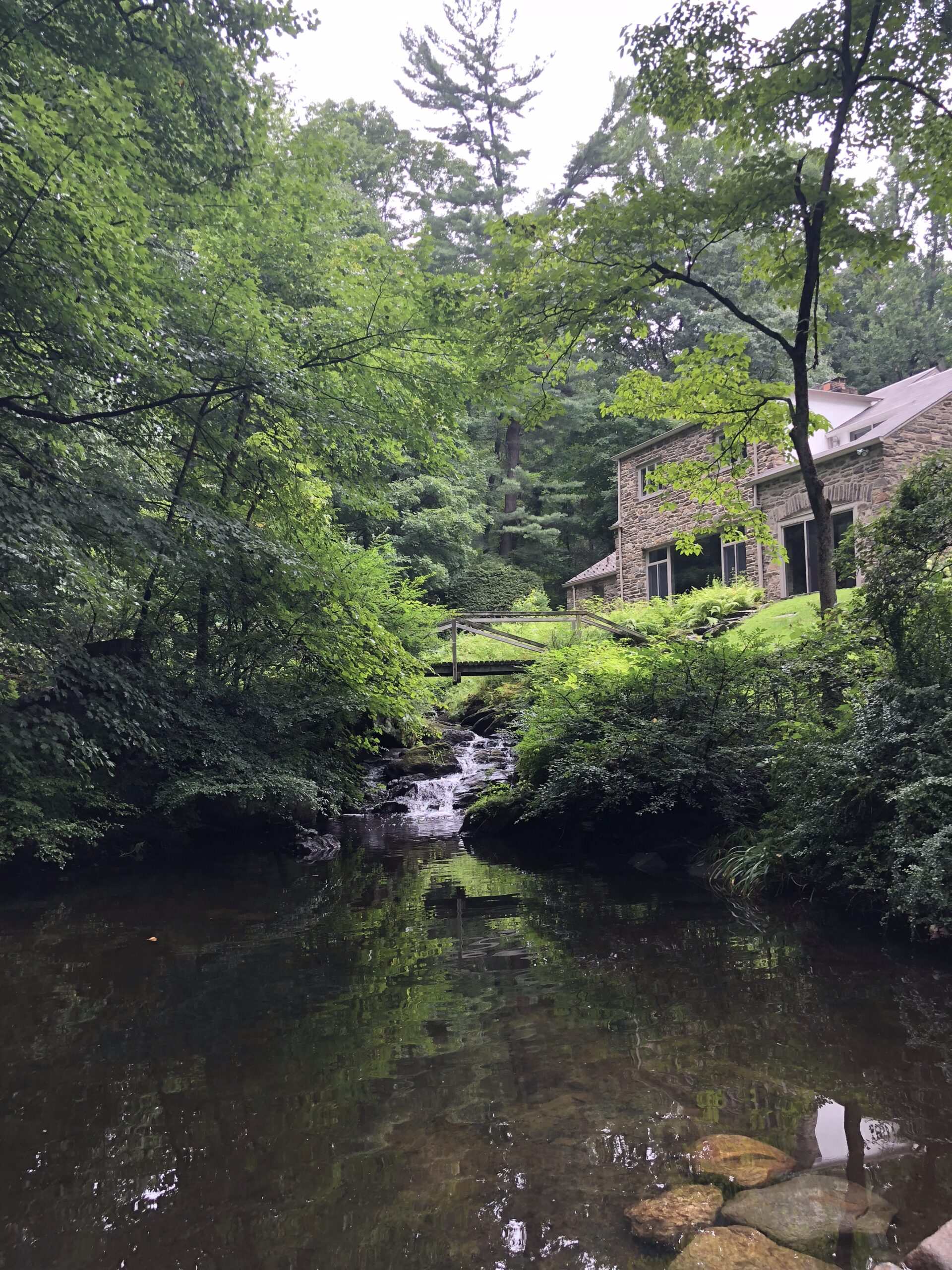
This adorable property features a stream babbling through the backyard.  At one point, probably in the 1930s, a concrete dam was poured to create a “natural” swimming pond that until now, held up fairly well, but had recently begun leaking in several spots.  Given the woodland setting, the pond had also accumulated quite a bit of debris from surrounding trees, which clouded the water and depth of the pond.


The clients wished to restore the pond as much as possible to its swimming pond function.   GJL crew first manually removed large sticks and debris, then we partnered with Cooper Ponds to suction harvest the mud and muck from the pond floor. In the end we achieved a depth of 4’ at the deepest point, and a great increase in water clarity. Jay was swimming by the last day…but that’s nothing new.

We also repaired the leaking stone wall with hydraluic cement to ensure that water flow was constrained to the desired inflow and outflow areas, preserving overall depth in the swimming pond.

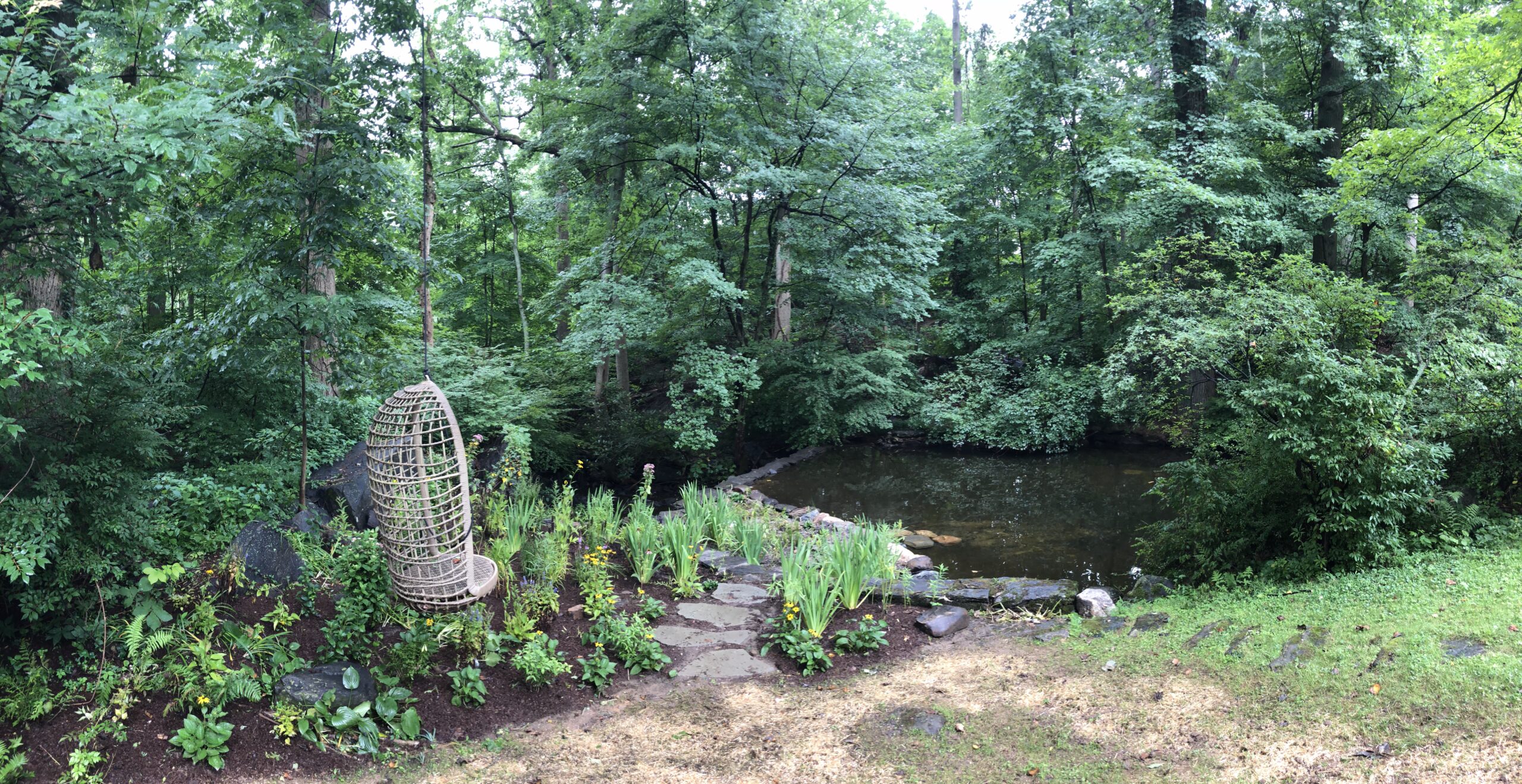
To promote lasting water quality, GJL also constructed two retaining walls, one forming a semi-circle within the pond, and one across a vacant area between the pond and bank. Both areas were filled with the extracted pond muck, and used as the foundation for planting beds. The bed within the pond became a bog garden, planted with native aquatic plants that help to clean the water when the bog is flooded. The second wall-turned-planting-bed became the terrestrial continuation of the bog garden, featuring flowering native perennials and ferns for a flowering forest vibe.


Filed Under: Featured Work, Water Features, Wetland Restoration & Storm Water Tagged With: Cooper ponds, ecological landscape design, ecological landscaping, landscape designer, landscape renovation, masonry repair, natural swimming pond, pond restoration, repurposed materials, suction harvesting, swimming pond, water quality restoration

The APLD International Design Conference (Sept 13th – 17th 2018) is a power-packed weekend to say the least.  Unlike most conferences I’ve attended, we weren’t locked in a lecture hall for four days.  Rather, APLD strikes the perfect balance of specialist speakers and boots-on-the-ground garden tours; seeing theory in action, which is always preferred!

Friday: Lectures, Demos & Networking

On Friday we heard from legend Darrel Morrison, FASLA and senior faculty at University of Wisconsin-Madison. Darrel spoke of teaching and drawing inspiration from naturally occurring Wisconsin plant communities, in both their species groupings and the innate beauty in their natural patterns: Rivers & Drifts, as he so called his presentation.  Below are some fascinating examples of his theory on paper.

We also saw a thematic compilation of landscape styles – traditional, rustic. & contemporary, from Susan Cohan and learned about Green Infrastructure case studies from Sabrena Schweyer. Jan Johnsen delved into the ‘most ancient materials’ –STONE and “stonescaping” – for a delightful preview of her newly released book The Spirit of Stone.  Finally, Toronto Botanical Garden’s own Paul Zammit delighted the room with an energizing container gardening demo.

Saturday: Public & Private Garden Tours

Kim Price

We visited three gardens designed and constructed by Kim Price Landscape Design  and were lucky enough to have her present for two of the tours to field our questions. Kim’s designs consistently used strong architectural elements with clean lines, and an emphasis on structural evergreens and foliage (to withstand Toronto’s half-year winter). I admired her modern blend of materials, especially to disguise unsightly features like A.C. units! The photo above is of a custom water feature of cor-ten steel and stainless steel egg planters; it created such a great focal point for that coveted indoor-outdoor continuum. See more photos of Kim’s work in the gallery below!


Jennifer Hayman

Jennifer addressed a challenging pie-slice lot shape by creating two patio areas on 45-degree angles, effectively elongating the space, increasing functionality and maintaining clean, modern geometry.  The front yard featured textured block plantings of Pervoskia, Taxus, and Pennisetum. See photos below.

Toronto Botanical Garden & Toronto Music Garden

It was a real treat to tour the Toronto public gardens, especially after learning that they have been maintained organically for over a decade! The Toronoto Music Garden, designed by Julie Moir Messervy to reflect Bach’s First Suite, features swirling paths inspired by fern frond for the early sections; ‘performance rocks’ in every gathering space; and spiraling crescendo and decrescendo staircases surrounded by grasses, perennials, and an outdoor grass amphitheater.

Sunday: Private Garden Tours & Sheridan Nursery Tour

We began the day with a tour of Old World Wonder which was a fabulous example of how to design on a tricky site.   Right against the property line is a massive 2.5 story church, which would have dominated previous site views.  In the finished landscape, the church is an afterthought, as is masked by a charming old-world style dual pool house, with green roofs and an antique mask waterfall. Designer Jim Mosher seamlessly melded the clients’ collection of found objects and worldly artifacts.

The next tour was an organic, naturalistic ten-acre beauty. Designer Randy Tumber cut around an existing pool to create a walk-out basement entry, and used the fill to create sweeping berms across the once-flat front yard. Other areas of the property were left un-mowed and allowed to re-vegetate as native meadows with mowed paths for optimal nature walks.

Finally, we ended the day touring one of Canada’s largest nurseries –Sheridan Nursery. 

Monday: Rooftop Garden Tour

Monday’s program featured several public and private roof gardens, each with their own inspiring mission and style. First was the Women’s Hospital garden which features raised beds of veggies that serve as an outdoor classroom for at-risk youth. Next was the Native Family Center whose beautiful rooftop was designed to highlight the four sacred plants: cedar, sage, tobacco and sweet grass.  A modern sweat lodge and birch planting accentuates important cultural practices. Finally, a park-like private rooftop for apartment residents proved just how successful of an amenity garden roof space can provide.

We left the conference feeling inspired and energized by our fellow designers and their commitment to elevating our public and private outdoor spaces in a sustainable way.  Learn more about APLD, and especially check out this year’s APLD Award Winners, on their website and in APLD’s The Designer magazine.

—–

Kathryn Saphire

Landscape Development Associate

914-560-6570

Filed Under: Ecological Education, Events & Garden Tours Tagged With: APLD, Association of Professional Landscape Designers, design inspiration, garden inspriation, garden tour, international design conference 2018, landscape designer, organic landscaping, sustainable landscaping

  • « Go to Previous Page
  • Page 1
  • Interim pages omitted …
  • Page 37
  • Page 38
  • Page 39
  • Page 40
  • Page 41
  • Interim pages omitted …
  • Page 61
  • Go to Next Page »

Footer

Shop Address: 369 Bradhurst Ave, Hawthorne, NY 10532
(914) 560-6570
  • Facebook
  • Instagram
  • LinkedIn
  • Pinterest
  • YouTube
  • Houzz
  • Slide Share
  • Installation
  • Portfolio
  • Pricing
  • About
  • Contact

Copyright © 2026 · Green Jay Landscape Design. All Rights Reserved · Privacy Policy · Website and Local SEO by Ramblin Jackson