• Skip to main content
  • Skip to footer
Green Jay Landscape Design

Green Jay Landscape Design

Green Jay Landscape Design

(914) 560-6570
  • Design
  • Installation
  • Portfolio
  • Pricing
  • About
    • Service Area
    • Meet Our Team
    • Our Process
    • Our Promise
    • Mission, Vision, & Core Values
    • FAQ
    • Press & Events
    • Blog
    • Reviews
    • Careers
    • Affiliations
  • Contact

greenjayadmin

Green Jay Landscape Design is thrilled to be included in The Examiner Plus’s article byBailey Hosfelt Restoring Biodiversity, One Yard at a Time. Hosfelt wrote a thorough and well-researched article featuring quotes from Jay Archer as well as our ecological landscaping colleague Amanda Bayley of Plan it Wild, and grassroots leader Filippine Hoogland of Bedford 2030’s Healthy Yards, and Margie Lavender of Hastings Pollinator Pathways.

The article examines the shift toward ecological landscaping as more people begin to see the destructive nature of pesticides, the resource-intensive nature of lawn maintenance, and the dire need for more habitat for insects, pollinators, and birds.

As Jay explains, “Pesticides have corrupted, contaminated, disturbed, and distressed our soils, and by compromising the soils, the plants can’t possibly be healthy. We need to heal the actual soil before we can go forward and start constructing a new landscape that will support plant life and, by extension, human life in the healthiest way.”

Below is a reprint of Hosfelt’s article. Thank you Bailey for your excellent reporting and attention to this critical issue!

Restoring Biodiversity, One Yard at a Time

A look at the environmental impact of traditional landscaping techniques and their eco-friendly alternatives in a county renowned for its lawns and green space

Bailey Hosfelt

May 23

A well-manicured lawn is, in many ways, synonymous with the American suburbs. Frequently mowed and often sprayed with pesticides, these seemingly green landscapes do little to nothing to attract pollinators — the essential insects that bring pollen from one plant to another and, in turn, support food sources for animals and wildlife as well as humans. 

For sustainable landscapers, ecologists, and environmentally-minded homeowners restoring local biodiversity and fighting climate change is essential, and it starts right outside your doorstep. 

“I say it all the time: the most important room in your house is not in your home; it’s in your yard,” Jay Archer, President and Landscape Ecologist at Rye-based Green Jay Landscape Design, says. 

Archer — a leading advocate for ecological landscaping, native plants, and organic land care — works alongside his team to design, construct, and manage landscapes throughout Westchester, Putnam, and Fairfield County that will be not only visually appealing but also ecologically attractive and life-sustaining. 

“We’re designing for living to create biological life, our first mandate,” Archer explains. “We’re also using the natural resources and conserving and preserving as much as we can.”

Archer’s team designs and builds ecological landscapes without utilizing gas- or oil-powered machinery to create them. 

“We use a lot of primitive technology, frankly, to create landscapes that don’t require those resources to be maintained,” Archer explains. 

Archer says that while you would think the traditional landscaping industry, narrowly focused on maintaining lawns and green spaces, would want to do good for the environment, that is not the case, primarily due to the overuse of pesticides.

“Pesticides have corrupted, contaminated, disturbed, and distressed our soils, and by compromising the soils, the plants can’t possibly be healthy,” Archer notes. 

As a result, Archer and his team spend a lot of time analyzing landscape sites before focusing on remediating and regenerating them. 

“We need to heal the actual soil before we can go forward and start constructing a new landscape that will support plant life and, by extension, human life in the healthiest way,” Archer explains.

Filippine Hoogland, a landscaper who helped start Healthy Yards — an organization of professional, master, and passionate gardeners based in Bedford — explains that Westchester is one of the counties in New York State with the highest pesticide use.

A 2016 investigation by Lohud found that Westchester was among just six of 62 counties in the state that applied more than one million pounds of pesticides in 2010, the most recent state data available. At the time, Westchester ranked third-highest in pesticide use, at 2.26 million pounds.

The overuse of pesticides county-wide puts the environment and residents’ health at risk, particularly for runoff that contaminates water. 

Water with high concentrations of nitrates from synthetic fertilizers and pesticides can cause congenital disabilities, nervous system impairments, and cancer.

“More homeowners are becoming aware and interested, but it’s very difficult to find landscapers that can answer to that demand,” Hoogland explains. 

Using pollinators as an entry point

At Healthy Yards, Hoogland and her team set out to educate both homeowners and landscapers, sharing resources to help individuals and professionals change their yard practices. 

However, they found that the traditional landscaping industry is very reluctant to change, and homeowners often feel offended when you suggest there are more sustainable ways to tend to their lawns.

That was until Healthy Yards started to embrace Pollinator Pathways, a grassroots movement of volunteers working together to establish pollinator-friendly habitats and food sources for bees, butterflies, hummingbirds, and other pollinating insects and wildlife along a series of continuous corridors.

“It is really the insect as a whole that needs protection because they are the base of our food pyramids,” Hoogland explains. “Without those pollinators, the whole ecosystem will crumble.”

Because of pesticide use and loss of habitat, pollinator populations are in sharp decline. Bee and monarch butterfly populations, in particular, have declined significantly in recent years.

“We found [Pollinator Pathways] to be a perfect opener for people to have this discussion,” Hoogland explains, highlighting that this approach significantly changed the atmosphere of their work. “Interestingly enough, if you start with just the suggestions of flowers [to promote pollinators in your yard], people take the next steps almost automatically.”

Hoogland highlights that many homeowners may take additional actions such as stopping the use of pesticides, planting native trees and perennials, removing invasive species, mowing less frequently, or leaving leaves for pollinators over winter. 

No Mow May, a movement started by Oregon-based Xerces Society for Invertebrate Conservation, encourages homeowners not to mow their lawns throughout May. 

Margie Lavender, who founded Hastings Pollinator Pathway alongside Haven Colgate, Hastings-on-Hudson’s Village naturalist, says No Mow Way is a simple concept to support biodiversity. 

Because of climate change, many pollinators emerge from hibernation earlier in spring. At this time of year, there is very little blooming to provide native bees with nectar and pollen to eat. 

“A mown lawn provides little to nothing of benefit to a pollinator — it’s a pollinator desert,” Lavender explains. “By not mowing until the end of May, we allow dandelions, violets, and other early spring ‘weeds’ to flower, providing much-needed nourishment before the usual abundance of blooms to come in June.”

In a study conducted in Appleton, Wisconsin, researchers found that lawns that participated in No Mow May had five times the number of bees and three times the bee species that mown lawns did. At a time when many pollinating insects, birds, and mammals are facing extinction due to habitat loss, fragmentation, climate change, and pesticide use, this intentional practice is quite important. 

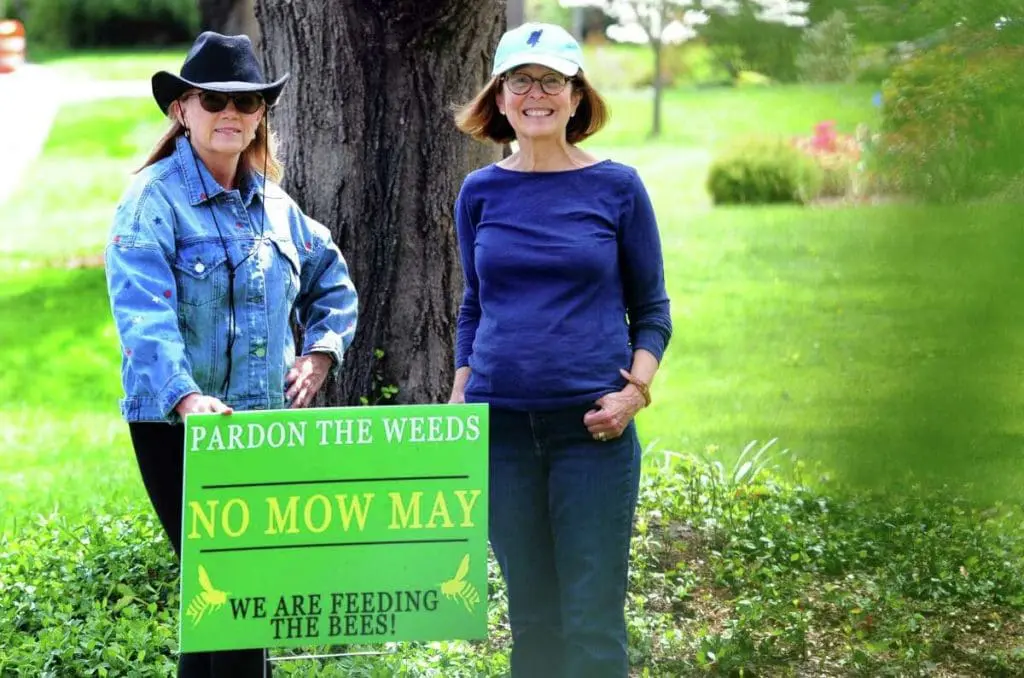
At Hastings Pollinator Pathway, they partnered with Kimi Weart, a graphic designer, to make yard signs so that residents can tell their neighbors that they’re participating this spring.

“We plan for these signs to be reused each year and hope the No Mow May movement is catching [on],” Lavender says.

On their Instagram page, Lavender also shares a post each Friday with food that will no longer exist without pollinators — further encouraging residents to participate in the movement. 

Hoogland says No Mow May provides an additional entry point to spark discussion about broader practices and cultural ideals when it comes to landscaping.

“Should [lawns] be pristine and clean, or is it okay to have a little bit more life and grassy fields?” Hoogland says. 

An industry hesitant to change

There’s no question that the landscaping industry is a big business in Westchester — whether it’s for individual homeowners, golf courses, or municipal properties throughout the county. 

According to Hoogland’s estimates, there are over 2,000 landscaping businesses in the county alone. 

Conversations about more sustainable lawn practices, Hoogland says, invite a lot of aggression from members of the traditional landscaping industry — especially as it relates to local proposals to ban gas-powered leaf blowers. Just this month, a contentious public hearing on the topic of a proposed spring-to-early fall ban took place in Pleasantville.

“[Landscapers] feel offended because they have been doing their thing for many years in a way they’re proud of, so us educating feels like criticizing them,” Hoogland explains, noting that members of Healthy Yards have even received death threats. “There are guys that are so violent and angry.”

Although gas-powered leaf blowers and other emissions-emitting landscaping equipment leave landscapers themselves vulnerable to inhaling unhealthy fumes, Hoogland says many are still hesitant to make changes.

As the No Mow May movement grows, landscapers are also finding new ways to recoup income previously generated from mowing during the month. 

“If they mow later, they will find something else to offer,” Hoogland says. “Pesticide applications are completely rising at this time because these landscapers need an alternative income.”

While Archer agrees that the traditional landscaping industry has many harmful practices, he says homeowners often encourage or engage in bad cultural practices, too such as buying pesticides at hardware stores and applying them indiscriminately to their properties.

“While I’m opposed to traditional landscaping, it’s not the poor landscapers’ fault that this is what people wanted until yesterday,” Archer explains. “There are way more homeowners taking care of their own properties than landscapers, so we have to do outreach both to the industry and to homeowners.”

Lavender says that while her landscaper has been patient and open to exploring the best practices for her property, he has said many clients have an expectation of perfection.

“A client will request that he not use a gas leaf blower but will scoff at paying anything extra for the extra labor of raking,” Lavender says. “Even I have had to reshape my own ideas of what makes a beautiful garden.”

“I heard Kim Eierman say in a lecture once, ‘If your garden is not being eaten, it is not a part of the ecosystem,’” Lavender adds. “Once you really dig in and begin to understand the severity of the crisis and how simple changes in your garden can make tangible change, you see everything differently. A pile of leaves may hold butterfly chrysalis to overwinter, a caterpillar nibbling the parsley will become a Swallowtail or lunch for an American Goldfinch, a patch of bare dirt is where ground-nesting bees will emerge in the spring, and violet is bee food.” 

Among homeowners, Archer says there’s a growing consciousness that we should treat our landscapes as if our lives depend on them because they indeed do. 

“Without bees, we’ll have no flowers, and without flowers, we’ll have no plants. Without plants, we’ll have no food, and then we’ll have no us,” Archer explains. “This is why Pollinator Pathways has been a hugely successful initiative in terms of raising awareness and making changes.”

Archer also works not just to raise awareness but also to give homeowners and members of the landscaping industry the tools to make changes through educational outreach. 

“If you put your resources into the environment with good intentions, you reap benefits from it directly,” Archer underscores. 

Changing tides in the trade 

When asked about emerging trends in sustainable landscaping, Hoogland says she sees a lot of women who have studied horticulture or landscape design working to educate landscapers working on properties, as well as younger people starting to get involved in the industry who offer a type of landscaping business rooted in building biodiversity instead of traditional lawn maintenance. 

Amanda Bayley, CEO, and Co-Founder at Croton-on-Hudson-based Plan it Wild, operates one sustainable landscape company that provides an alternative, Earth-centered approach for clients throughout Westchester.

With a background as a landscape architect focused on nature-driven design and habitat restoration, Bayley saw the suburban yard space as a critical, untapped niche.

“The fossil fuel-driven maintenance and aesthetic of a lawn being a green flowerless carpet is what the landscaping industry has you believe your yard should look like,” Bayley says. “We’re saying native plants and a more wild but still intentionally-looking yard does so much more than a mowed green carpet. That’s why Plan it Wild exists.”

At Plan it Wild, Bayley and her team don’t want to be compared to the traditional landscaping industry because they say they’re doing something completely different. 

“We’re helping not just to expand the biodiversity but also to reduce the carbon footprint, plant [native], and end the use of fossil fuels,” Bayley explains. 

Working with a property owner, Bayley says her team can show their clients what they can do with their yard beyond traditional mowing, blowing, and pesticide spraying.

“That business model is so dependent upon doing it quickly in a very controlled way because that’s how [the industry] makes money,” Bayley adds. “Our priority is biodiversity and doing more with your yard than just mowing it.”

David Baker, vice president of Landscape Operations at Plan it Wild, says the time is right to help homeowners change their thinking.

“A lot of people don’t realize how polluting gas and oil trimmers, blowers, and mowers actually are,” Baker explains. “People see them as smaller and not as destructive as cars, but that’s not really the case with the hydrocarbons they emit.”

According to the United States Environmental Protection Agency (EPA), hour-for-hour gasoline-powered lawn mowers produce 11 times as much pollution as a new car. The EPA estimates that lawn care as a whole produces 13 billion pounds of toxic pollutants per year.

While there are landscapers using electric-powered equipment and designers who build unique landscapes with native plantings and remove invasives, Baker says it typically happens separately. 

“There’s nobody mowing and maintaining your property, as well as doing 100 percent native planting,” Baker explains. “We’re unique in that bucket.”

Archer says that what his company is doing, as well as Bayley’s team at Plan it Wild, aren’t as common.

“Amanda and I represent a small but growing market in ecological design development,” Archer says. “People who reach out and hire us, they want what we offer.” 

Bayley says that while ecological concepts can be complicated, she’s trying to synthesize best practices and show homeowners how to apply them to the American yard. 

Things like repurposing leaf litter instead of discarding it as yard waste, planting native, and removing invasive species all have value, and Bayley’s team is working to show their clients the many ways their yard can better support biodiversity and combat climate change. 

While Bayley and Baker say it remains discouraging to see so many property owners and contractors throughout Westchester continue to use pesticides, mow incessantly, and use fossil-fuel-powered machinery, being able to change the minds and practices of some is most gratifying.

“Some people don’t care, and it’s exhausting. Then others do, they pay for our services to do it, tell their neighbors, and then their neighbors call us because they’re like ‘They’re thinking in a different way,’” Baker explains. “That’s by far the most rewarding.”


Filed Under: Ecological Education Tagged With: biodiversity, eco-friendly gardening, eco-friendly landscaping, ecological landscape design, ecological landscaping, examiner plus, feature, habitat garden, healthy yard, landscape designer, landscape ecologist, local news, native plant garden, natural landscaping, no mow may, organic garden, organic gardens, organic landscape, pollinator garden, pollinator habitat, pollinator pathway, press, rye NY, Westchester county landscape design, Westchester County NY

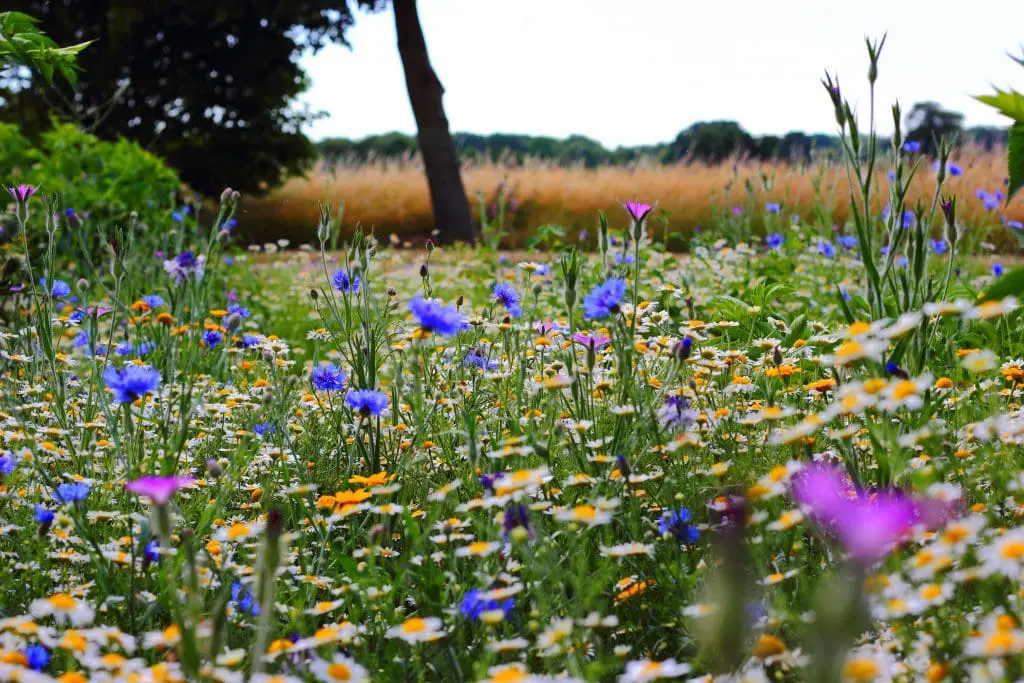
In at least five states in the country, a movement to protect native bees by refraining from mowing lawns for the month of May is gaining momentum. The movement started in Britain in 2019, and in Wisconsin in 2020. A New York Times feature this year about Wisconsin’s program brought attention to the matter and several states including in Connecticut adopted their own No Mow May programs.  Two researchers at Wisconsin’s Lawrence University studied the lawns of 435 participants and found that the unmowed lawns had three times the number of species and five times the total number of bees as did mowed parks. 

Photo by Christian Abraham / Hearst Connecticut Media. Two residents of West Hartford lead their communities No Mow May effort.

No Mow May Benefits

The concept is simple: stop mowing lawns for the entire month of May to allow “weeds” such as dandelion, clover and violet to emerge and provide a food source for bees at a time of year when pollen and nectar sources are limited.

No doubt, there are benefits here. In spring, there are limited native flowering options (compared to summer) and most of the spring flowering landscape plants used in the landscape are not native and also not popular with pollinators.  (think forsythia, cherry trees, pear trees, most azaleas, and rhododendrons, nearly all bulbs.) Dandelion and clover are both native to Europe, however they are still often visited by pollinators. Both plants have the added benefit of improving the soil. Dandelions have a deep taproot that brings up minerals from deeper soil strata, improving the A soil horizon for the surrounding plants. Clover is in the pea / legume family and is a nitrogen fixer. There is a native species of violet, Viola soraria or Common Blue Violet. It is a host plant for the Great Spangled Fritillary and a food source for many insects and pollinators. 

Not a Historically a Prairie 

While this is an admirable grassroots effort, a month-long solution will not initiate meaningful change in our declining bee and insect populations.  Insects need habitat and food throughout the growing season (spring – fall) to survive. While these early season lawn weeds are food sources for pollinators, they will not sustain them for the season, particularly if these sources disappear after four weeks.

Also, your lawn is not likely to bounce back to a lush turf after a month of not mowing it. Some turf seeds will have been shaded by taller plants and you will have many patches of “weed” foliage to repair. Be aware that 18” grasses are perfect tick questing habitat, so avoid walking through these areas. 

Furthermore, in the Midwest and the the souteast the predominant historical ecosystem was prairies. Much of the seedbank consists of these classic prairies wildflowers and grasses. In the northeast, we are predominantly a forest ecosystem. Untouched landscapes eventually revert to forests.

 If you like the concept of No Mow May, consider implementing these principals in conjunction for a more impactful landscape.

Organic First!

While lawns are a resource-intensive monoculture, the core problem is the mainstream use of synthetic fertilizers and pesticides to maintain massive spreads of lawn. If you are using synthetics, your soil is virtually sterile of any soil microbiology. Soil microbes are essential to our health (our gut bacteria evolved alongside it!), the stable storage of CO2 from the atmosphere in the soil, and to thriving plants with strong immune systems. Synthetic lawn chemicals also threaten our waterways and aquatic ecosystems through stormwater runoff. If you are considering making one ecological change in your lawn, taking it organic is far more impactful!

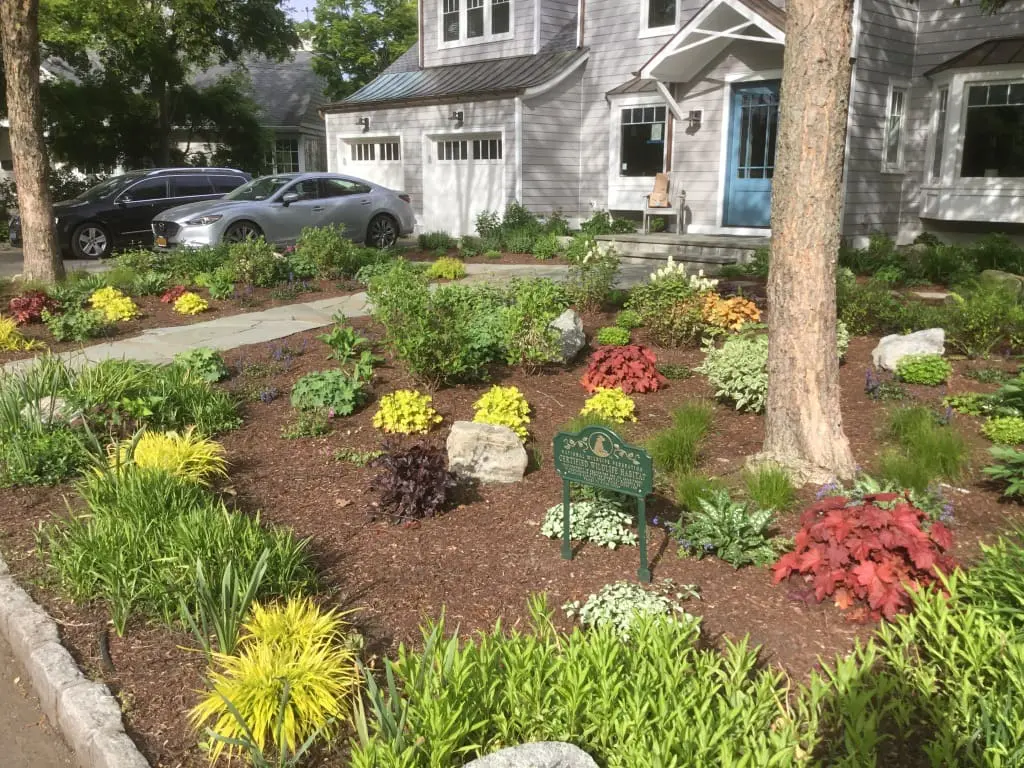
Front lawn converted to a habitat garden in Mamaroneck, NY.

Reduce Your Lawn Area

After going organic, the next most impactful step you can have toward making your lawn more ecological is…reducing the size of it. Yep, we said it. Any and every type of organic garden is more ecologically beneficial than a resource and maintenance-intensive turf monoculture. Biodiversity is critical to a healthy ecosystem that supports many species, both specialists and generalists. Some staggering statistics: one in four native bees are endangered or threatened; 40% of global insect populations are in decline; North American bird populations have declined by 3 billion birds in the last fifty years. These critical species, the foundation of crop pollination and ecosystem food webs, need our help! Consider planting a sunny pollinator garden or a native woodland garden, depending on your site conditions. A rain garden is another excellent replacement for lawn that can help absorb stormwater and provide habitat.

June Lawn Tips

When you do decide to mow again, make sure you are mulch mowing at 3 ½ – 4” high! Mulch mowing returns grass clippings to the soil, reducing the need for fertilizer inputs. Mowingat a greater height encourages more root development, making for a more resilient turf that can access more resources.

Contact us to discuss your landscape design project or schedule a consultation.

Filed Under: Ecological Education Tagged With: ecological landscape design, ecological landscaping, healthy yard, landscape design master plan, landscape designer, landscape ecologist, native landscape, native plant garden, natural landscaping, no mow may, organic garden, organic landscape, organic lawn, pollinator garden, reduce your lawn area

Storms and rainfall accumulation have gotten more extreme in our region; in fact, this is the fourth wettest year on record (so far). The Northeast is now approaching temperate rainforest levels of annual precipitation. That means our landscapes need to be designed to manage an increased quantity and frequency of extreme stormwater events. Green Infrastructure is our pejorative toolbox for dealing with stormwater as ecological landscape designers. Green Infrastructure refers to stormwater management strategies that mimic natural systems to direct and absorb stormwater; it is a form of bio-engineering or biomimicry. Below we outline some Green Infrastructure tools and strategies, with examples from our landscape design and construction projects. Contact us to discuss your green infrastructure stormwater management project!

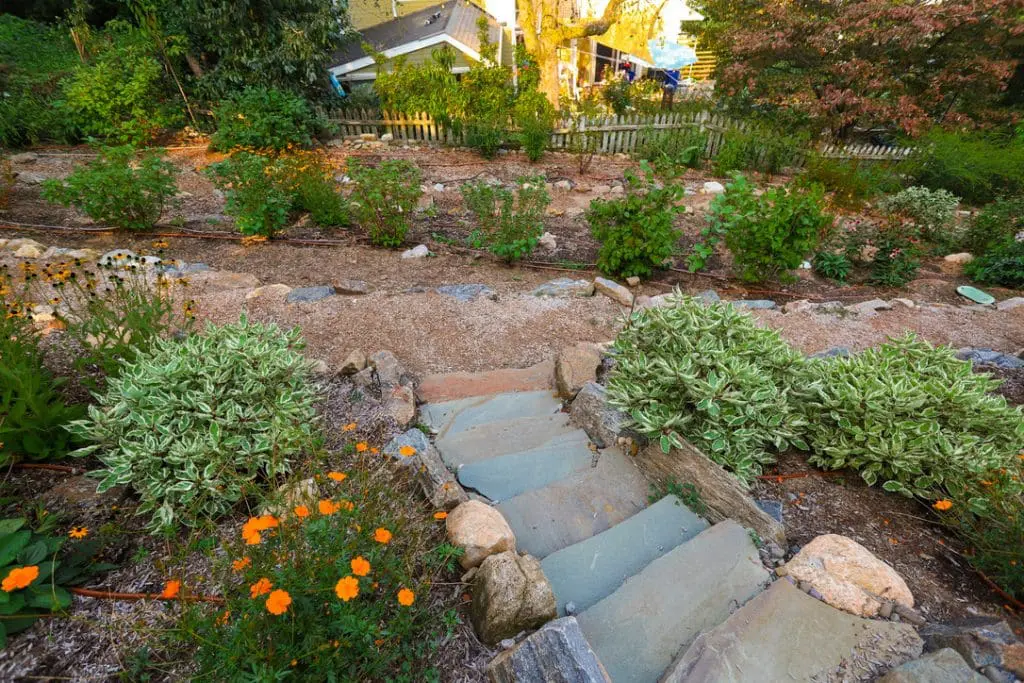
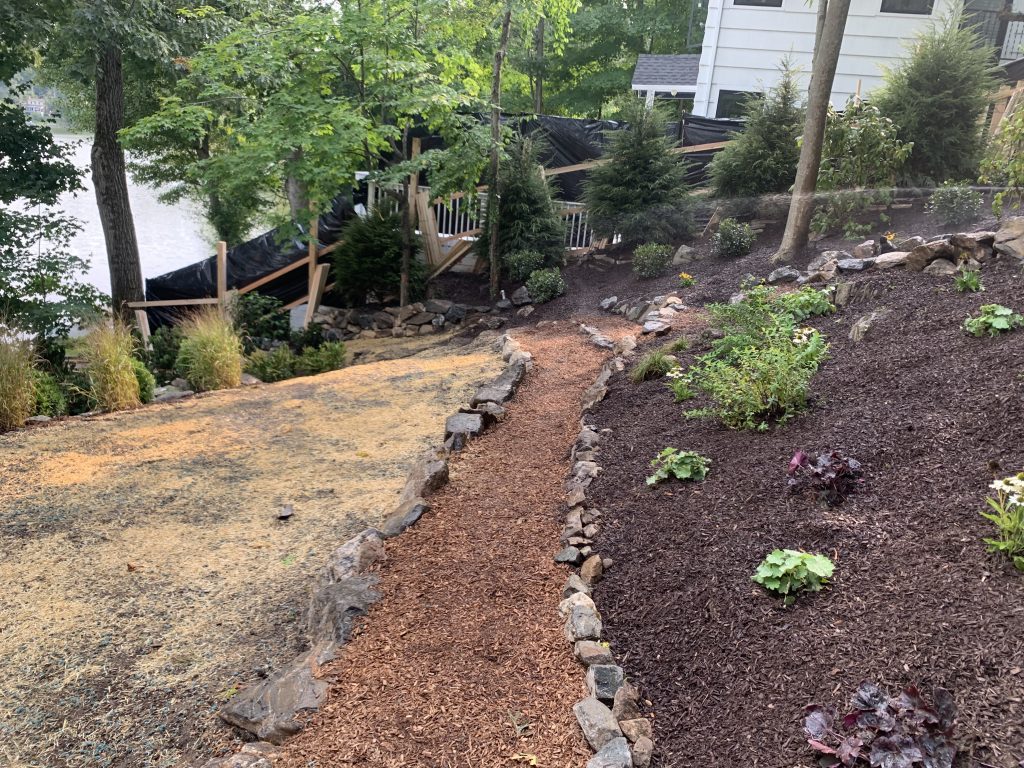
Finished terraces create both planting beds and walkways

Green Infrastructure on a Slope

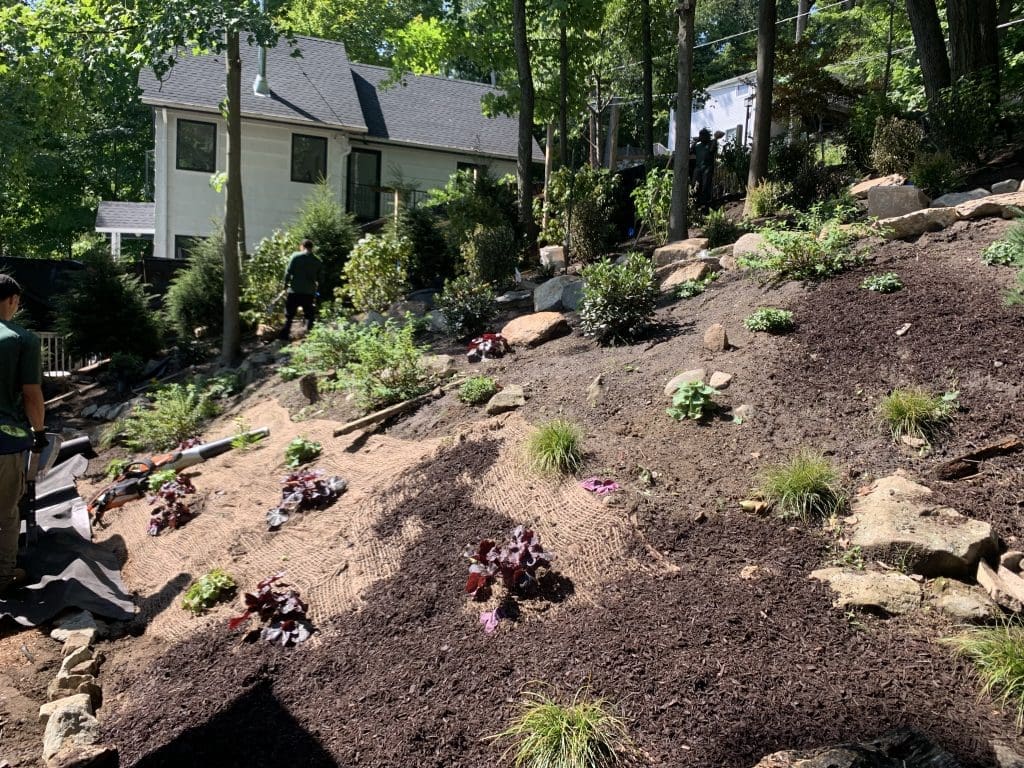
Hillsides and steep slopes are common in our region and can often complicate and/or exacerbate drainage issues. Clients often tell us the slope on their property has been “unusable” for years, prone to erosion, fast flowing stormwater, and migrating landscape materials. We worked on several steep slope projects like this in Lake Peekskill, NY and Holmes, NY (click through to read full blogs on the projects!).

Terraces – to make steep slopes more functional as garden space, we often opt to construct stone terraces. Terraces allow for garden space and / or walkways, and also create the foundation for slowing down stormwater. We always use natural stone boulders and as many materials harvested on-site as possible.

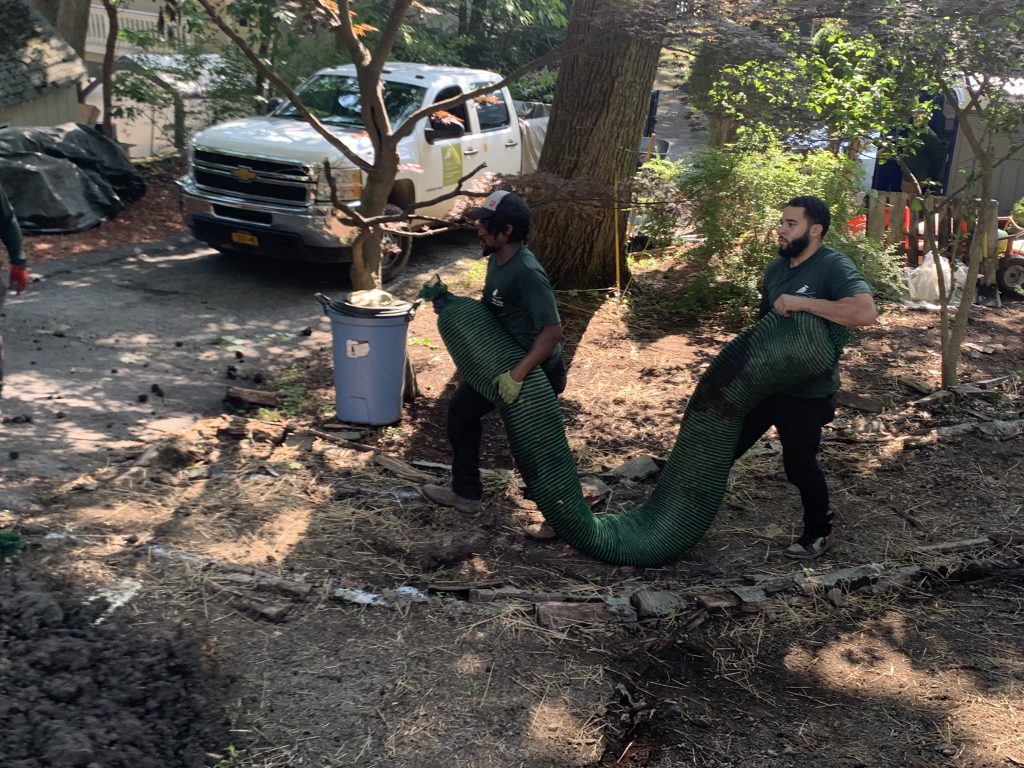
Installing biodegradable Filtrexx Siltsoxx in the stone terraces

Filtrexx SiltSoxx – We install Filtrexx Siltsoxx and the base of our terraces to capture silt and sediment in the stormwater and act as another barrier to slow down the flow. The Filtrexx SiltSoxx are biodegradable and filled with compost, so they gradually add nutrients to the garden terraces as they degrade.

Structural Soil – On steep slopes, we use a custom blend of engineered soil that is roughly 80% mineral and 20% organic matter. Most topsoil you buy is actually about 50% organic matter, mostly derived from leaf litter. This much organic matter will degrade quickly, and risks compromising the integrity of the slope. We opt for a more mineral blend to ensure the soil density is maintained for a longer period of time, protecting the grade of the slope.

Jutte netting enables planting of steep slopes.

Jutte Netting – Finally, on steep hillsides, we opt to plant into Jutte netting. Jutte netting is natural-source (coir fiber) and biodegradable. The netting holds plants in place as their root system gets established.

Green Infrastructure for Residential Properties

If you don’t have a steep slope, there are still plenty of ways you can improve stormwater management on your property through green infrastructure. The aim is to conserve, direct and absorb as much stormwater as possible before it becomes polluted from developed areas and joins other valuable freshwater ways.

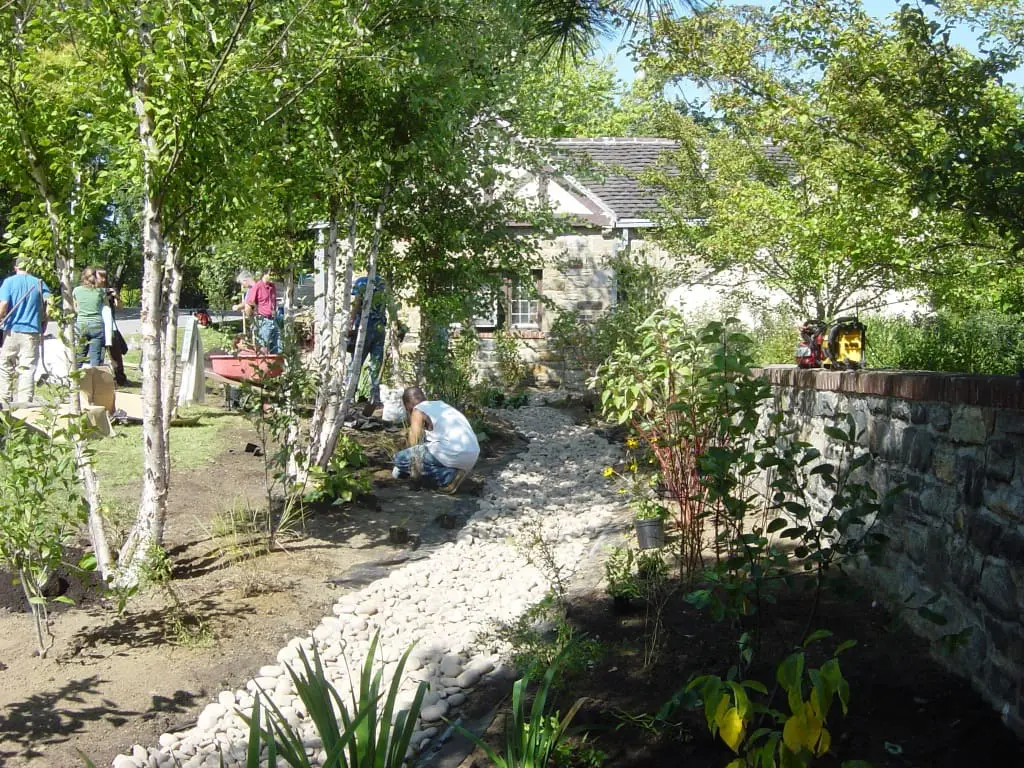
A vegetated bioswale under construction.

Swales – Swales are a form of land contouring that subtly directs stormwater by manipulating grades / topography. Swales are often designed to guide water away from buildings are flat surfaces like tennis courts or swimming pools.

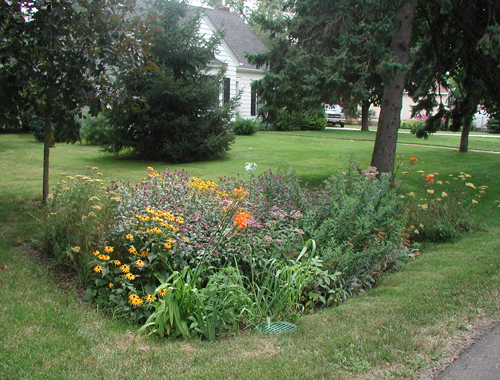
A residential rain garden.

Rain Gardens – Rain gardens are types of gardens that are designed to be inundated with storm water, contain the water within the bounds of the garden, and slowly allow it to percolate into the aquifer or evapotranspirate through the plants. Essentially, they slow down the water and allow it to recirculate in the water cycle. Rain gardens typically use native plants – that are adapted to our precipitation climate – and therefore have the added benefit of creating habitat for local wildlife and pollinators. When designing rain gardens, we opt for facultative plants – those that are found equally as much in wetlands and non-wetlands – because they will be able to handle both extreme flooding and drought. Learn more about rain gardens on our previous blog post and case study.

Passive Irrigation – Passive irrigation is a great way to repurpose stormwater into irrigation for your gardens! We typically design passive irrigation systems off of existing gutters. We connect the gutters to perforated pipes directed toward garden areas. The perforation allows the water to slowly leak out but still reach the desired area.

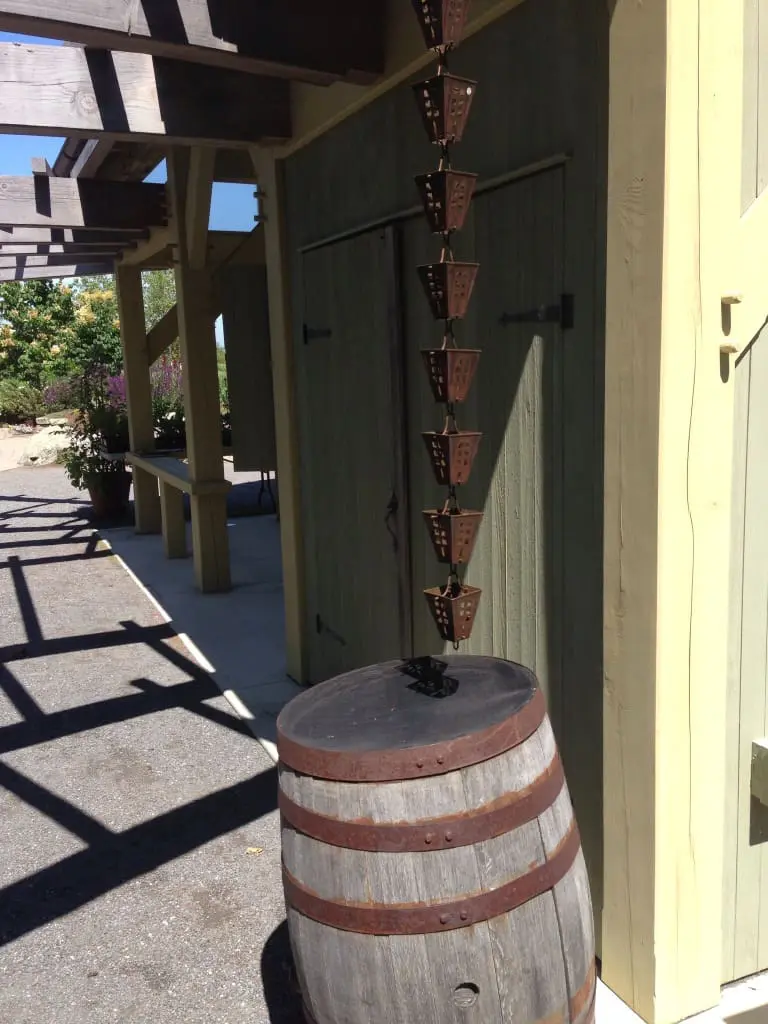
Rain chain leading to a rainwater harvesting barrel.

Rainwater Harvesting – Many of our clients keep rain barrels on-site to capture excess stormwater. Passive irrigation pipes can also be connected to rain barrels and ‘turned on’ during droughts. We love any application for recycling stormwater in the garden!

Need help with your stormwater management and landscape drainage? Contact us to schedule a consultation!

—

Green Jay Landscape Design

Where Design Meets Ecology

914-560-6570

Filed Under: Irrigation & Water Systems, Landscape Construction & Installation Tagged With: drainage, ecological landscape design, ecological landscaping, erosion control, green infrastructure, hillside landscaping, landscape designer, native plant garden, native plants, natural landscaping, pollinator garden, rain garden, rain garden design, rain garden plants, sloped landscaping, steep slope, stormwater, stormwater management, swale, terrace garden, water management

Recently, we have had more requests from clients to design and build hiking trails on their property. Often these are estate clients, part of our Sustainable Stewardship Program, who have five acres or more of property. As part of their design program, we assess and analyze the property to determine siting for the trails. Sometimes we are working from existing, abandoned woodland trails and sometimes we start from scratch.

In constructing trails, we aim to repurpose material on-site as much as possible. For example, logs and boulders to line the trail, create steps, and water bars; dead trees on-site can be cut down and ground into woodchips to define the trail, in some instances. We are always factoring in stormwater and designing erosion control measures as part of our trail construction process.

Having accessible trails right out your backyard is an incredible amenity! Fresh air, nature, and exercise right at your fingertips! Make evening strolls with your family a tradition and notice together how the natural world around you is changing.

Contact us to discuss your trail building or landscape design project! 914.560.6570

—

Green Jay Landscape Design

Where Design Meets Ecology

Filed Under: Landscape Construction & Installation, Uncategorized

Throughout our years as a landscape design and build business, we’ve had the opportunity to partner with professionals in every aspect of the home improvement industry. Below is a list of our favorite home improvement contractors and consultants based in Fairfield County, CT and Westchester County, NY. We have worked with all of these companies and can vouch for their excellence of service.

Architects

Trillium Architects – We have worked with the team at Trillium Architects on several home renovation projects for our clients, including additions and deck expansions. Trillium Architects have impeccable design sense, and it has been a breeze to communicate with them and coordinate installations.

Engineering

Bryan Hildebrand – We worked with Bryan on a project with a steep slope approaching a lake.  It required an erosion control plan, that we outsourced to Bryan Hildebrand. Submitting and executing Bryan’s erosion control plan enabled us to obtain a waiver for the wetland permit, a trajectory that kept the project on schedule and on-budget. Read more about that erosion control project on Lake Peekskill here.

David Lombardo, JMC – GJL worked with David Lombardo and the JMC team extensively on a freshwater dam project in South Salem, NY. The project required extensive permitting from the NY DEC. Read more about the project here.  David and his team are incredibly professional, smart people.

Arborists

Bill Davies, Westchester Tree Life – Bill Davies is the best arborist in the industry! His expertise at evaluating tree health and advising the next steps for pruning or removal are second to none. For any mature tree questions, call Bill at Westchester Tree Life.

Plant Health Care

CompostWerks – CompostWerks is a premier local provider of organic plant health care for trees and shrubs. We have used their products with great success for years!

Electric Lawn Mowing

Jeff Cordulack, Organic Ways & Means – Electric autonomous mowing is really taking off! You can have a zero-emission lawn through Jeff’s autonomous, daily mowing. Since the mowers run daily and only trim a bit of lawn, the clippings drop and return nutrients into the soil naturally. Learn more on the Organic Ways & Means website.

Fencing

Salem Fence ­– Salem Fence is a team of professional, responsive, and timely craftsmen and they are our top provider for fence installation in Putnam & Westchester County, NY (they are based in Mahopac, NY). Coordinating our installations with them has been seamless. For examples of their work on our design projects, view our previous blogs:

Terraced, Erosion-Proof Landscape in Lake Peekskill, NY

Summer Pool Landscape with Native Plants in Mamaroneck, NY

Contact us to schedule a 15-minute discovery call or on-site professional consultation to discuss your landscape design & build goals

—

Green Jay Landscape Design

Where Design Meets Ecology

915.560.6570

 

Filed Under: Ecological Education Tagged With: arborist, architect, ecological landscape design, ecological landscaping, electric mowing, engineer, fence installation, fencing, general contracting, home contractors, home improvement, home improvement contractor, home improvement contractors, landscape designer, local contractor, organic gardening, organic landscape, plant health care, recommendation, recommended service provider

A tangible shift is occurring in the way we view and value our landscapes. While we once revered immaculate, unchanging expanses of lawn and exotic evergreens, the trend in recent years is to use landscape design to effect real ecological restoration. No matter the size of your property, by following the principals of ecological landscape design, we can create habitats to support local wildlife. Linking together designed suburban habitats creates biotic corridors, safe, rewilded zones that bridge larger ecosystems through more developed areas. We discuss habitat design principals in our previous blog, Design For Biodiversity Pollinator & Wildlife Gardens.  After achieving your dream designed habitat, don’t forget to certify or register your property with one of the many grass roots organizations tracking our national efforts! We review our favorite ecological organizations for property certification below.

Why Certify Your Landscape?

To effect change, change must be observed, measured, and reported. Data informs knowledge, progress or decline, and policy decisions. There are many incredible non-profit organizations tackling ecological restoration and biodiversity from their respective niches. Whether they protect a specific species or wildlife habitat, or promote broader standards for land stewardship, these non-profits deserve our attention and participation, if we truly believe in their missions. By registering your property with one (or all!) of these organizations, you strengthen their dataset, promote their cause, and set an example for others (by posting the associated signage!). Below are some local and national organizations that track responsible residential land stewardship for biodiversity and ecological restoration.

National Wildlife Federation Certified Wildlife Habitat

For decades the National Wildlife Federation has advocated for wildlife protection at the national level. You may not be aware of their site Garden for Wildlife, with information for property owners on planting native to support bees, butterflies, birds and more.

Through NWF, you can register your property as a Certified Wildlife Habitat, if you fulfill the below guidelines.

Once registered, you’ll see your property on their Garden for Wildlife Impact Map, a beautiful visual of the grassroots effort of property owners across the nation to support wildlife.

Pollinator Pathway

Pollinator Pathway is an organization that promotes, educates on, and tracks pollinator gardens. There are currently volunteer-run local chapters in Connecticut, New York, New Jersey, Massachusetts, Maryland, Vermont, Pennsylvania, Rhode Island, Oregon, Ontario.

We are beyond proud to have so many dedicated volunteers dedicated to pollinator conservation in our landscape design service area:

Fairfield County: Darien, Fairfield, Greenwich, New Canaan, Norwalk, Redding, Ridgefield, Stamford, Weston, Westport, Wilton

Westchester County: Bedford, Bronxville, Croton-on-Hudson, Dobbs Ferry, Elmsford, Hastings-on-Hudson, Irvington, Lewisboro, Mount Kisco, New Rochelle, North Salem, Pound Ridge, Rye, Sleepy Hollow, Somers, Tarrytown, White Plains

Putnam County:

Patterson, Putnam Valley

To qualify as a Pollinator Pathway, you must rethink your lawn, maintain your property organically, plant native plants, and remove invasive species where possible. By doing so, you create both pollinator and wildlife habitat.

Register your garden here, and be sure to check out their resources including a collection of Native Plant Lists and guides on Xeriscaping.

Audubon Plants for Birds

Audubon is an international organization that protects bird species through conservation efforts, climate mitigation policies, water conservation, and ornithology education. They have a fabulous zip code based native plant database and fun family-friendly activities for creating bird-friendly homes.

Order an Audubon Plants for Birds sign to educate your neighbors on your beautiful bird habitat. Your $25 order supports Audubon’s important advocacy work on behalf of bird biodiversity. Find your local Audubon chapter here.

While you’re at it, sign Audubon’s Pledge to Act on Climate, in support of their “call on elected leaders to create a brighter future for birds and people through durable and inclusive policies and climate solutions.”

Homegrown National Park

Homegrown National Park is the brainchild of Doug Tallamy, an entomologist whose landmark book Bringing Nature Home sparked a national conversation about biodiversity and native landscapes. Homegrown National Park’s (initial) goal is to transform 20 million acres (about one half of privately-owned lawns in the country) into native landscapes. So far, they have over 44,000 planted acres.

Get your property On the Map. Find Doug Tallamy’s collection of excellent books here.

Million Pollinator Garden Challenge

The Million Pollinator Garden Challenge was founded in 2015 by the National Pollinator Garden Network, a collection of garden groups, conservation organizations, and volunteer associations, seeking to inspire communities to plant native to support pollinator habitats.

Their mission is to reach one million registered pollinator gardens.  Register your garden here.

Be sure to check out their collection of resources including native plant lists, curriculum & lesson plans for educators, examples of school garden programs, and examples of pollinator citizen science programs.

Monarch Waystation Program

Monarch Watch, a website that educates on Monarch butterfly life cycle, migration and habitat needs. Their Monarch Waystation Program encourages registering your property if you meet the following design criteria for Monarch habitats:

  • Exposure: Full sun site that receives at least 6 hours of sunlight each day.
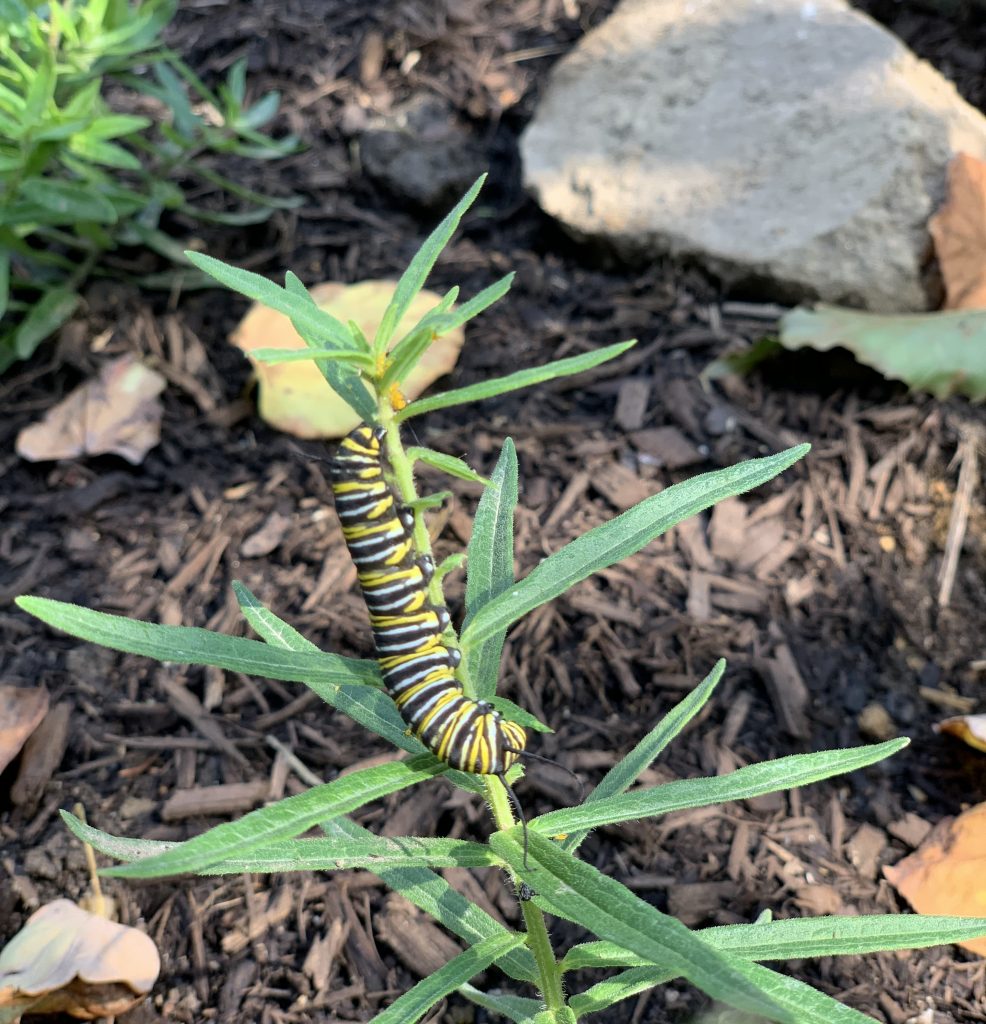
  • Milkweed Plants: Milkweed (Ascelpias) is the host plant genus for Monarch caterpillars, meaning it is the only plant on which Monarch butterflies will lay their eggs. Monarch larvae are uniquely adapted to digest the toxins in Milkweed leaves, a defense adaptation that makes their bodies toxic to predators.
  • Shelter: A dense massing of Milkweed creates a safer habitat with greater protection for Monarchs.
  • Nectar Plants:  Monarch butterflies feed on a variety of native plants. The most important factor is to ensure that there are nectar sources throughout spring, summer and fall.
  • Organic Maintenance: Eliminate use of toxic pesticides that harm pollinators. Remove invasive weeds as necessary.

They will send you a Certificate of Appreciation and a Monarch Waystation outdoor sign to display.

Check out their compilation of butterfly and pollinator resources here.

Xerces Society Pollinator Protection Pledge

The Xerces Society for Invertebrate Conservation has been protecting pollinators and other endangered invertebrates for decades through conservation policy initiatives, grassroots educating, and field research.

As part of their Pollinator Protection Program, you can sign the Pollinator Protection Pledge.

Don’t miss their Pollinator Conservation Resource Center

Bumble Bee Watch

Bumble Bee Watch is a citizen science initiative aiming to track bumblebee sightings to gain data about population distributions and changes over time. All you need is an observant eye and a camera! Upload your photo of a bumblebee or nest, use the site to identify it, then an expert verifies your ID, and your sighting is added to the map!

Sign up to record your sighting and view the aggregated data.

You can find great resources on this site, especially their profile of the bee Species of the Month.

Healthy Yards Westchester

Healthy Yards is a Westchester-based non-profit that promotes responsible land stewardship at a residential level. They provide a wealth of resources and information, for both property owners and professionals, on practices such as: mulch mowing, organic maintenance, planting native, responsible water use, and more.

Check out their Checklist for a Healthy Yard, 10 steps to start your healthy yard journey! Be sure to read their full compilation of Resources for Homeowners too!


Filed Under: Ecological Education Tagged With: audubon, Audubon international, bee-friendly, biodiversity, bird-friendly, bird-friendly garden, bumblebee watch, certified wildlife habitat, climate mitigation, designed habitat, ecological landscape design, ecological landscaping, ecological restoration, healthy yard, healthy yards, homegrown national park, million pollinator project, monarch watch, on the map, organic garden, organic gardening, organic landscape, pollinator garden, pollinator pathway, pollinator pathway CT, pollinator pathway NY, restoration, wildlife habitat, xerces pollinator protection pledge

  • « Go to Previous Page
  • Page 1
  • Interim pages omitted …
  • Page 9
  • Page 10
  • Page 11
  • Page 12
  • Page 13
  • Interim pages omitted …
  • Page 60
  • Go to Next Page »

Footer

Mailing Address: 222 Purchase Street, #144 Rye, NY 10580
Shop Address: 369 Bradhurst Ave, Hawthorne, NY 10532
(914) 560-6570
  • Facebook
  • Instagram
  • LinkedIn
  • Pinterest
  • YouTube
  • Houzz
  • Slide Share
  • Installation
  • Portfolio
  • Pricing
  • About
  • Contact

Copyright © 2025 · Green Jay Landscape Design. All Rights Reserved · Privacy Policy · Website and Local SEO by Ramblin Jackson