• Skip to main content
  • Skip to footer

Nassau County Residents

Green Jay Landscape Design is licensed and insured only for landscaping services in Nassau County.

All other services mentioned on this website are performed by independent contractors.

Green Jay Landscape Design

Green Jay Landscape Design

Green Jay Landscape Design

(914) 560-6570
  • Design
  • Installation
  • Portfolio
  • Pricing
  • About
    • Service Area
    • Meet Our Team
    • Our Process
    • Our Promise
    • Mission, Vision, & Core Values
    • FAQ
    • Press & Events
    • Blog
    • Reviews
    • Careers
    • Affiliations
    • Newsletter Sign-up
  • Contact

greenjayadmin

Summer is here and outside is where we want to be! Many of our clients hire us to improve their outdoor living environment – aesthetically, ecologically, and functionally. Whether that translates into a new patio or entertaining area, solving a soggy yard problem, and/or revitalizing the planting, is determined through an on-site consultation and subsequent Landscape Design Master Plan. We’ve rounded up our best backyard landscape designs in Westchester County, NY EVER! We hope it provides inspiration for your own backyard design goals!
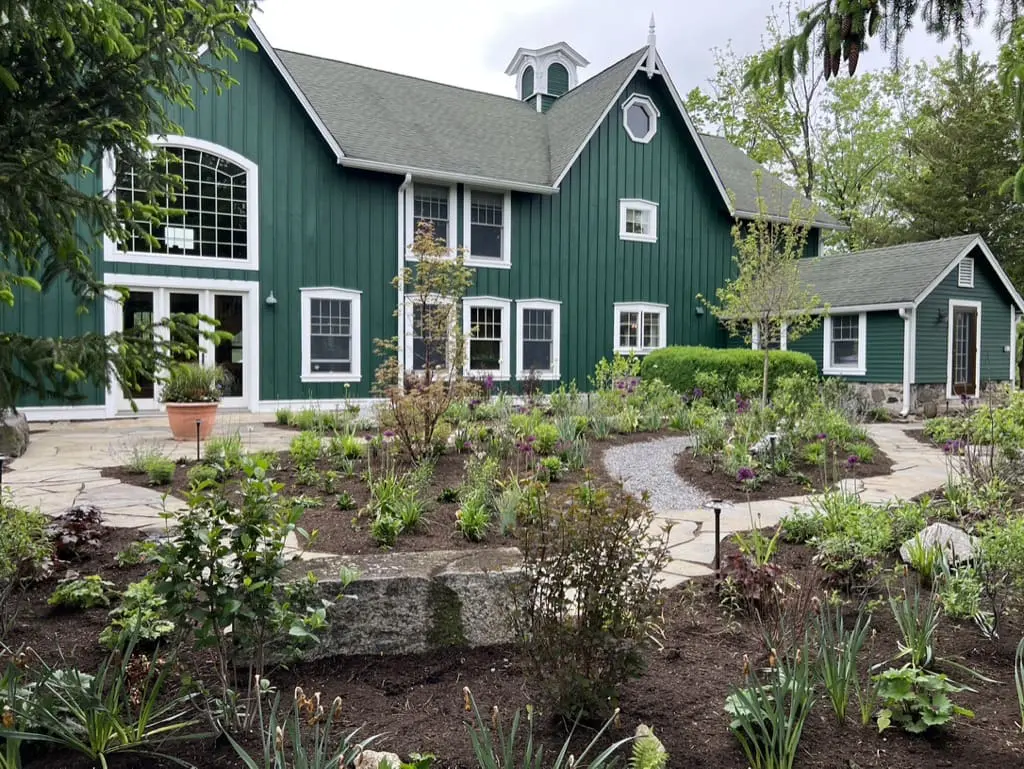
Designed Backyard Courtyard | Somers, NY

This charming backyard was naturally enclosed by mature trees, lending the feeling of a walled courtyard. Titled The Cloister of Sweet Serenity, GJL designed a circular flagstone walkway with a secondary gravel path running through it as the new backyard landscape design. This new masonry provides the perfect framework to stroll through the garden and take in its wonder. We also constructed a new flagstone patio off the house –  a favorite spot for morning coffee or entertaining. The plant palette is predominantly native, a mixture of unique foliage and pollinator-favorite perennials. Beginning with spring flowering bulbs, all the way through the last days of fall, this garden will provide sources of pollen, nectar, seeds and berries for pollinators while remaining beautiful and stimulating for the clients. As seen through the windows of the house or from the stroll paths of the garden, this new backyard landscape design is a stunning feature of the property.

In the words of the client:

I am sure that my words will not do justice to the happiness that Jay and his wonderful team have brought me. They transformed a plain yard into the most glorious garden! It is peaceful, serene and my most favorite place for morning coffee. I would never hesitate to use Green Jay Landscape Design, Jay really listens to what you want and then makes the dream a living reality. They are truly marvelous.

European-Inspired Parterre Garden | South Salem, NY

Wild within structure was the inspiration for this backyard landscape design, a European parterre garden turned ecological masterpiece. The clients wanted the formal geometry of a traditional Spanish or French garden coupled with Green Jay Landscape Design’s knack for ecological gardening. The result is a mix of natives and traditional European perennials (that pollinators here still frequent!) that we designed in an asymmetrical planting plan.
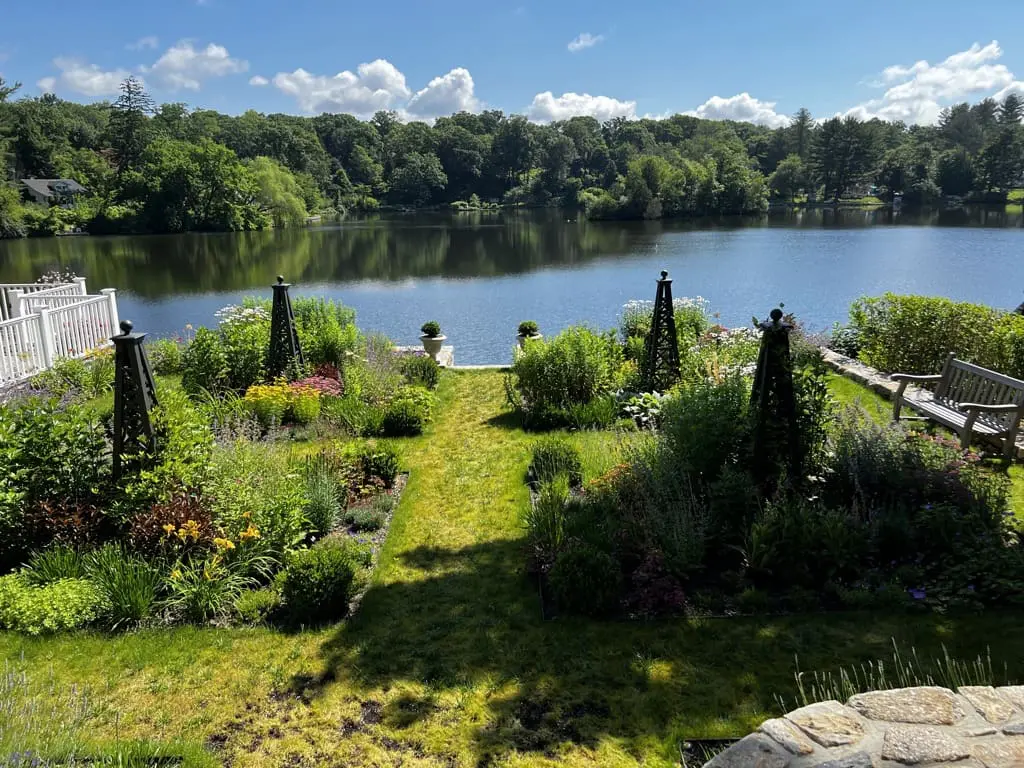
Set against the lake backdrop, the colorful blooms and height from the trellis really pop and command the backyard. As always with our designs, plants were chosen for their ecosystem services and resilience in our region. Whether viewed from the upper stone terraces, through the home’s windows, or from the parterre garden itself, this landscape design is truly stunning and unique.
Lawn Terraforming with Terraced Border Garden | Harrison, NY

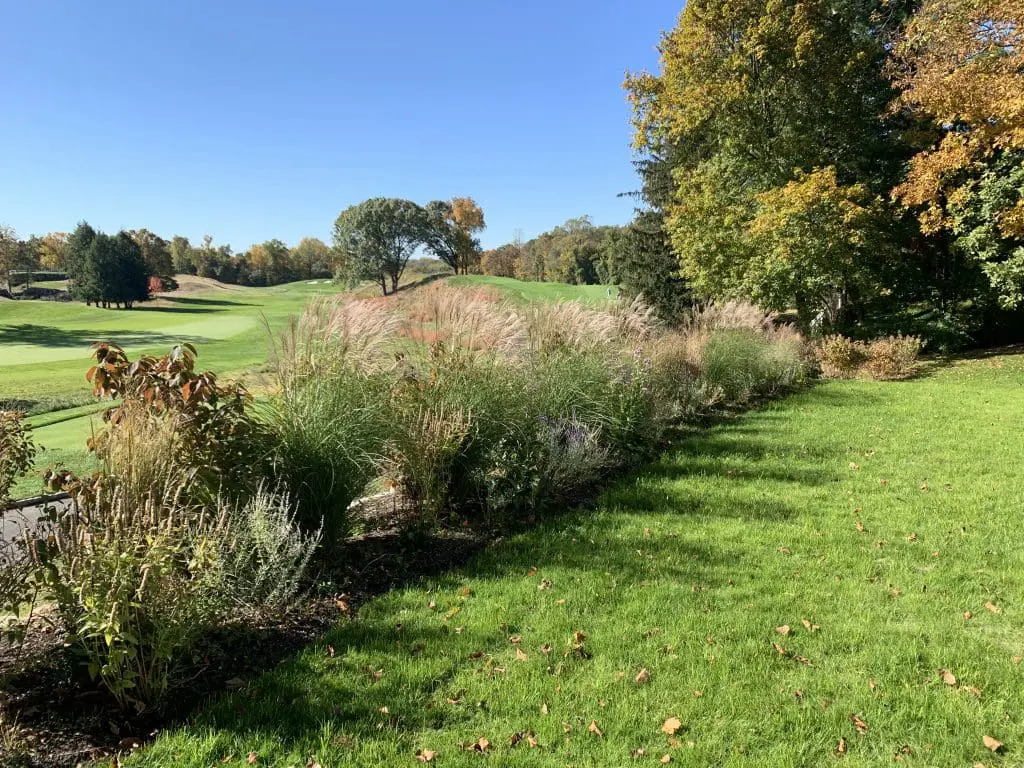
A common request from clients with young families is create a level area for outdoor play.  In this case, the property had an ample backyard lawn, but the slight slope made playing ball impractical for their children, especially since the property borders a golf course. For this Harrison, NY backyard landscape design, we brought in many yards of engineered soil and graded the lawn area into a level play area.
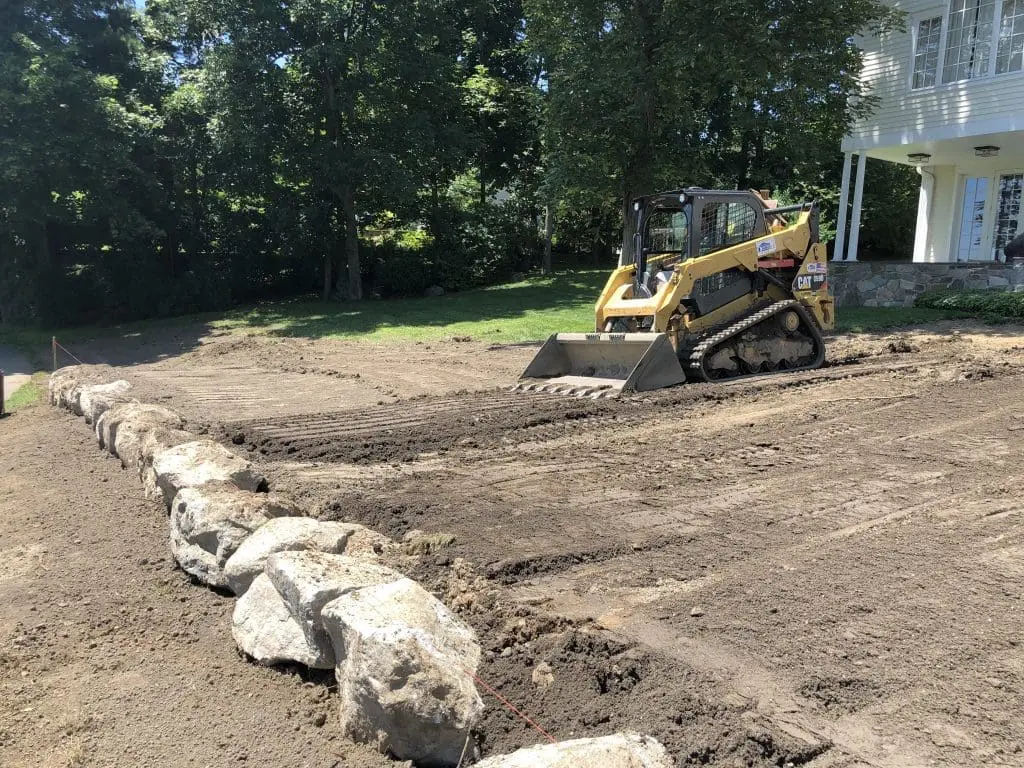
To support the new grade, we designed a two-tier terrace to line the back border. Planting with a mix of viburnums (an excellent native shrub for wildlife!), ornamental grasses and perennials, the border is now a focal point instead of an eyesore.
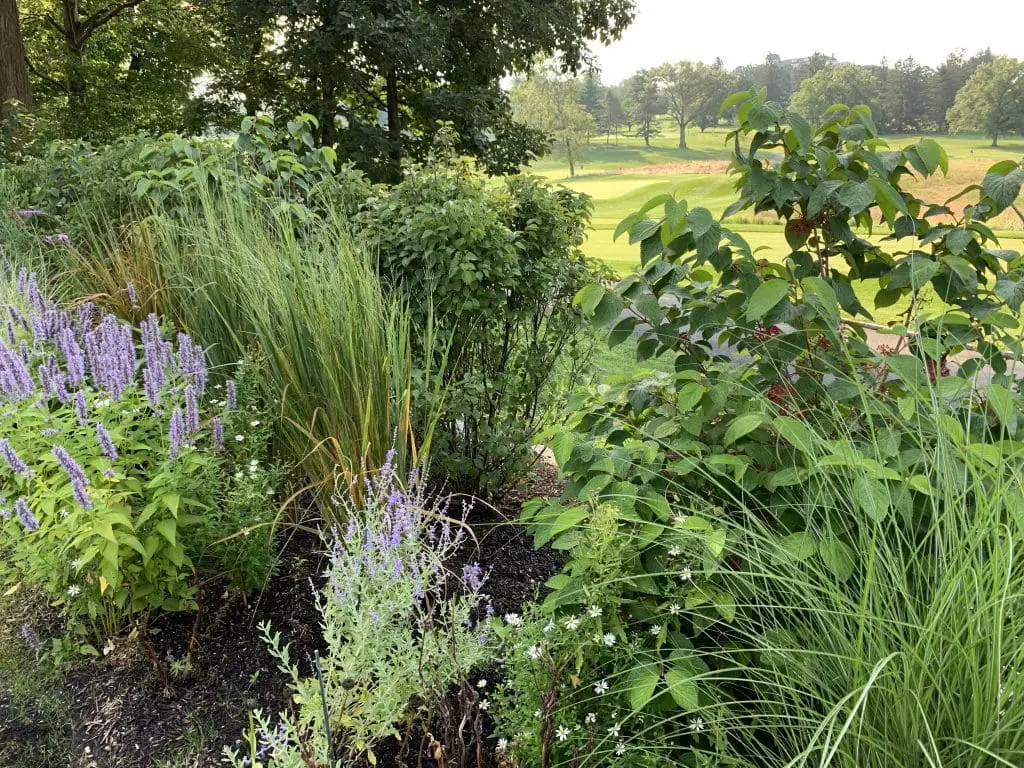
The previous border, legacy yews that were  leggy and hid the green golf course while accentuating the asphalt road directly behind the property. The result, after GJL’s installation, creates an intimate and beautiful backyard for play, relaxation, or hosting guests.

Family Friendly Ecological Estate | Rye, NY

This Rye, NY client came to us seeking a complete backyard landscape renovation for a home they had recently moved into.  With a large, young family, the client wanted the backyard to be a destination for his children and their friends, with plenty of amenities and garden secrets to discover for the curious mind.

We started by revamping the pool landscaping, which was filled with tired and traditional landscaping plants. We revtalized it with a pollinator and ornamental grass garden that evokes a casual, naturalistic feel instead of the formal landscaping of previous.

Another favorite feature of the design is the perimeter-encircling woodland stroll path. With an existing border of mature evergreens trees, shrubs, and birches, it was a natural extension to design and woodland path and shrub border. The effect is marvelous! Wandering under birches, through fern glens, around gracefully flowering woodland perennials and commanding hydrangeas, imagination and wonder are ignited.  The client even bought fairy houses and placed them along the woodland path for his daughters. Additionally, a vegetable garden and rain garden provide further learning opportunities about food cultivation, stormwater management and the water cycle.

In the words of the client:

We know whats going on with species dying out and the climate warming. So for me it was about, at least in the small plot of land I have, being able to be part of the solution not part of the problem.

Watch the full client testimonial and project install time lapse here on our Youtube channel.

Schedule your Landscape Design consultation with us!

—

Green Jay Landscape Design

Where Design Meets Ecology

914.560.6570
Filed Under: Featured Article, Featured Work, Landscape Design, Uncategorized Tagged With: backyard design, backyard landscape design, client testimonial, ecological landscaping, garden for wildlife, habitat garden, harrison NY, healthy yard, landscape design, landscape designer, landscape ecologist, landscape grading, native plant garden, natural landscaping, organic garden, organic landscape, parterre garden, pollinator garden, rye, rye NY, somers NY, south Salem NY, Westchester county landscape design, Westchester landscape designer

Environmentally conscious gardening — what we in the industry call Ecological Landscaping — is making splashes in mainstream media (hooray!). As spring thaws to summer, and extreme, climate change-driven weather plagues us month after month, more people are starting to look to responsible land stewardship. How can we use our own plots of land to right decades of disturbance and malpractice towards the environment? We round up some of the best ecological landscaping news stories of the past few months, for inspiration, tips and fun facts. Hope you enjoy!

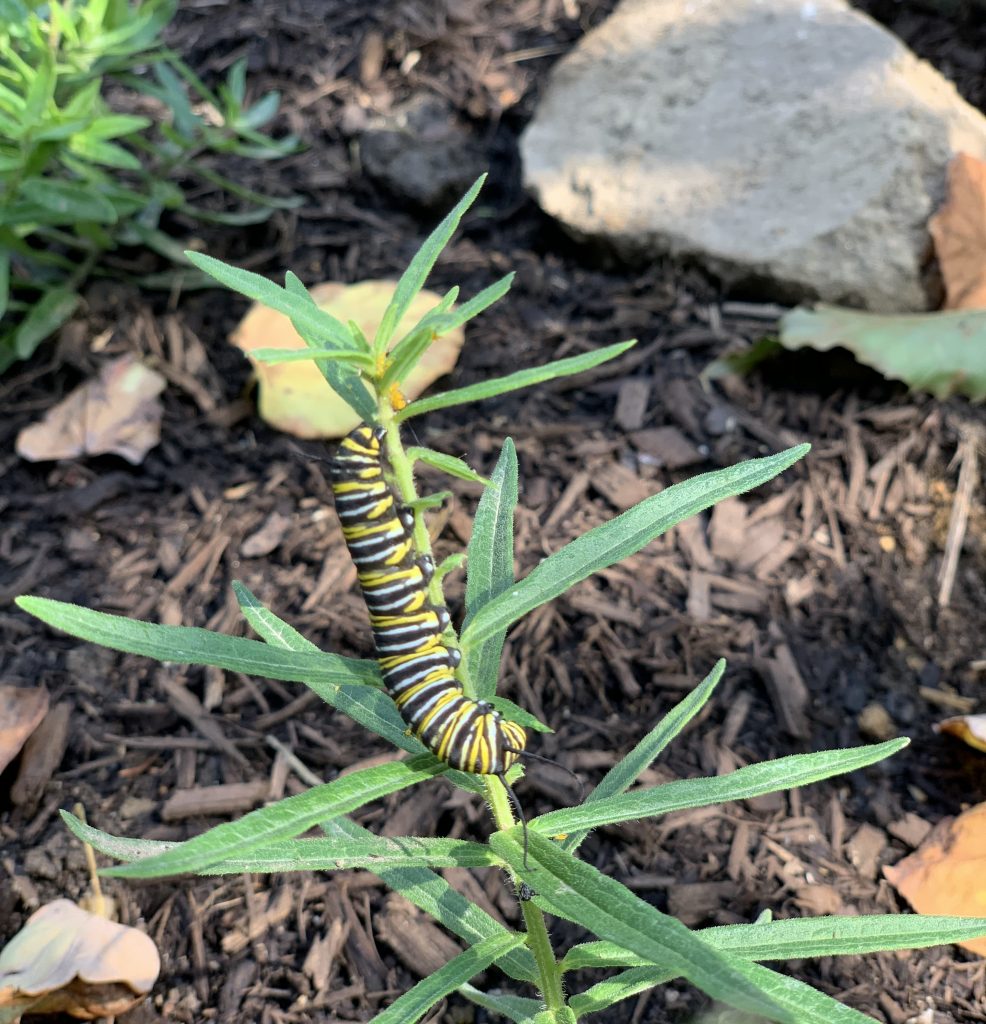
Monarch caterpillar on Butterfly Weed.

Ecological Landscaping Spring 2022 News Round Up:

Yes, You Can Do Better Than the Great American Lawn | NY Times | Margaret Roach

Renkl interviews Daniel Jaffe Wilder, renowned horticulturalist and director of applied ecology at Norcross Wildlife Foundation in Wales, MA, on why reducing and replacing your lawn with native alternatives is the best place to start to make your yard more environmentally-friendly.

The reasoning is two fold. First, the lawn is extremely resource intensive (water, fertilizer, gasoline for mowing) and using these resources has a ripple effect on the environment (worsening drought, polluting waterways, and emitting greenhouse gases, respectively). Second, lawns are monocultures of imported species, they are ecologically sterile.

Jaffe suggests several native alternatives. Worth the read!

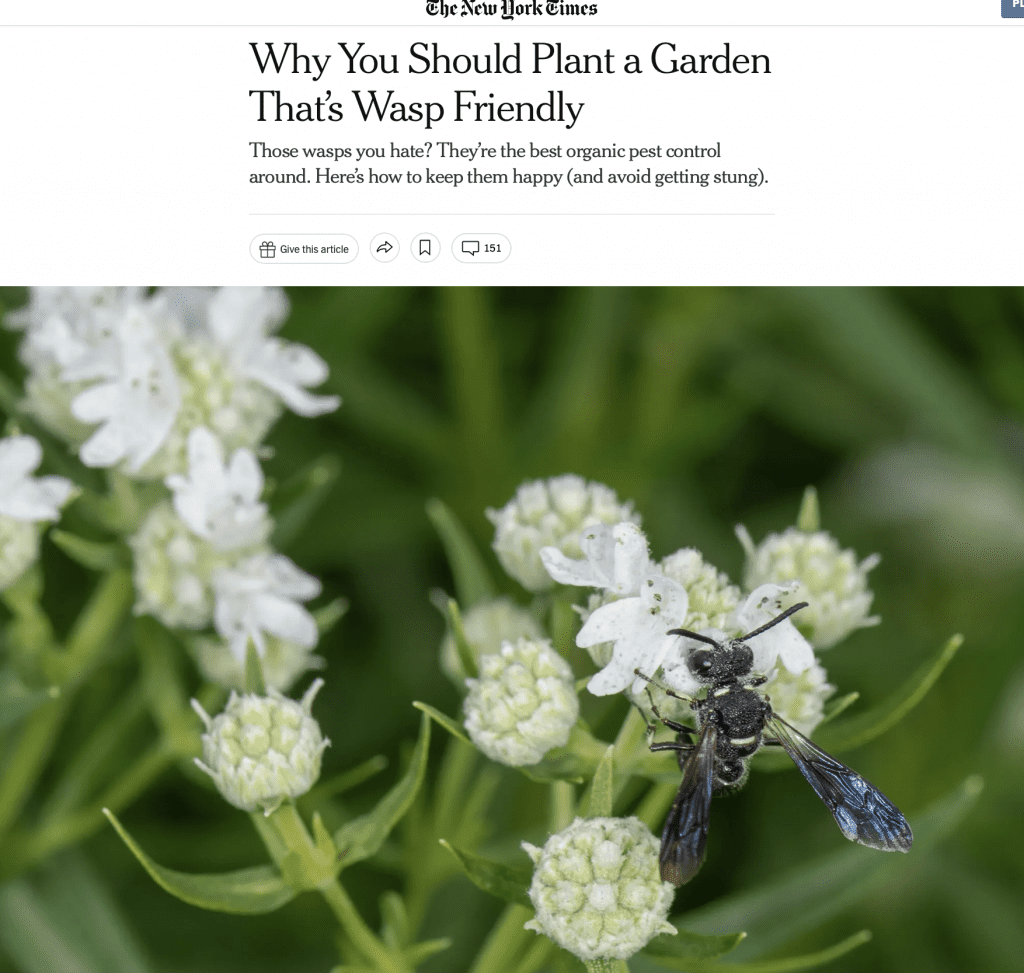
Why You Should Plant a Garden thats Wasp Friendly | NY Times | Margaret Roach


“The list of the organic pest-control services offered by wasps goes on, and yet it is the wasps that we humans reflexively regard as pests,” Roach explains. Only 1.5 percent of wasps in the world are social wasps, those that build nests and can get defensive. The vast majority of wasps in the world are beneficial insects, serving as natural garden predators and performing amazing ecological feats.

Read the full article here.

Glyphosate and Your Health | Mount Sinai Exposomics Research Summary

Mount Sinai’s Exposomic Research department studies the effect of various chemical exposures on human health. A June 2022 report summarized their recent findings on the impact of the herbicide Glyphosate on rodents and its implications for human health.

“Drs. Chen and Lesseur are investigating the impacts of glyphosate exposure during pregnancy in human cohorts and animal models. Utilizing data from Dr. Shanna Swan’s The Infant Development and Environment Study (TIDES), they found an association between glyphosate exposure during pregnancy and risk of pre-term birth. In the United States, complications that arise from pre-term births are a leading cause of infant mortality. In another study of TIDES participants, they found that girls born to mothers with higher glyphosate exposure during pregnancy had longer anogenital distance, a marker of testosterone exposure. This suggests that glyphosate interferes with hormones and may have additional impacts on development of reproductive organs and other hormone-dependent systems.

These findings are supported by a study that Drs. Chen and Lesseur conducted in rodents, where long-term exposure to glyphosate as well as the glyphosate-based herbicide Roundup was linked to hormone disruption. They found that prenatal glyphosate exposure at levels considered to be “safe” for human consumption was associated with longer anogenital distance in both male and female offspring, and an increase in thyroid stimulating hormone in males. These findings are further evidence of the endocrine disrupting properties of glyphosate.”

Read the full report including tips to avoid Glyphosate exposure here.


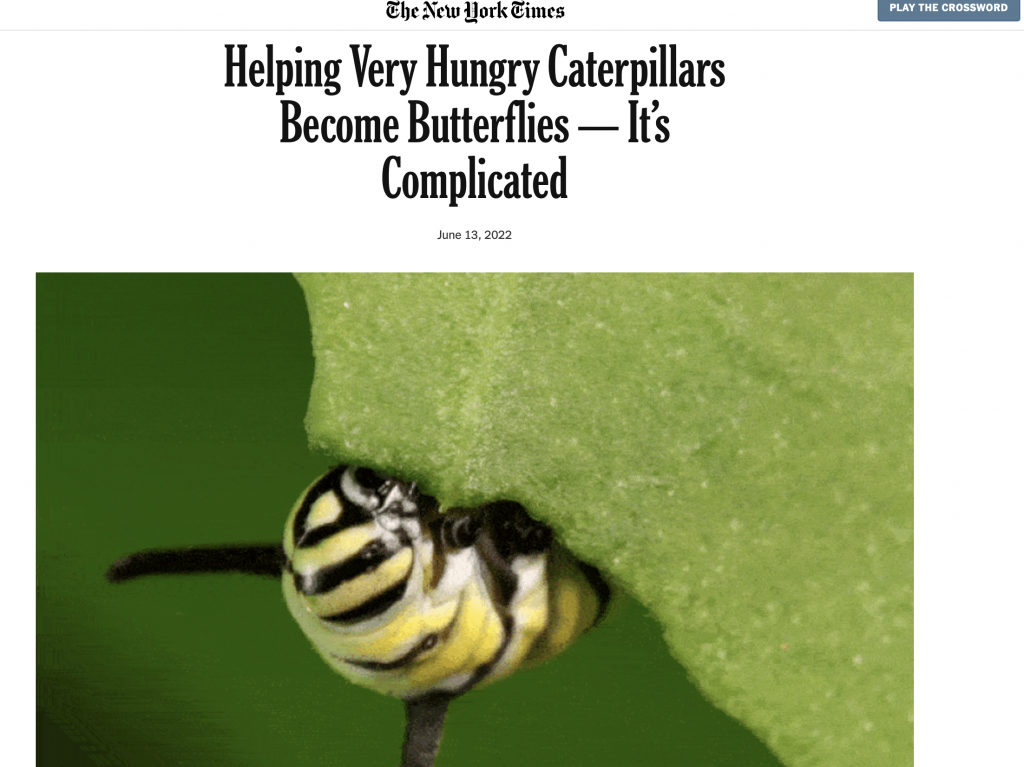
Helping Very Hunger Caterpillars Become Butterflies – Its Complicated | NY Times | Margaret Renkl

An avid gardener and with vast pollinator knowledge, Margaret Renkl shares her experience trying to protect precious caterpillars as the metamorphosis into butterflies. A lesson in the complicated nature of ecosystems, and how our gardens (even with ecological landscaping!) are imperfect replications of natural environments. A fascinating and informative read!


Check out more of Renkl’s articles on NY Times including:

One Way to Do More for the Environment: Do Less with Your Yard

For the Butterflies, and the Rest of Us


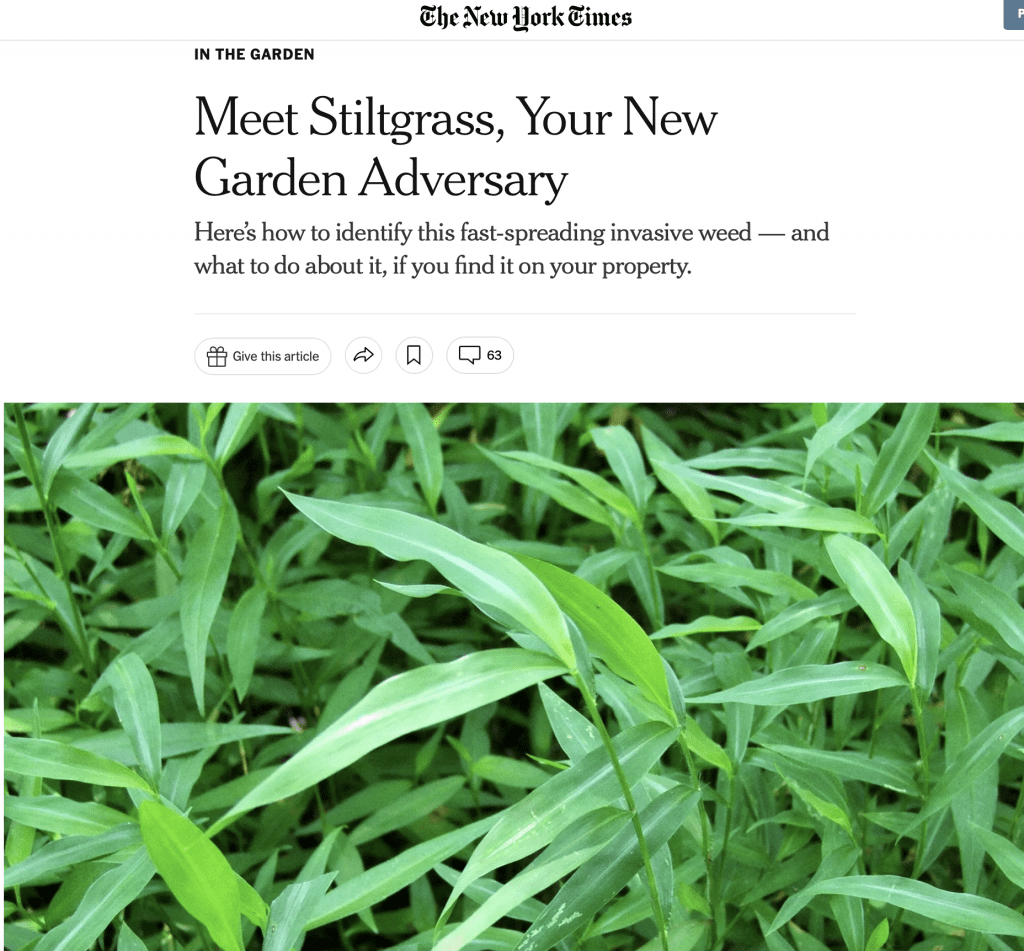
Meet Stiltgrass, Your New Garden Adversary by Margaret Roach for NYTimes

Roach writes an informative article on the pesky invasive Stiltgrass, what we know about the plant and what management practices are available. Read the full article here.

Ecological Landscaping Book Recommendations

Check out our previous posts with booklists of Jay’s favorite ecological landscaping, nature and ecology books!

Jay Archer’s Winter 2021 Book List

Jay Archer’s Summer 2020 Reading List

—

Green Jay Landscape Design

Where Design Meets Ecology

914.560.6570

Filed Under: Ecological Education Tagged With: eco news, ecological gardening, ecological landscaping, environmental news, gardening news, gardening tips, glyphosate, glyphosate and your health, landscaping tips, native plant garden, new york times, news, organic gardening, science news, stilt grass, wasp gardening

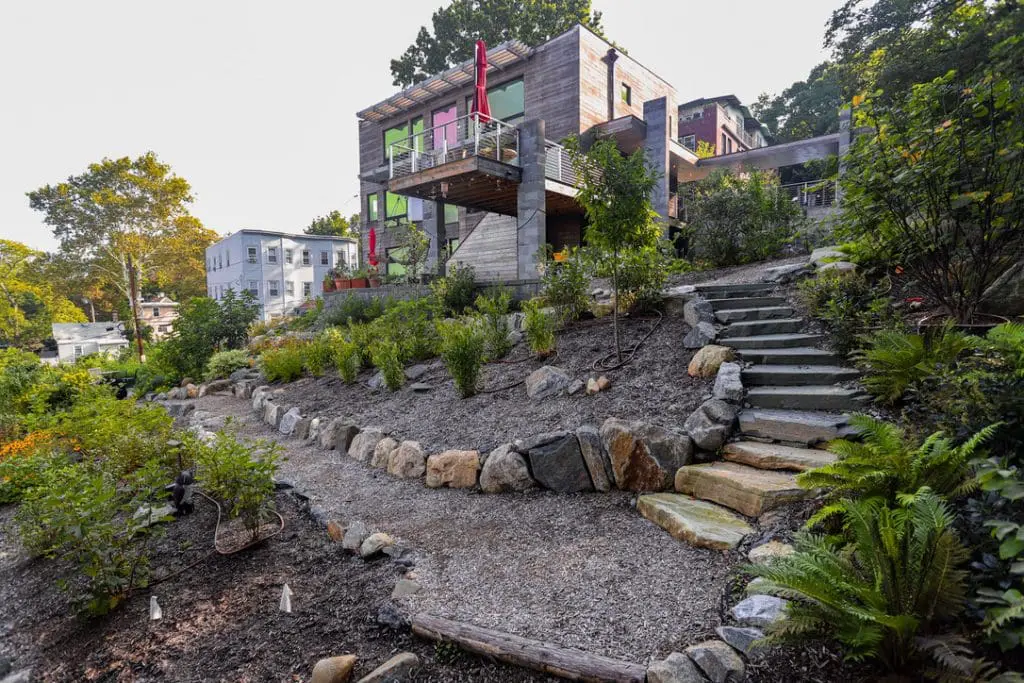
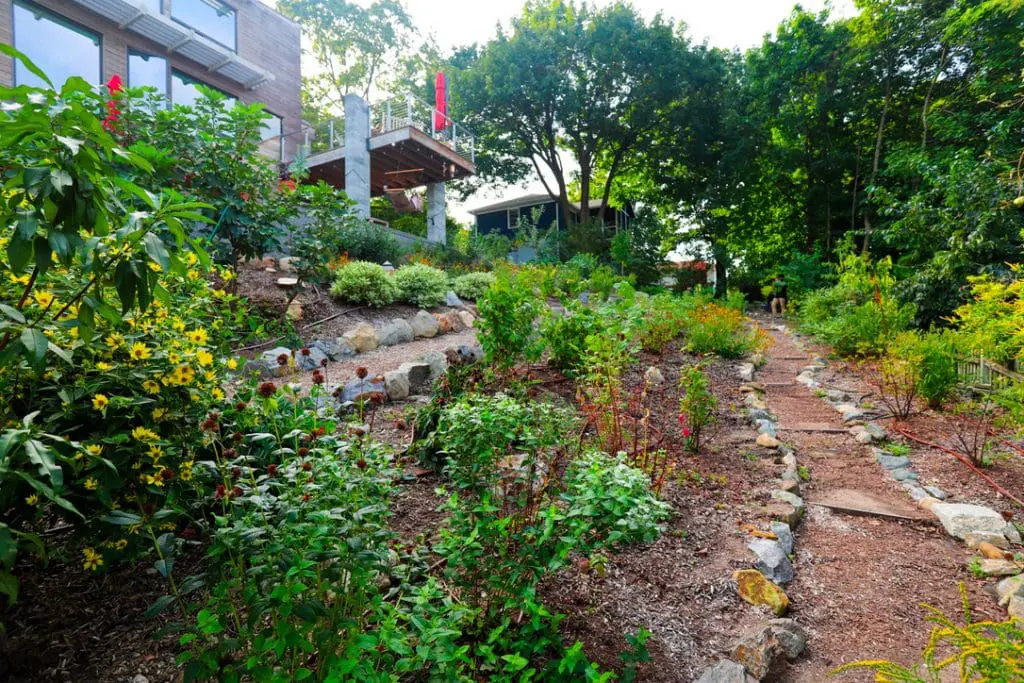
When you dream of your ideal landscape, does it include edibles? Vegetables, herbs, fruiting trees and shrubs – there are many options when designing and edible landscape and it doesn’t have to be separate from the rest of your landscape! If this is music to your ears, you might be interested in a permaculture landscape design! This case study in Hastings-on-Hudson, part of Westchester County, NY, involved a complete front yard renovation – removing existing weeds, constructing terraces, walkways, stairs and a new patio encircled by the garden.

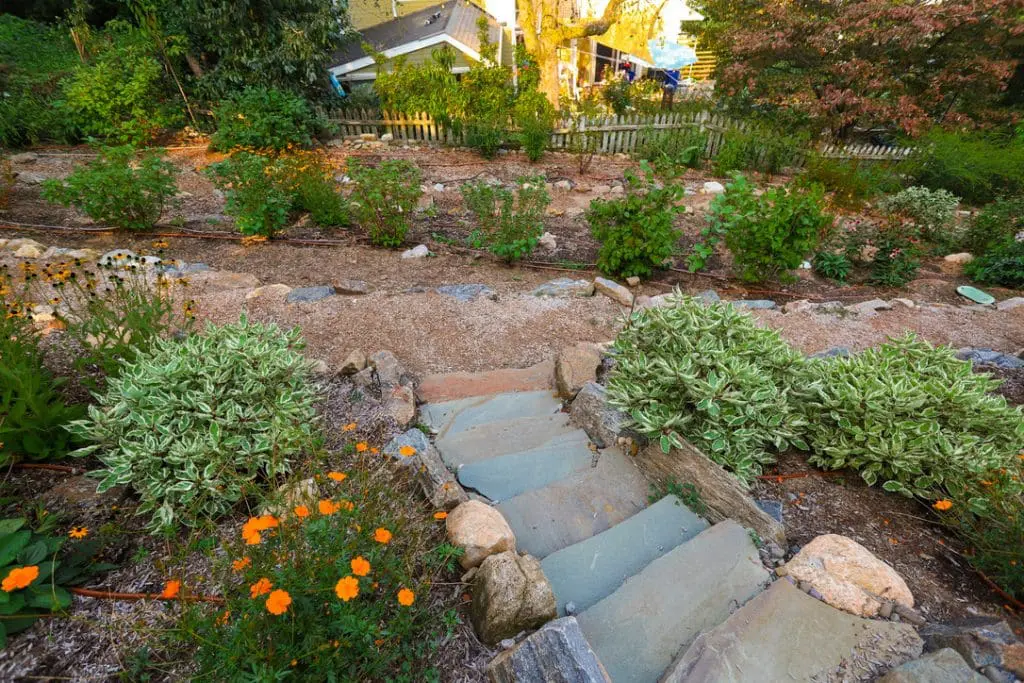
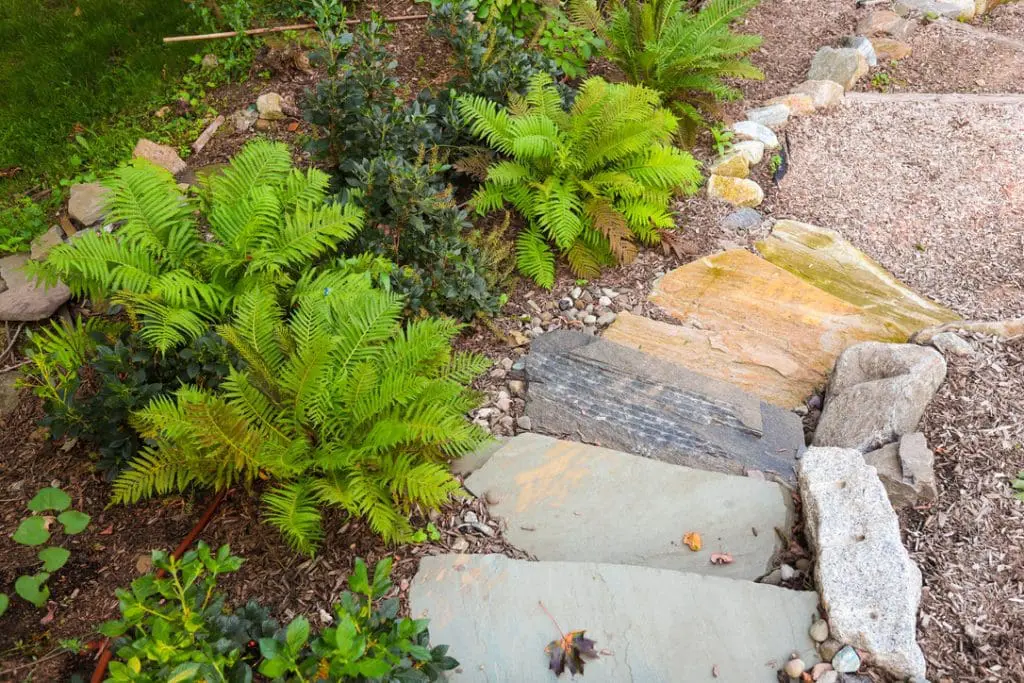
Natural stone terracing and stair case constructed by Green Jay Landscape Design.

Designing a Hillside for Erosion Control

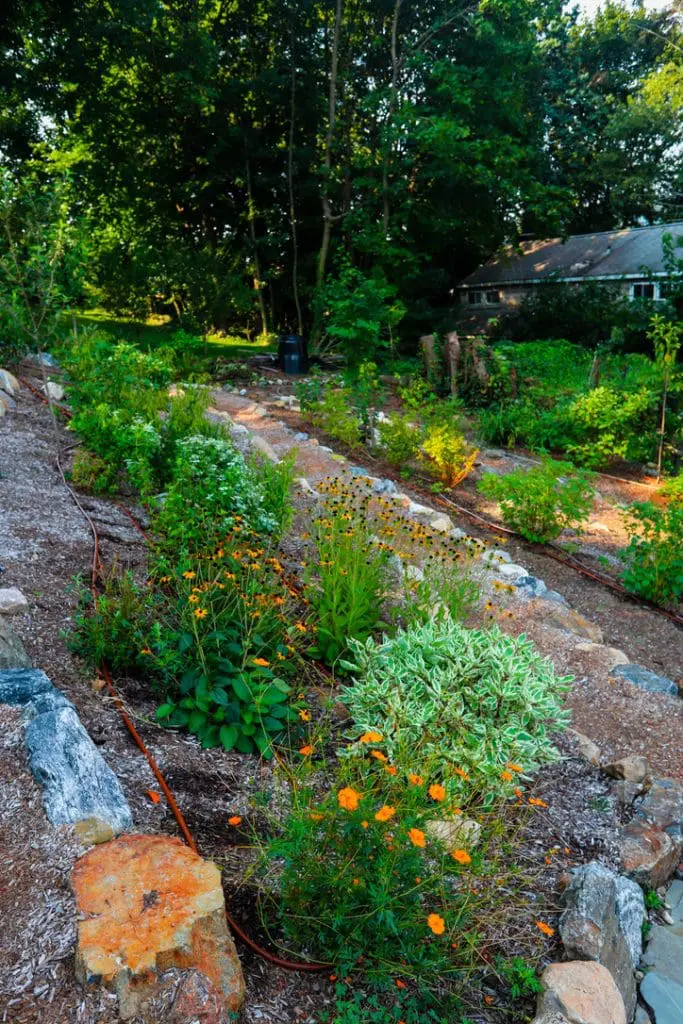
The network of garden terraces and pathways were constructed with boulders, logs and engineered soil. Cumulatively, they effectively halt erosion of the slope and allow for greater absorption of stormwater during storm events.  The previous herbaceous vegetation had little impact absorbing stormwater. The designed landscape’s strategic mix of trees, native shrubs, and deeply rooted ornamental grasses and perennials are much more effective at stabilizing the slope with their varied root systems and at transferring water back into the atmosphere (via evapotranspiration, strengthened by their high root-to-shoot mass ratio).

Native Blackeyed Susan shines in the first season of this designed permaculture landscape.

Permaculture Landscape Design: Blending Edibles with Ornamentals

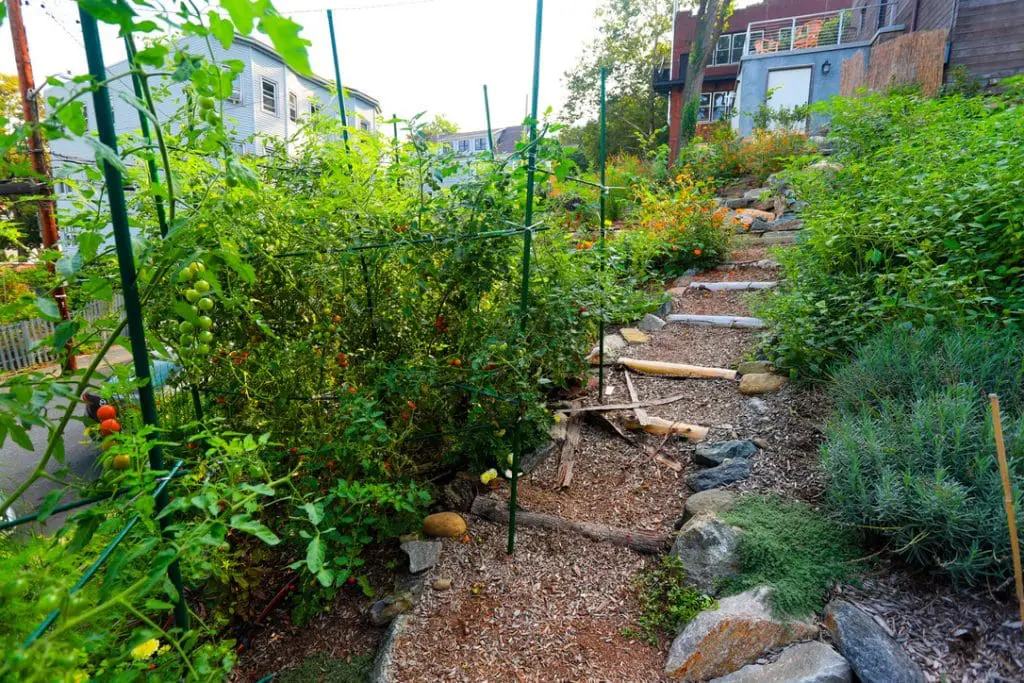
For this permaculture landscape design, we incorporated many edible plants into the garden terraces: tomatoes, squash, blueberries, paw paws, hazelnuts, herbs…the sky is the limit! Just be sure to have an enclosed area to begin with, to limit deer browse and other unwanted wildlife munching on your hard work!

Tomatoes and rosemary are incorporated into the landscape next to pollinator-attracting perennials.

 There are a few benefits to incorporating vegetables and edibles into your landscape. First, they can benefit from neighboring plants’ improving the soil.  For example, some native perennials like Lupines and Baptisia are part of the legume family, meaning they fix nitrogen from the atmosphere into the soil in a plant-available form. Vegetables will be happy with this highly accessible nutrient-dense soil.

Bumblebee visits native Oxeye Sunflower.

Plus, the pollinators attracted to the native perennials and shrubs surrounding your edibles will be more likely to find and pollinate your edibles when they are incorporated into the garden bed. Finally, many herbs act as natural pest deterrent because of its strong fragrance.  Incorporating herbs into your perennial garden will transfer some of this pest tolerance to your perennials.  Likewise, there are perennials in the mint family, like Monarda and Salvia, that deter pests and deer with their scent. Locating these perennials next to your vegetables can help preserve your veggies.

Garden terraces and walkways zig zag across the new front yard in a permaculture pollinator paradise.
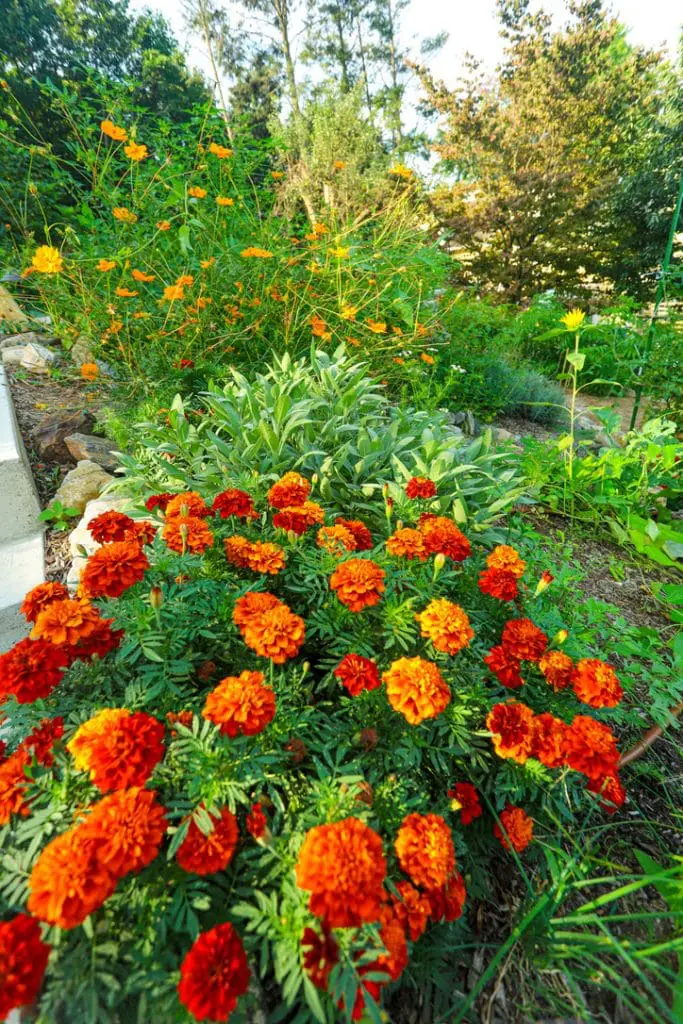
Marigolds and coreopsis – an annual and perennial, respectively – attract beneficial insects and pollinators to the garden.

Make the Permaculture Garden a Destination

Not only do the series of terraced garden walkways contribute to slope stabilization and erosion control, they also enhance the experience (and maintenance!) of the garden. We always try to incorporate pathways into our landscape designs for this is exact reason.

They encourage our clients to meander through their property, harvesting veggies or just noticing what’s newly in bloom, and be present in their natural oasis.

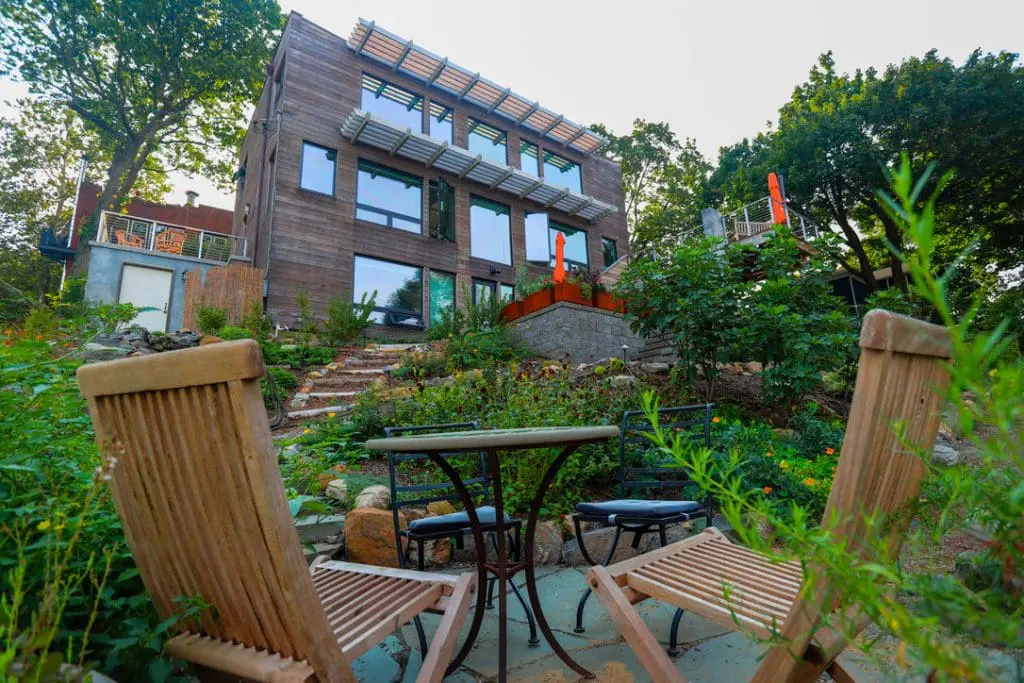
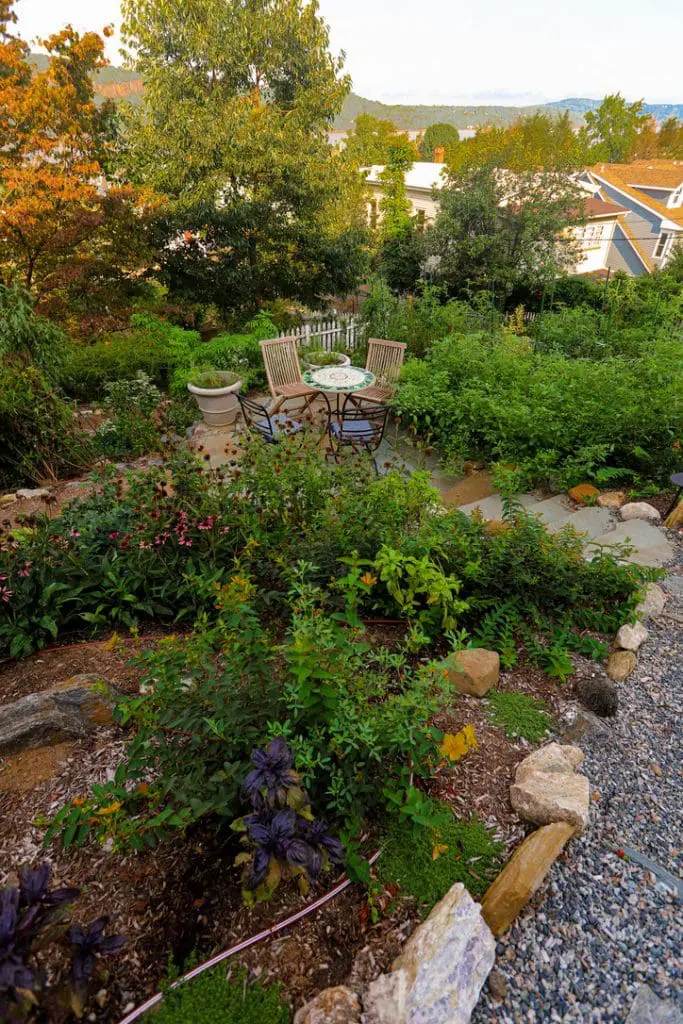
A terrace admits the garden for relaxing, dining and taking it all in!

On this property, the hillside required a few staircases to connect the network of walkways. A circular flagstone patio in the center is the perfect perch to view the garden, the waterfall feature, and the Hudson River! Simply divine.

New natural stone steps line with ferns enable the transition to lower terraces.

Thanks to Cooper Ponds for partnering with us and constructing the recirculating waterfall!

Recirculating waterfall constructed by Cooper Ponds.
Permaculture terraces featuring coreopsis, dogwood and more!

Client Testimonial

While this front yard, hillside permaculture landscape design may not be for everyone, this client was absolute thrilled with the outcome. In the words of her Google Review:

If you can afford the best, forget the rest. Jay Archer and the whole Green Jay team are the best contractors I’ve ever hired for anything in 22 years in Westchester…and I’ve hired many. From the first visit to the design presentation to plant selection to soil remediation to hardscape choices to planting, each stage was executed according to clear & transparent communication. How refreshing to work with folks who take their job seriously, are open to learning new things and love what they do. Every job will have some unexpected challenges but Jay, Lora, Uzi, Aztlan and the whole crew are responsive, thoughtful and nimble, calmly solving any glitch. Throughout the process communication was stellar, which is the key to success in every endeavor. The results were better than I could have hoped. Jay & Uzi took a neglected, steep, weed infested, post-home construction (debris-strewn) back yard and turned it into my dream permaculture food forest. Native flowers, shrubs and trees coexist between a series of switchback pathways that take advantage of the natural slope. Piece de resistance is the recirculating waterfall. It looks as if we have a stream running towards the Hudson River. The sound is magical. There are too many little details that coalesce to create this Hastings idyll to list but don’t take my word for it, ask the bees and birds and butterflies and worms. This land will continue to give nutrition and joy to all living things for decades. Now stop reading reviews, call your broker to sell some of that overvalued stock & go hire Green Jay Landscape Design. For the kids.

–Joan D, Hastings-on-Hudson, NY

Contact us to schedule your landscape design consultation or free 15-minute discovery call!

Circular flagstone patio encircled by the permaculture terrace garden.

—

Green Jay Landscape Design

Where Design Meets Ecology

914.560.6570
Filed Under: Featured Work, Landscape Design, Uncategorized Tagged With: design and build, edible landscape, erosion control, erosion control devices, hillside garden, landscape designer, native landscaping, natural landscaping, naturalistic landscape, permaculture, permaculture design, permaculture garden, steep slope, stormwater management, terrace garden, vegetable garden, water feature

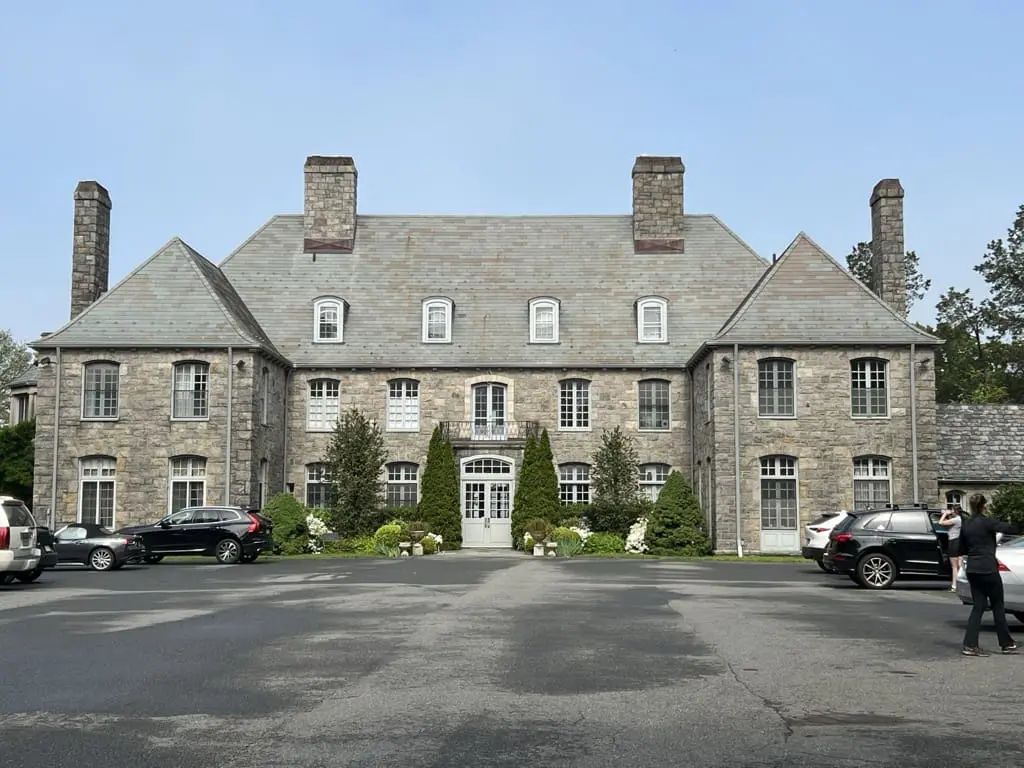
A new garden is on display at the Wainwright House entrance in Rye, NY.

The project was spearheaded by Delia Bajuk, a Rye High School junior  and president of the RHS environmental club, who took an interest in supporting pollinators and biodiversity locally. Delia contacted Green Jay in the winter of 2022 with her idea of developing a pollinator garden at the public and highly visible Wainwright House.

Wainwright House, a historic mansion and now public event space in Rye, NY.

“So, it was the coronavirus, and I was looking at everything, I was looking at the bees, the birds and the hummingbirds, and I thought to myself wouldn’t it be great to have an area where we can bring this all together,” Delia explained.

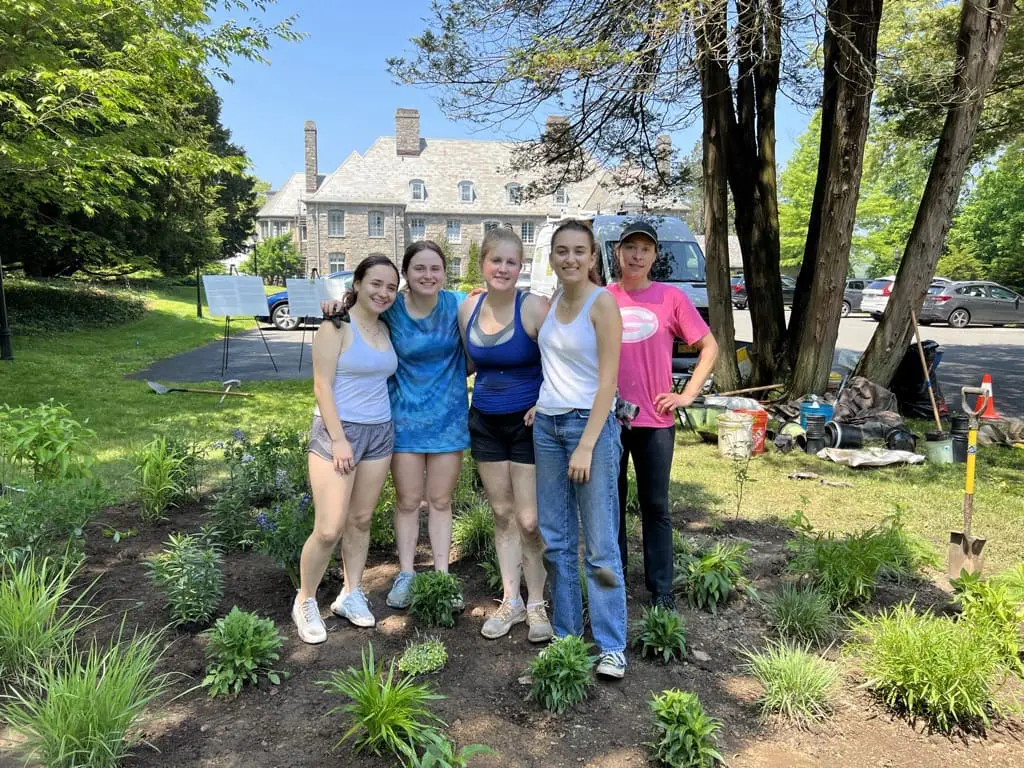
Rye High School Student Volunteers, including Delia (center).

“My mom, she was on the board of Wainwright. This is a beautiful place that really fosters love for the environment, love for Rye, so I figured, why not put one right here?”

Pollinatro Garden Design Plan by Green Jay Landscpaing

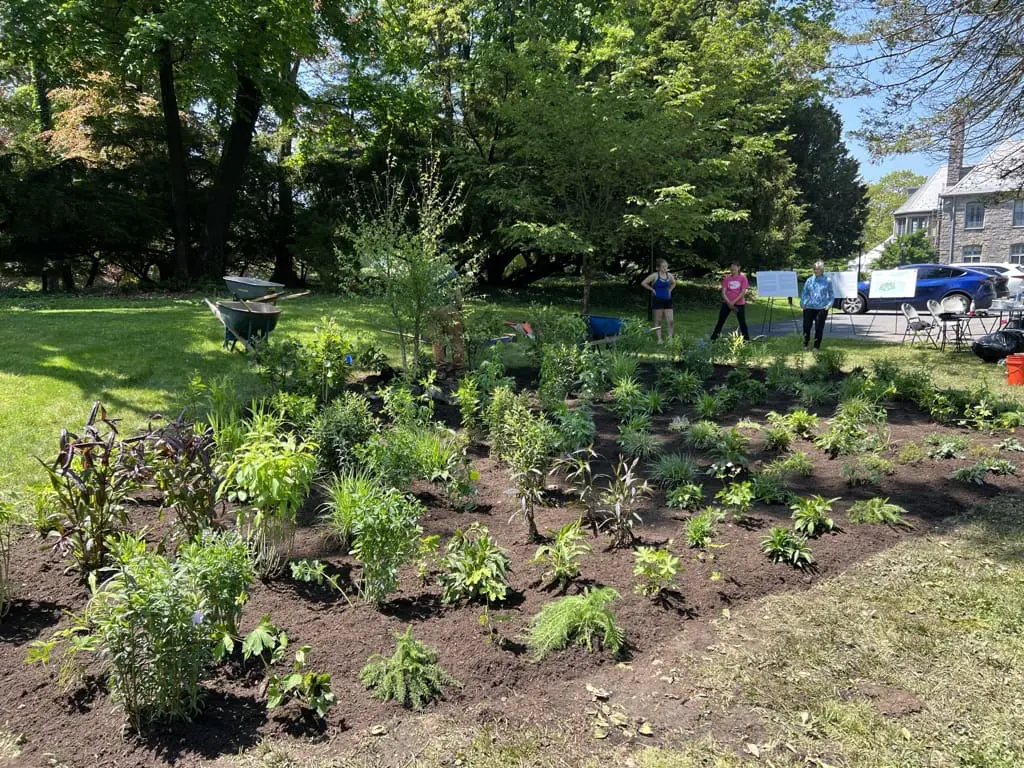
Green Jay’s Nature Design Studio completed the design over the winter and provided Delia with a budget for the plant material; Delia worked on securing funding and student volunteers for the install. Rye Rotary was a significant doner for the project and half a dozen young women and the environmental club advisor showed up on an unseasonably hot and humid Saturday to put in the sweat equity.

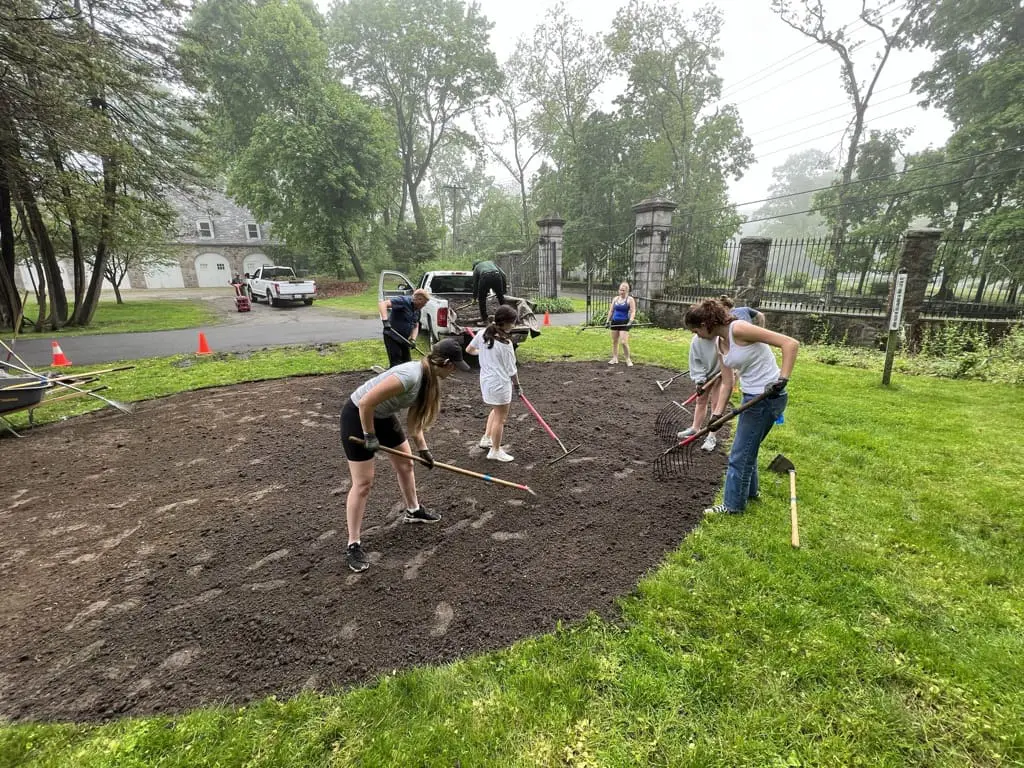
Step one, dethatch turf from new garden area.
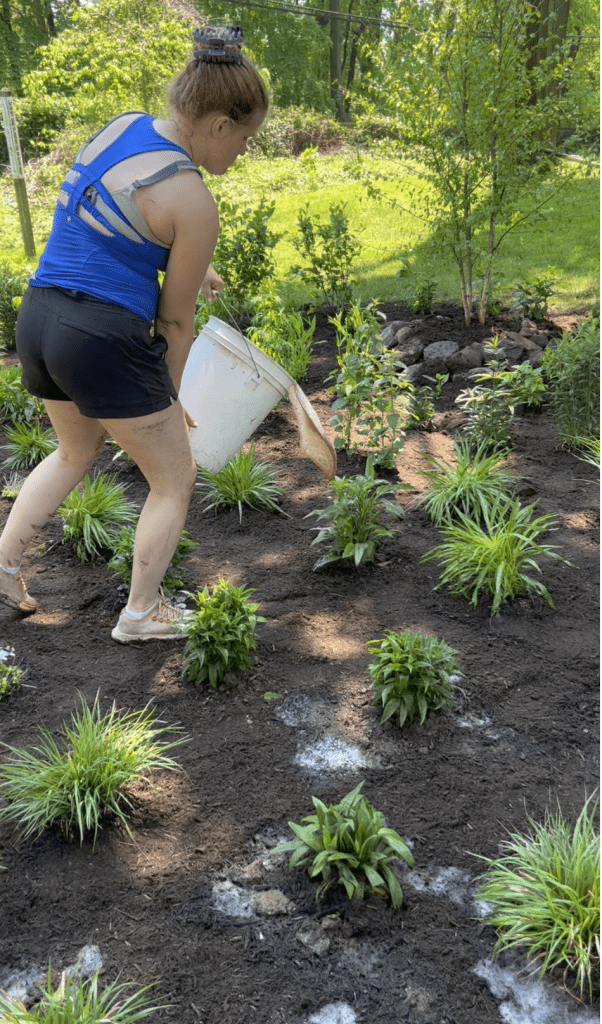
Students incorporating new topsoil to the garden area.

The design is (as usual) heavy on native plants, starting with a specimen tree, the ecological powerhouse that is River Birch. According to Doug Talamy’s research, Birches support over 413 species of Lepidoptera (moths and butterflies) and countless species of birds.

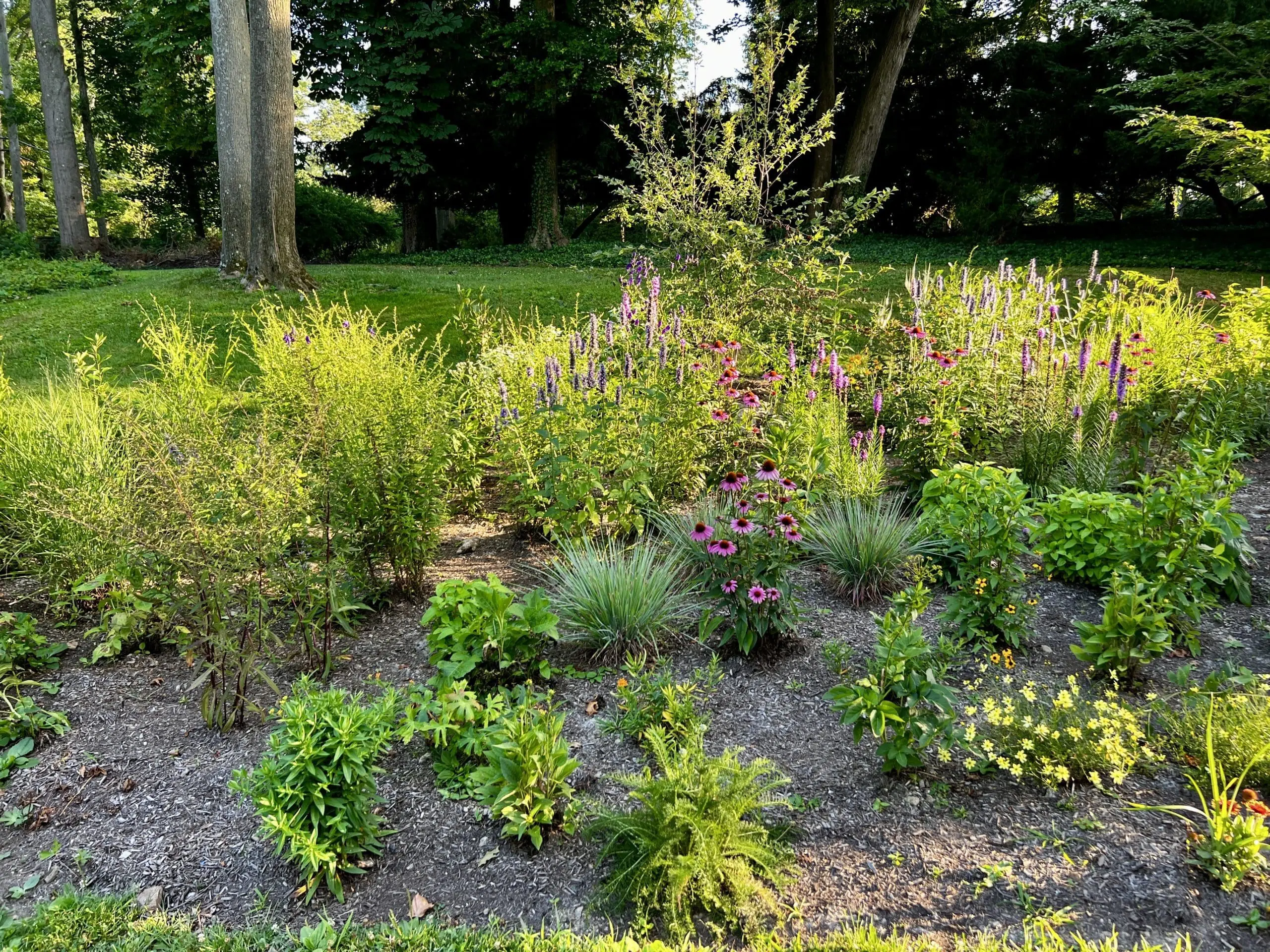
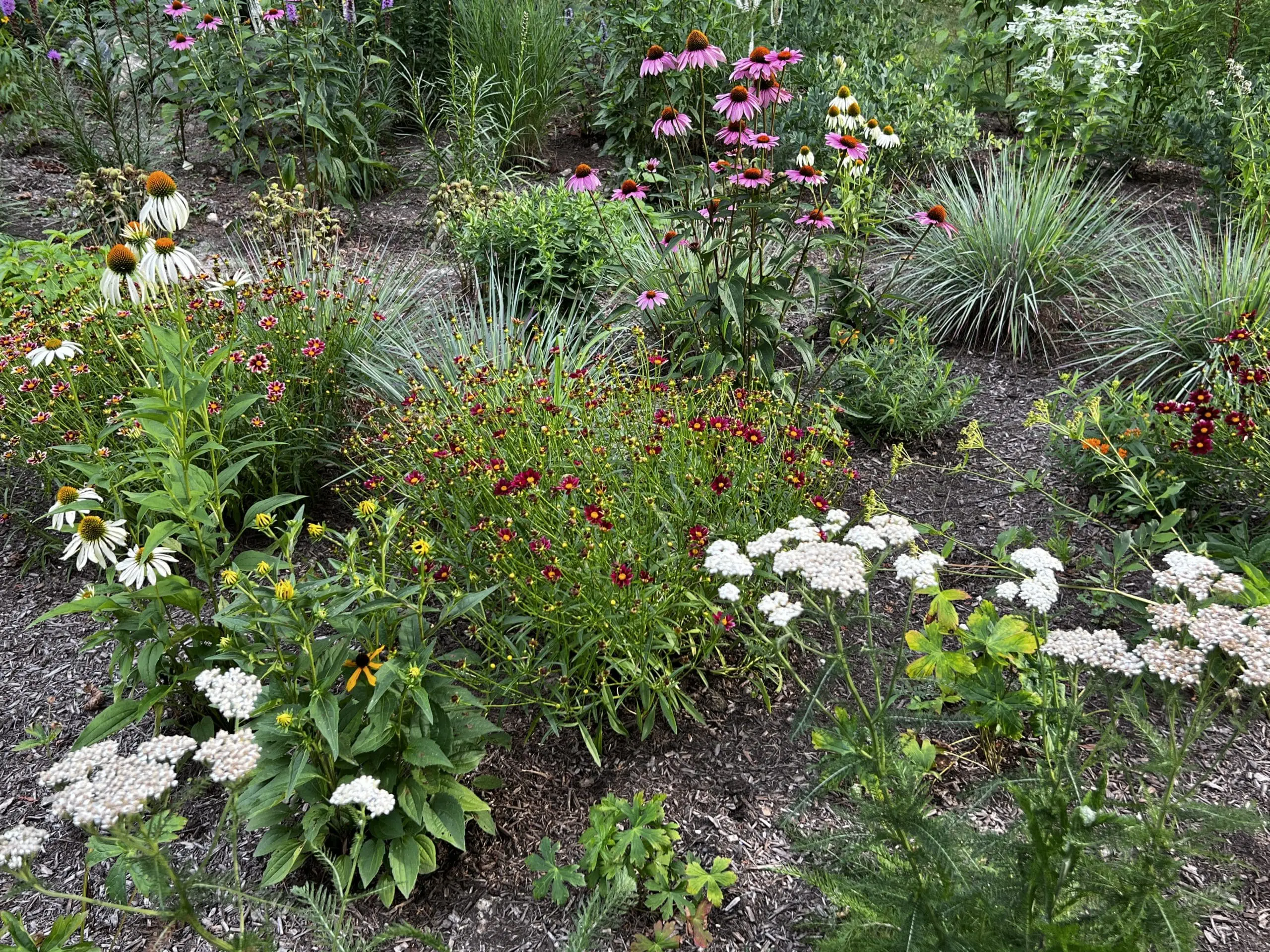
The River Birch is underplanted with a smattering of native woodland perennials including one of our favorites, Turtlehead. The rest of the bed is filled with native grasses and full sun perennials that pollinators flock to.

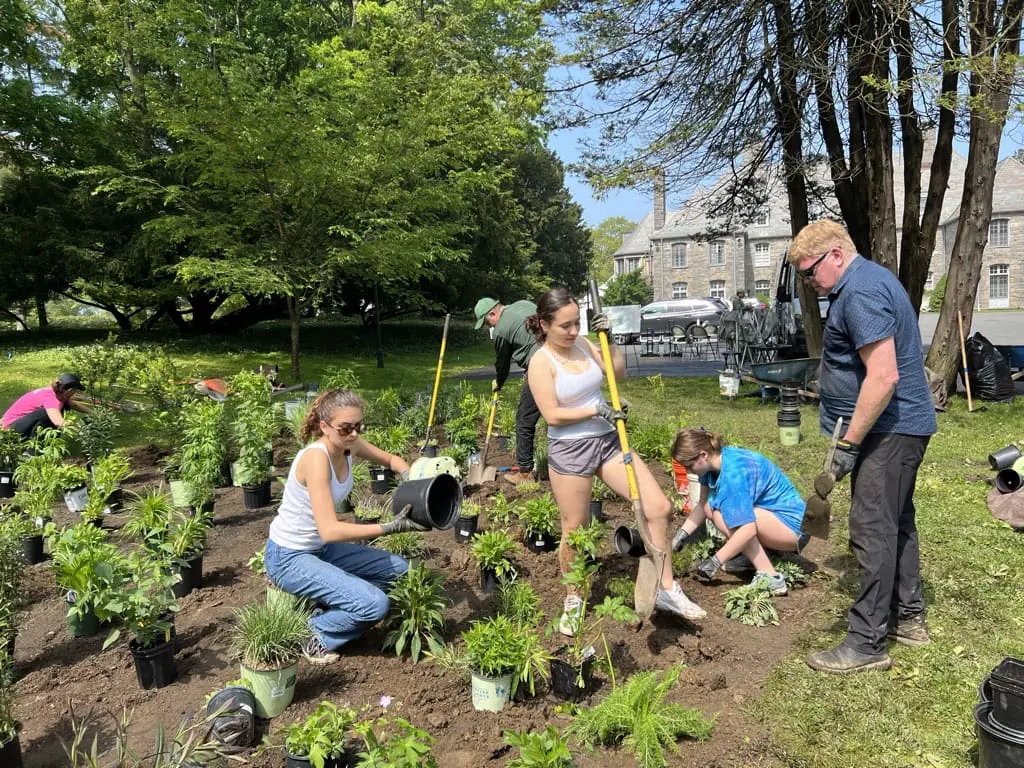
Plants placed in designed layout, ready for planting!

RHS students helped with every stage of the install, from turf removal, to topsoil and amendment incorporation to planting and soil drenching. Jay offered mini lectures on soil amendments, soil analysis, the importance of soil microbes, biodynamic planting with the moon, and biodiversity. Checkout our Instagram reels (@greenjaylandscaping) for video recap and behind the scenes footage!

Students get planting at a new pollinator garden in Rye, NY.
Student volunteers work alongside Green Jay Landscape Design to install a new organic pollinator garden.
Delia soil drenches the planting with yucca and biostimulants to help offset heat stress on this ninety degree planting day.

Be sure to stop by the Wainwright House (260 Stuyvesant Ave, Rye, NY) and check out the new pollinator garden – first bed on the left as you enter the front gates. They offer workshops on a range of topics from sound baths to stand up paddleboarding.

Happy Summer!

—

Green Jay Landscape Design

Where Design Meets Ecology

914.560.6570

Filed Under: Ecological Education, Featured Work Tagged With: climate activists, community garden, ecological landscape design, ecological landscaping, healthy yard, landscape designer, landscape ecologist, native plant garden, natural landscaping, organic garden, organic landscape, pollinator garden, pro bono, public garden, Rye New York, rye NY, student volunteer, volunteer, wainwright house, Westchester County NY

Green Jay Landscape Design is thrilled to be included in The Examiner Plus’s article byBailey Hosfelt Restoring Biodiversity, One Yard at a Time. Hosfelt wrote a thorough and well-researched article featuring quotes from Jay Archer as well as our ecological landscaping colleague Amanda Bayley of Plan it Wild, and grassroots leader Filippine Hoogland of Bedford 2030’s Healthy Yards, and Margie Lavender of Hastings Pollinator Pathways.

The article examines the shift toward ecological landscaping as more people begin to see the destructive nature of pesticides, the resource-intensive nature of lawn maintenance, and the dire need for more habitat for insects, pollinators, and birds.

As Jay explains, “Pesticides have corrupted, contaminated, disturbed, and distressed our soils, and by compromising the soils, the plants can’t possibly be healthy. We need to heal the actual soil before we can go forward and start constructing a new landscape that will support plant life and, by extension, human life in the healthiest way.”

Below is a reprint of Hosfelt’s article. Thank you Bailey for your excellent reporting and attention to this critical issue!

Restoring Biodiversity, One Yard at a Time

A look at the environmental impact of traditional landscaping techniques and their eco-friendly alternatives in a county renowned for its lawns and green space

Bailey Hosfelt

May 23

A well-manicured lawn is, in many ways, synonymous with the American suburbs. Frequently mowed and often sprayed with pesticides, these seemingly green landscapes do little to nothing to attract pollinators — the essential insects that bring pollen from one plant to another and, in turn, support food sources for animals and wildlife as well as humans. 

For sustainable landscapers, ecologists, and environmentally-minded homeowners restoring local biodiversity and fighting climate change is essential, and it starts right outside your doorstep. 

“I say it all the time: the most important room in your house is not in your home; it’s in your yard,” Jay Archer, President and Landscape Ecologist at Rye-based Green Jay Landscape Design, says. 

Archer — a leading advocate for ecological landscaping, native plants, and organic land care — works alongside his team to design, construct, and manage landscapes throughout Westchester, Putnam, and Fairfield County that will be not only visually appealing but also ecologically attractive and life-sustaining. 

“We’re designing for living to create biological life, our first mandate,” Archer explains. “We’re also using the natural resources and conserving and preserving as much as we can.”

Archer’s team designs and builds ecological landscapes without utilizing gas- or oil-powered machinery to create them. 

“We use a lot of primitive technology, frankly, to create landscapes that don’t require those resources to be maintained,” Archer explains. 

Archer says that while you would think the traditional landscaping industry, narrowly focused on maintaining lawns and green spaces, would want to do good for the environment, that is not the case, primarily due to the overuse of pesticides.

“Pesticides have corrupted, contaminated, disturbed, and distressed our soils, and by compromising the soils, the plants can’t possibly be healthy,” Archer notes. 

As a result, Archer and his team spend a lot of time analyzing landscape sites before focusing on remediating and regenerating them. 

“We need to heal the actual soil before we can go forward and start constructing a new landscape that will support plant life and, by extension, human life in the healthiest way,” Archer explains.

Filippine Hoogland, a landscaper who helped start Healthy Yards — an organization of professional, master, and passionate gardeners based in Bedford — explains that Westchester is one of the counties in New York State with the highest pesticide use.

A 2016 investigation by Lohud found that Westchester was among just six of 62 counties in the state that applied more than one million pounds of pesticides in 2010, the most recent state data available. At the time, Westchester ranked third-highest in pesticide use, at 2.26 million pounds.

The overuse of pesticides county-wide puts the environment and residents’ health at risk, particularly for runoff that contaminates water. 

Water with high concentrations of nitrates from synthetic fertilizers and pesticides can cause congenital disabilities, nervous system impairments, and cancer.

“More homeowners are becoming aware and interested, but it’s very difficult to find landscapers that can answer to that demand,” Hoogland explains. 

Using pollinators as an entry point

At Healthy Yards, Hoogland and her team set out to educate both homeowners and landscapers, sharing resources to help individuals and professionals change their yard practices. 

However, they found that the traditional landscaping industry is very reluctant to change, and homeowners often feel offended when you suggest there are more sustainable ways to tend to their lawns.

That was until Healthy Yards started to embrace Pollinator Pathways, a grassroots movement of volunteers working together to establish pollinator-friendly habitats and food sources for bees, butterflies, hummingbirds, and other pollinating insects and wildlife along a series of continuous corridors.

“It is really the insect as a whole that needs protection because they are the base of our food pyramids,” Hoogland explains. “Without those pollinators, the whole ecosystem will crumble.”

Because of pesticide use and loss of habitat, pollinator populations are in sharp decline. Bee and monarch butterfly populations, in particular, have declined significantly in recent years.

“We found [Pollinator Pathways] to be a perfect opener for people to have this discussion,” Hoogland explains, highlighting that this approach significantly changed the atmosphere of their work. “Interestingly enough, if you start with just the suggestions of flowers [to promote pollinators in your yard], people take the next steps almost automatically.”

Hoogland highlights that many homeowners may take additional actions such as stopping the use of pesticides, planting native trees and perennials, removing invasive species, mowing less frequently, or leaving leaves for pollinators over winter. 

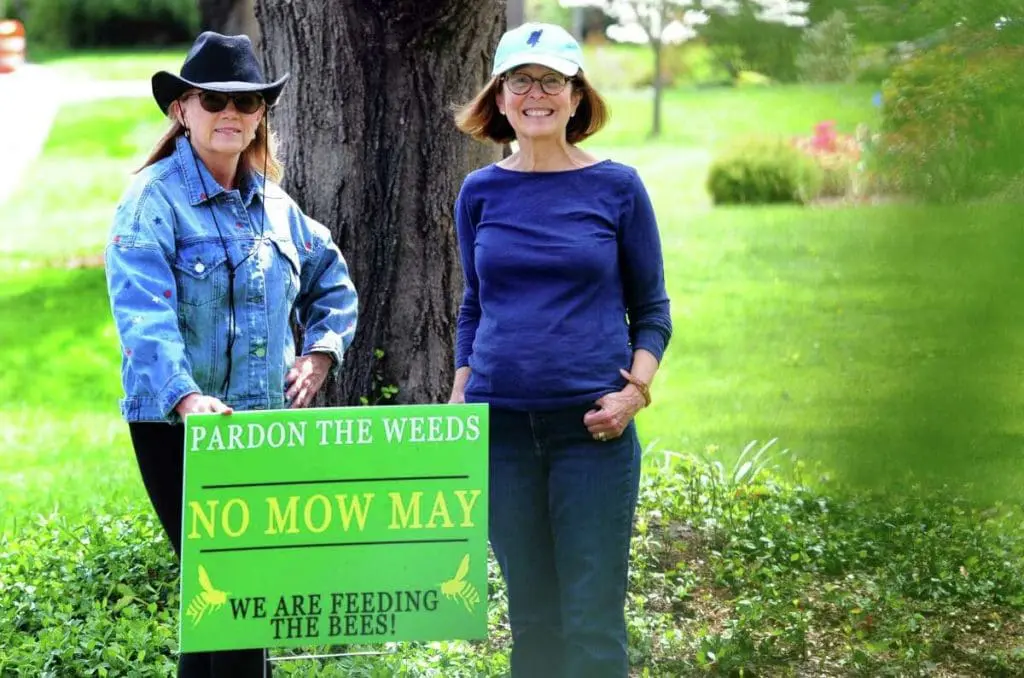
No Mow May, a movement started by Oregon-based Xerces Society for Invertebrate Conservation, encourages homeowners not to mow their lawns throughout May. 

Margie Lavender, who founded Hastings Pollinator Pathway alongside Haven Colgate, Hastings-on-Hudson’s Village naturalist, says No Mow Way is a simple concept to support biodiversity. 

Because of climate change, many pollinators emerge from hibernation earlier in spring. At this time of year, there is very little blooming to provide native bees with nectar and pollen to eat. 

“A mown lawn provides little to nothing of benefit to a pollinator — it’s a pollinator desert,” Lavender explains. “By not mowing until the end of May, we allow dandelions, violets, and other early spring ‘weeds’ to flower, providing much-needed nourishment before the usual abundance of blooms to come in June.”

In a study conducted in Appleton, Wisconsin, researchers found that lawns that participated in No Mow May had five times the number of bees and three times the bee species that mown lawns did. At a time when many pollinating insects, birds, and mammals are facing extinction due to habitat loss, fragmentation, climate change, and pesticide use, this intentional practice is quite important. 

At Hastings Pollinator Pathway, they partnered with Kimi Weart, a graphic designer, to make yard signs so that residents can tell their neighbors that they’re participating this spring.

“We plan for these signs to be reused each year and hope the No Mow May movement is catching [on],” Lavender says.

On their Instagram page, Lavender also shares a post each Friday with food that will no longer exist without pollinators — further encouraging residents to participate in the movement. 

Hoogland says No Mow May provides an additional entry point to spark discussion about broader practices and cultural ideals when it comes to landscaping.

“Should [lawns] be pristine and clean, or is it okay to have a little bit more life and grassy fields?” Hoogland says. 

An industry hesitant to change

There’s no question that the landscaping industry is a big business in Westchester — whether it’s for individual homeowners, golf courses, or municipal properties throughout the county. 

According to Hoogland’s estimates, there are over 2,000 landscaping businesses in the county alone. 

Conversations about more sustainable lawn practices, Hoogland says, invite a lot of aggression from members of the traditional landscaping industry — especially as it relates to local proposals to ban gas-powered leaf blowers. Just this month, a contentious public hearing on the topic of a proposed spring-to-early fall ban took place in Pleasantville.

“[Landscapers] feel offended because they have been doing their thing for many years in a way they’re proud of, so us educating feels like criticizing them,” Hoogland explains, noting that members of Healthy Yards have even received death threats. “There are guys that are so violent and angry.”

Although gas-powered leaf blowers and other emissions-emitting landscaping equipment leave landscapers themselves vulnerable to inhaling unhealthy fumes, Hoogland says many are still hesitant to make changes.

As the No Mow May movement grows, landscapers are also finding new ways to recoup income previously generated from mowing during the month. 

“If they mow later, they will find something else to offer,” Hoogland says. “Pesticide applications are completely rising at this time because these landscapers need an alternative income.”

While Archer agrees that the traditional landscaping industry has many harmful practices, he says homeowners often encourage or engage in bad cultural practices, too such as buying pesticides at hardware stores and applying them indiscriminately to their properties.

“While I’m opposed to traditional landscaping, it’s not the poor landscapers’ fault that this is what people wanted until yesterday,” Archer explains. “There are way more homeowners taking care of their own properties than landscapers, so we have to do outreach both to the industry and to homeowners.”

Lavender says that while her landscaper has been patient and open to exploring the best practices for her property, he has said many clients have an expectation of perfection.

“A client will request that he not use a gas leaf blower but will scoff at paying anything extra for the extra labor of raking,” Lavender says. “Even I have had to reshape my own ideas of what makes a beautiful garden.”

“I heard Kim Eierman say in a lecture once, ‘If your garden is not being eaten, it is not a part of the ecosystem,’” Lavender adds. “Once you really dig in and begin to understand the severity of the crisis and how simple changes in your garden can make tangible change, you see everything differently. A pile of leaves may hold butterfly chrysalis to overwinter, a caterpillar nibbling the parsley will become a Swallowtail or lunch for an American Goldfinch, a patch of bare dirt is where ground-nesting bees will emerge in the spring, and violet is bee food.” 

Among homeowners, Archer says there’s a growing consciousness that we should treat our landscapes as if our lives depend on them because they indeed do. 

“Without bees, we’ll have no flowers, and without flowers, we’ll have no plants. Without plants, we’ll have no food, and then we’ll have no us,” Archer explains. “This is why Pollinator Pathways has been a hugely successful initiative in terms of raising awareness and making changes.”

Archer also works not just to raise awareness but also to give homeowners and members of the landscaping industry the tools to make changes through educational outreach. 

“If you put your resources into the environment with good intentions, you reap benefits from it directly,” Archer underscores. 

Changing tides in the trade 

When asked about emerging trends in sustainable landscaping, Hoogland says she sees a lot of women who have studied horticulture or landscape design working to educate landscapers working on properties, as well as younger people starting to get involved in the industry who offer a type of landscaping business rooted in building biodiversity instead of traditional lawn maintenance. 

Amanda Bayley, CEO, and Co-Founder at Croton-on-Hudson-based Plan it Wild, operates one sustainable landscape company that provides an alternative, Earth-centered approach for clients throughout Westchester.

With a background as a landscape architect focused on nature-driven design and habitat restoration, Bayley saw the suburban yard space as a critical, untapped niche.

“The fossil fuel-driven maintenance and aesthetic of a lawn being a green flowerless carpet is what the landscaping industry has you believe your yard should look like,” Bayley says. “We’re saying native plants and a more wild but still intentionally-looking yard does so much more than a mowed green carpet. That’s why Plan it Wild exists.”

At Plan it Wild, Bayley and her team don’t want to be compared to the traditional landscaping industry because they say they’re doing something completely different. 

“We’re helping not just to expand the biodiversity but also to reduce the carbon footprint, plant [native], and end the use of fossil fuels,” Bayley explains. 

Working with a property owner, Bayley says her team can show their clients what they can do with their yard beyond traditional mowing, blowing, and pesticide spraying.

“That business model is so dependent upon doing it quickly in a very controlled way because that’s how [the industry] makes money,” Bayley adds. “Our priority is biodiversity and doing more with your yard than just mowing it.”

David Baker, vice president of Landscape Operations at Plan it Wild, says the time is right to help homeowners change their thinking.

“A lot of people don’t realize how polluting gas and oil trimmers, blowers, and mowers actually are,” Baker explains. “People see them as smaller and not as destructive as cars, but that’s not really the case with the hydrocarbons they emit.”

According to the United States Environmental Protection Agency (EPA), hour-for-hour gasoline-powered lawn mowers produce 11 times as much pollution as a new car. The EPA estimates that lawn care as a whole produces 13 billion pounds of toxic pollutants per year.

While there are landscapers using electric-powered equipment and designers who build unique landscapes with native plantings and remove invasives, Baker says it typically happens separately. 

“There’s nobody mowing and maintaining your property, as well as doing 100 percent native planting,” Baker explains. “We’re unique in that bucket.”

Archer says that what his company is doing, as well as Bayley’s team at Plan it Wild, aren’t as common.

“Amanda and I represent a small but growing market in ecological design development,” Archer says. “People who reach out and hire us, they want what we offer.” 

Bayley says that while ecological concepts can be complicated, she’s trying to synthesize best practices and show homeowners how to apply them to the American yard. 

Things like repurposing leaf litter instead of discarding it as yard waste, planting native, and removing invasive species all have value, and Bayley’s team is working to show their clients the many ways their yard can better support biodiversity and combat climate change. 

While Bayley and Baker say it remains discouraging to see so many property owners and contractors throughout Westchester continue to use pesticides, mow incessantly, and use fossil-fuel-powered machinery, being able to change the minds and practices of some is most gratifying.

“Some people don’t care, and it’s exhausting. Then others do, they pay for our services to do it, tell their neighbors, and then their neighbors call us because they’re like ‘They’re thinking in a different way,’” Baker explains. “That’s by far the most rewarding.”


Filed Under: Ecological Education Tagged With: biodiversity, eco-friendly gardening, eco-friendly landscaping, ecological landscape design, ecological landscaping, examiner plus, feature, habitat garden, healthy yard, landscape designer, landscape ecologist, local news, native plant garden, natural landscaping, no mow may, organic garden, organic gardens, organic landscape, pollinator garden, pollinator habitat, pollinator pathway, press, rye NY, Westchester county landscape design, Westchester County NY

In at least five states in the country, a movement to protect native bees by refraining from mowing lawns for the month of May is gaining momentum. The movement started in Britain in 2019, and in Wisconsin in 2020. A New York Times feature this year about Wisconsin’s program brought attention to the matter and several states including in Connecticut adopted their own No Mow May programs.  Two researchers at Wisconsin’s Lawrence University studied the lawns of 435 participants and found that the unmowed lawns had three times the number of species and five times the total number of bees as did mowed parks. 

Photo by Christian Abraham / Hearst Connecticut Media. Two residents of West Hartford lead their communities No Mow May effort.

No Mow May Benefits

The concept is simple: stop mowing lawns for the entire month of May to allow “weeds” such as dandelion, clover and violet to emerge and provide a food source for bees at a time of year when pollen and nectar sources are limited.

No doubt, there are benefits here. In spring, there are limited native flowering options (compared to summer) and most of the spring flowering landscape plants used in the landscape are not native and also not popular with pollinators.  (think forsythia, cherry trees, pear trees, most azaleas, and rhododendrons, nearly all bulbs.) Dandelion and clover are both native to Europe, however they are still often visited by pollinators. Both plants have the added benefit of improving the soil. Dandelions have a deep taproot that brings up minerals from deeper soil strata, improving the A soil horizon for the surrounding plants. Clover is in the pea / legume family and is a nitrogen fixer. There is a native species of violet, Viola soraria or Common Blue Violet. It is a host plant for the Great Spangled Fritillary and a food source for many insects and pollinators. 

Not a Historically a Prairie 

While this is an admirable grassroots effort, a month-long solution will not initiate meaningful change in our declining bee and insect populations.  Insects need habitat and food throughout the growing season (spring – fall) to survive. While these early season lawn weeds are food sources for pollinators, they will not sustain them for the season, particularly if these sources disappear after four weeks.

Also, your lawn is not likely to bounce back to a lush turf after a month of not mowing it. Some turf seeds will have been shaded by taller plants and you will have many patches of “weed” foliage to repair. Be aware that 18” grasses are perfect tick questing habitat, so avoid walking through these areas. 

Furthermore, in the Midwest and the the souteast the predominant historical ecosystem was prairies. Much of the seedbank consists of these classic prairies wildflowers and grasses. In the northeast, we are predominantly a forest ecosystem. Untouched landscapes eventually revert to forests.

 If you like the concept of No Mow May, consider implementing these principals in conjunction for a more impactful landscape.

Organic First!

While lawns are a resource-intensive monoculture, the core problem is the mainstream use of synthetic fertilizers and pesticides to maintain massive spreads of lawn. If you are using synthetics, your soil is virtually sterile of any soil microbiology. Soil microbes are essential to our health (our gut bacteria evolved alongside it!), the stable storage of CO2 from the atmosphere in the soil, and to thriving plants with strong immune systems. Synthetic lawn chemicals also threaten our waterways and aquatic ecosystems through stormwater runoff. If you are considering making one ecological change in your lawn, taking it organic is far more impactful!

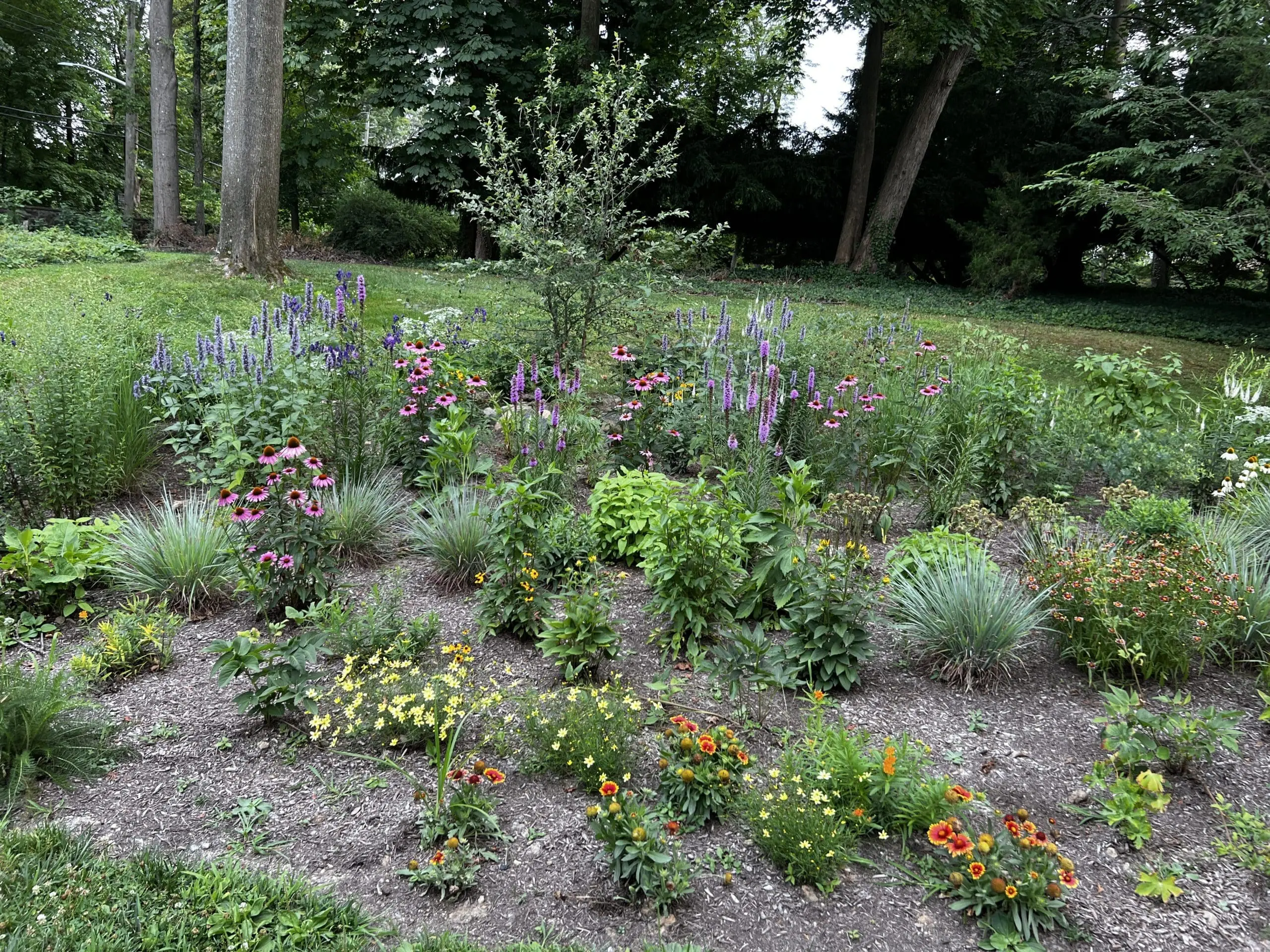
Front lawn converted to a habitat garden in Mamaroneck, NY.

Reduce Your Lawn Area

After going organic, the next most impactful step you can have toward making your lawn more ecological is…reducing the size of it. Yep, we said it. Any and every type of organic garden is more ecologically beneficial than a resource and maintenance-intensive turf monoculture. Biodiversity is critical to a healthy ecosystem that supports many species, both specialists and generalists. Some staggering statistics: one in four native bees are endangered or threatened; 40% of global insect populations are in decline; North American bird populations have declined by 3 billion birds in the last fifty years. These critical species, the foundation of crop pollination and ecosystem food webs, need our help! Consider planting a sunny pollinator garden or a native woodland garden, depending on your site conditions. A rain garden is another excellent replacement for lawn that can help absorb stormwater and provide habitat.

June Lawn Tips

When you do decide to mow again, make sure you are mulch mowing at 3 ½ – 4” high! Mulch mowing returns grass clippings to the soil, reducing the need for fertilizer inputs. Mowingat a greater height encourages more root development, making for a more resilient turf that can access more resources.

Contact us to discuss your landscape design project or schedule a consultation.

Filed Under: Ecological Education Tagged With: ecological landscape design, ecological landscaping, healthy yard, landscape design master plan, landscape designer, landscape ecologist, native landscape, native plant garden, natural landscaping, no mow may, organic garden, organic landscape, organic lawn, pollinator garden, reduce your lawn area

  • « Go to Previous Page
  • Page 1
  • Interim pages omitted …
  • Page 9
  • Page 10
  • Page 11
  • Page 12
  • Page 13
  • Interim pages omitted …
  • Page 61
  • Go to Next Page »

Footer

Shop Address: 369 Bradhurst Ave, Hawthorne, NY 10532
(914) 560-6570
  • Facebook
  • Instagram
  • LinkedIn
  • Pinterest
  • YouTube
  • Houzz
  • Slide Share
  • Installation
  • Portfolio
  • Pricing
  • About
  • Contact

Copyright © 2026 · Green Jay Landscape Design. All Rights Reserved · Privacy Policy · Website and Local SEO by Ramblin Jackson