• Skip to main content
  • Skip to footer
Green Jay Landscape Design

Green Jay Landscape Design

Green Jay Landscape Design

(914) 560-6570
  • Design
  • Installation
  • Portfolio
  • Pricing
  • About
    • Service Area
    • Meet Our Team
    • Our Process
    • Our Promise
    • Mission, Vision, & Core Values
    • FAQ
    • Press & Events
    • Blog
    • Reviews
    • Careers
    • Affiliations
  • Contact

greenjayadmin

Your permaculture terrace garden landscape will serve as an invitation to life…for all living beings great and small…plant, animal and mineral. The natural beauty and mystery of life, manifest in its many glorious forms and permutations, will inhabit your biosphere. 

From the primal source of rich organic and mineral matter complete with fungi and bacteria as well as all the possibilities and resources for life, we will create the optimum habitat to nourish the nature of your living green, flowering and fruiting plants throughout the seasons of your life.

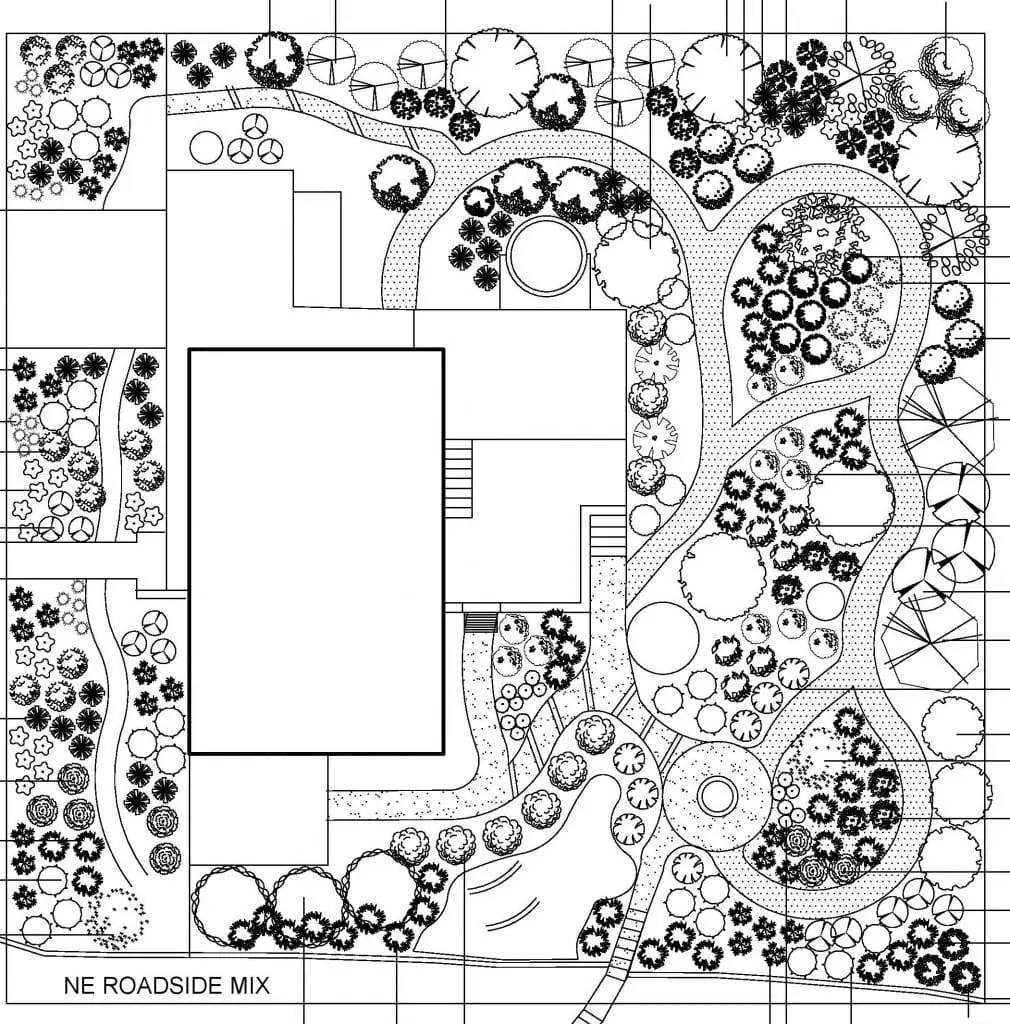
Jay Archer’s design concepts (above) start with big and bold goals: creating the conditions and habitat for life—in all its forms—to exist and THRIVE!

Rich results on Google's SERP for 'permaculture design plan'
Plan view of the new landscape design for permaculture gardens and walkways, all to be reinforced for erosion control.

Permaculture Theory

Such a perspective aligns with the overall theory and framework of permaculture: that every living thing, no matter how small, plays a role in the health and functioning of our ecosystem. We are all interconnected and dependent upon a healthy and thriving ecosystem, and permaculture prescribes a holistic view of designing and creating with nature in a way that respects every plant, animal and microbe. As Jay says, first, we do no harm.

This framework permeated every aspect of the landscape design and installation. We used only natural-source products — yes they are organic, and toxin free, but equally important, they are either recyclable or can be repurposed in years to come. None of the materials we brought onto the landscape will end up in a landfill.

The landscape installation itself was entirely “quiet” — no power tools were used whatsoever! Given what we now know about high decibel sounds effect on our blood pressure and mental health, we always prefer to do quiet landscaping whenever possible!

Applying Permaculture to Landscape Design 

Permaculture theory is often applied toward making more productive landscapes– both ecologically and as a means of nourishing ourselves. Permaculture foodscapes often implement edible perennials, fruiting trees and shrubs, and perennial culinary and medicinal herbs.

Successful food gardens require healthy populations of pollinators and beneficial insects, thus, permaculture also strives to create habitat for pollinators.  

Human and animal foodscapes were certainly design goals for this Hasting-on-Hudson, NY property: 

The energized exchange and interaction between diverse species populations will continually produce beautiful food, organically grown.

permaculture plants
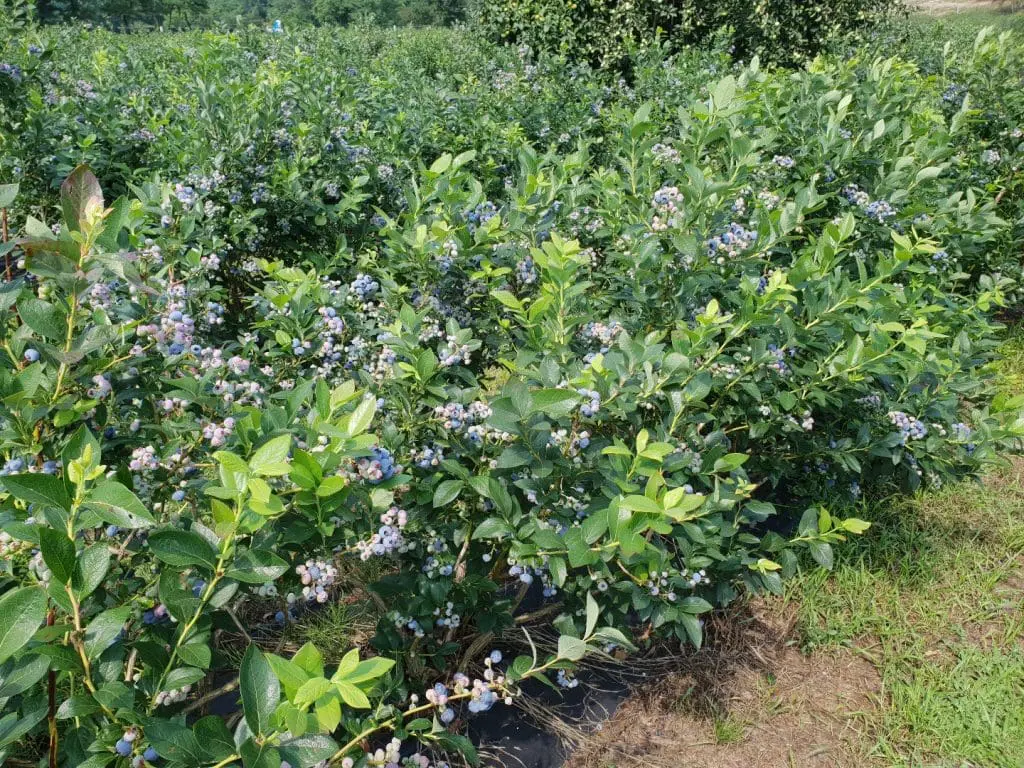
A row of native blueberries! Beautiful, edible, organic — perfect for the permaculture garden!

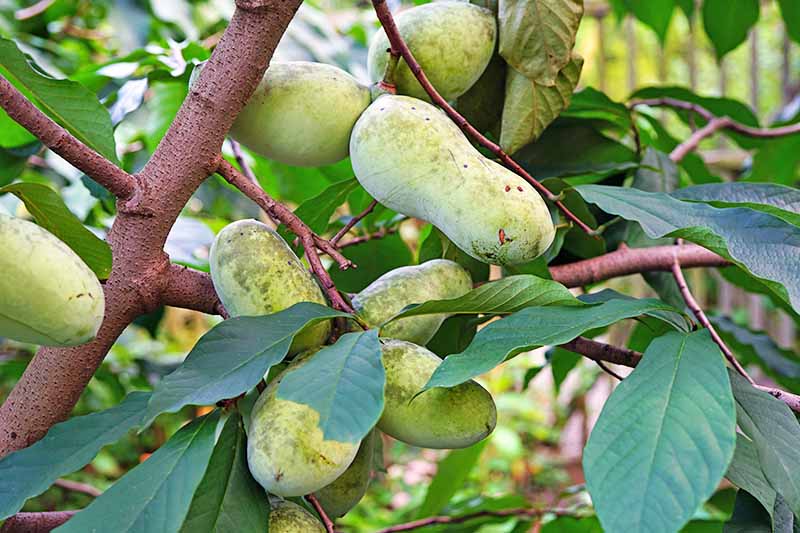
This landscape features* edibles including: Blueberry (native!), Redcurrant, Blackcurrant, Plum, Pawpaws (native!), Peaches and Goumi. 

Fruiting Pawpaw tree — native to the Eastern US and edible.
Native Aronia, flowering and fruiting! The shrub’s berries are an important fall and winter food source for birds.

Medicinal and culinary herbs planted include: thyme, mint and natives Echinacea, yarrow, and goldenrod. 

Rich results on Google's SERP for 'native pollinator plants'
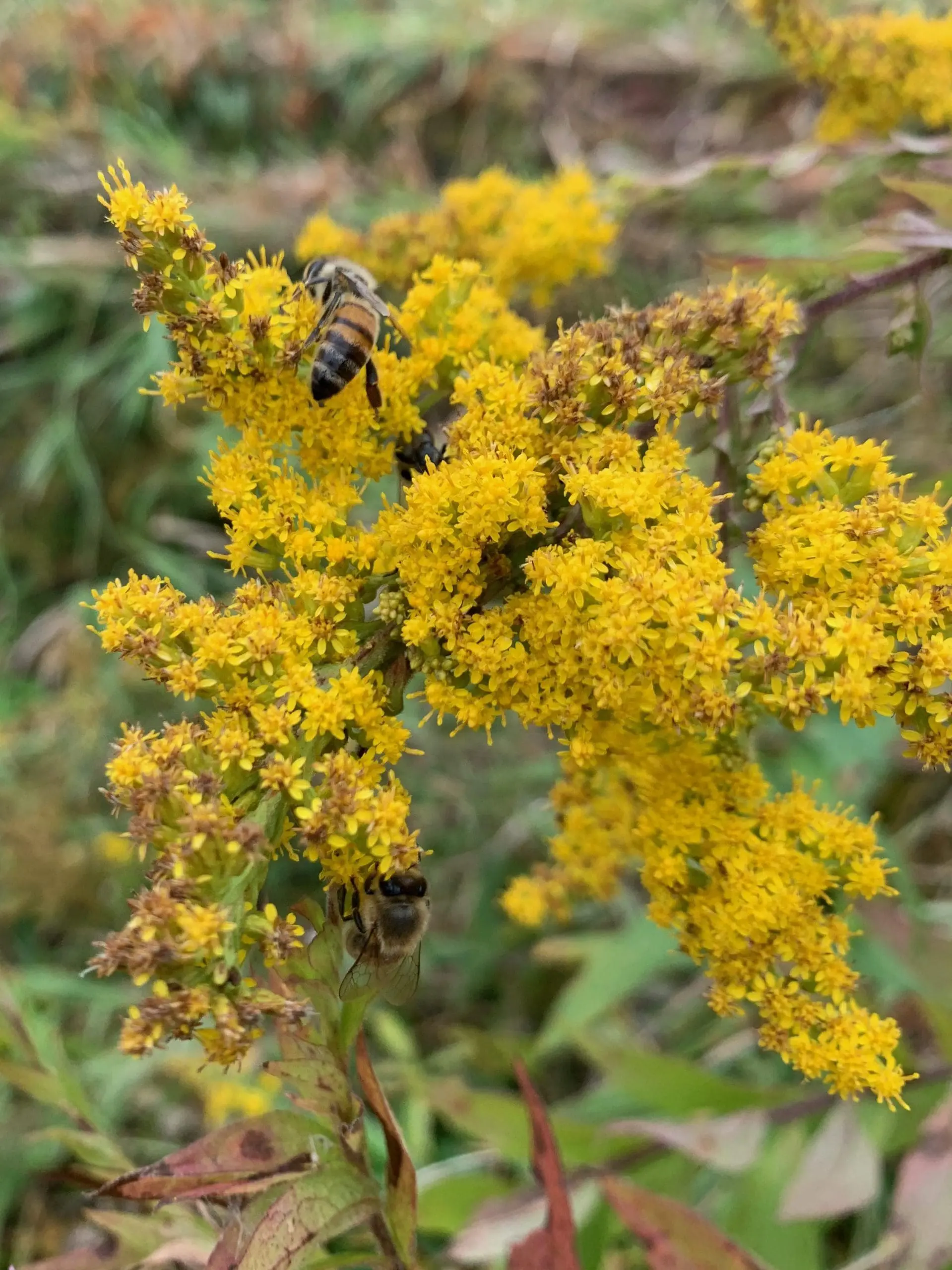
Bees enjoying native Goldenrod, which also functions as a medicinal herb

*Note: fruit trees are dug up in the spring and are thus only available at nurseries then; they will be planted in Spring 2021.

Why Perennial Edibles are Superior to Annuals

Permaculture is not a native-only design perspective.  Many of these edibles are non-native, however they still attract many pollinators. By incorporating edible perennials, trees and shrubs, instead of relying solely on annuals, we are taking advantage of other plant characteristics as well.  

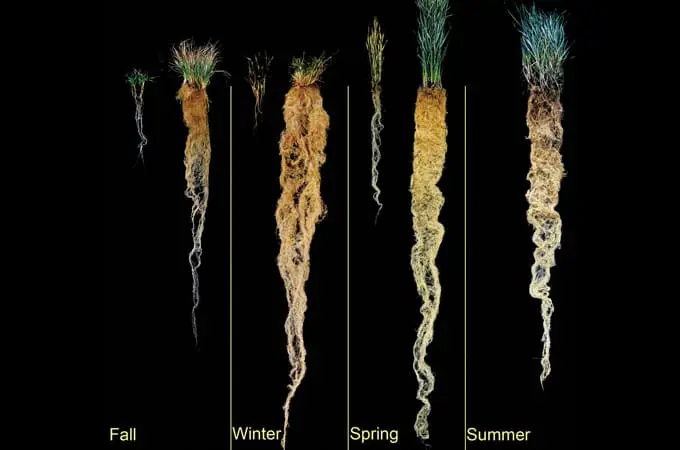
For example, perennials have a deeper root system than annuals, better stabilizing the soil and preventing against erosion.  As the root systems develop over the years, they improve soil structure by creating pathways for water, air and nutrients; these pathways also reduce soil compaction. 

Annual Grain Root Systems vs. Perennial Grain Root Systems.
Photo by: Carbon Cycle Institute.

Perennials are able to uptake nutrients from deeper in the soil strata than annuals are, thereby providing greater nutrient cycling for all the plants and soil microbes in the microclimate. 

terraces for erosion control

Of course if we only ate perennial edibles we would deprive ourselves of many tasty and nutritious fruits and vegetables. This project also included a more traditional organic vegetable garden of annuals.  However, the permaculture theory of making every landscape productive, enriching the soil and designing to nourish both humans and wildlife alike, permeated every aspect of this design.

Designing Organic Habitats

The peaceful harmony and coexistence of beneficial species in great biological diversity provide the highest value in ecosystem services. Day to day, the song of the birds, music of the bees and insects produce a symphony composed by nature, forever free of sour notes and pests unknown to true indigenous environments.

Promoting biodiversity and designing habitats for the permaculture landscape necessitates that the landscape be entirely toxin-free.  All of GJL’s landscapes are maintained using NOFA Organic Land Care principals.  We simply cannot plant plants to attract critical pollinators, only to have them poisoned upon pollination! Organic is the only way!

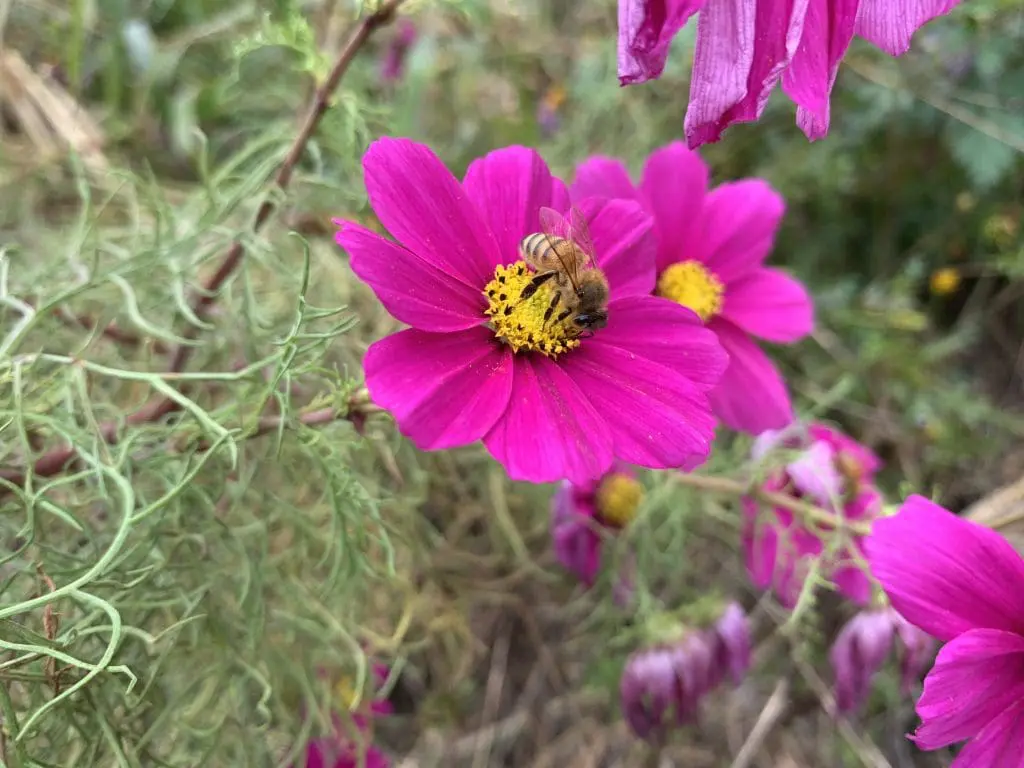
Bee feeding from a cosmo, non-native but beneficial for pollinators!

This permaculture landscape is a welcoming habitat for our critical pollinators and beneficial insects that not only pollinate many of our essential food crops and ornamental plants, but are also the foundation of the food chain for birds and other wildlife.  Without insects our landscapes would suffer immeasurable harm – they are worth protecting! 

Permaculture Design as an Environmental Solution

 Living in the era of the Anthropocene, this living machine (your permaculture landscape) will act as an antidote to the myriad of negative human impacts actively affecting our health, the health of our environment and ultimately the health of this place we inhabit…our Earth…our Mother. 

Another element of Permaculture design theory is designing with “stacked functions.” That means choosing and designing with plants to achieve multiple ecological services within one landscape. 

Northern Sea Oats (Chasmanthium latifolium) is a native ecological superstar!

For example, Northern Sea Oats is a native ornamental grass we planted.  Its seed heads provide late-season food for birds, it is a host plant for number of moths, skippers and butterfly larvae, and its leaves are a great nesting material for birds as well.  It is deep-rooted and its natural habitat is along stream banks, making it a great choice for erosion control projects such as this one.  

Rich results of Google's SERP for 'permaculture garden'
Young green Northern Sea Oats (Chasmanthium latifolium) plants in the terrace garden. These deep-rooted grasses are particularly able at erosion control on slopes.

Deep-rooted grasses are also fabulous at sequestering carbon and storing it in the soil (while woody plants like trees store carbon in their biomass).  This landscape, with its diversity of deep-rooted grasses, trees, shrubs and perennials (and no lawn!) is on-track to becoming a carbon net-positive landscape! 

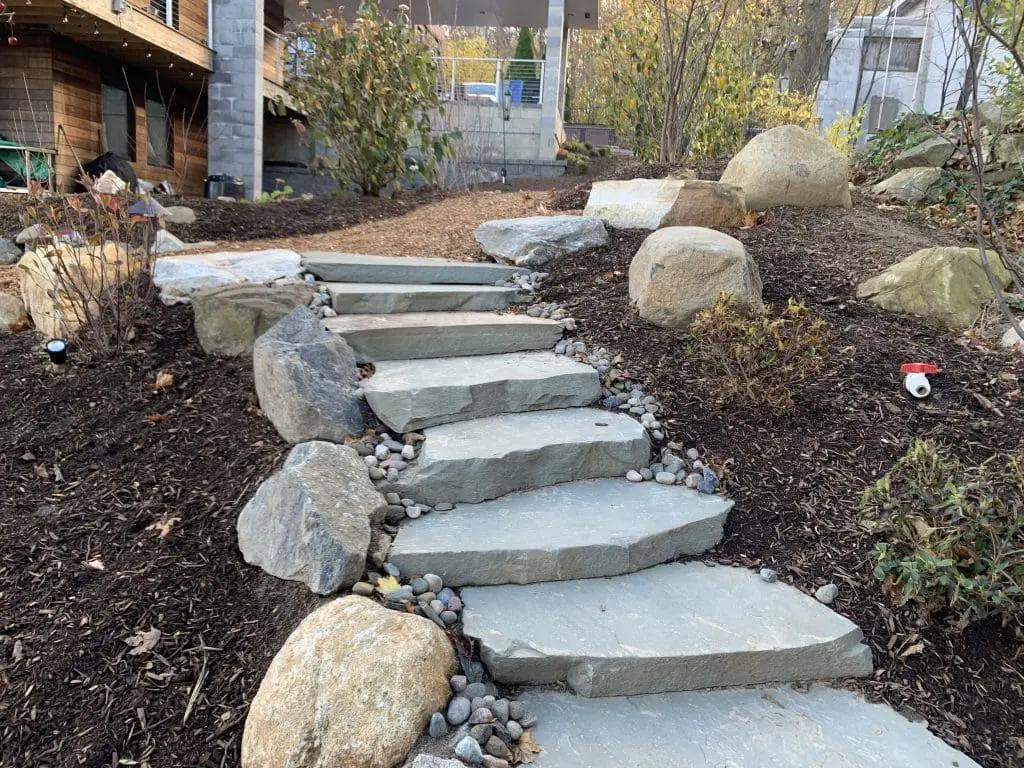
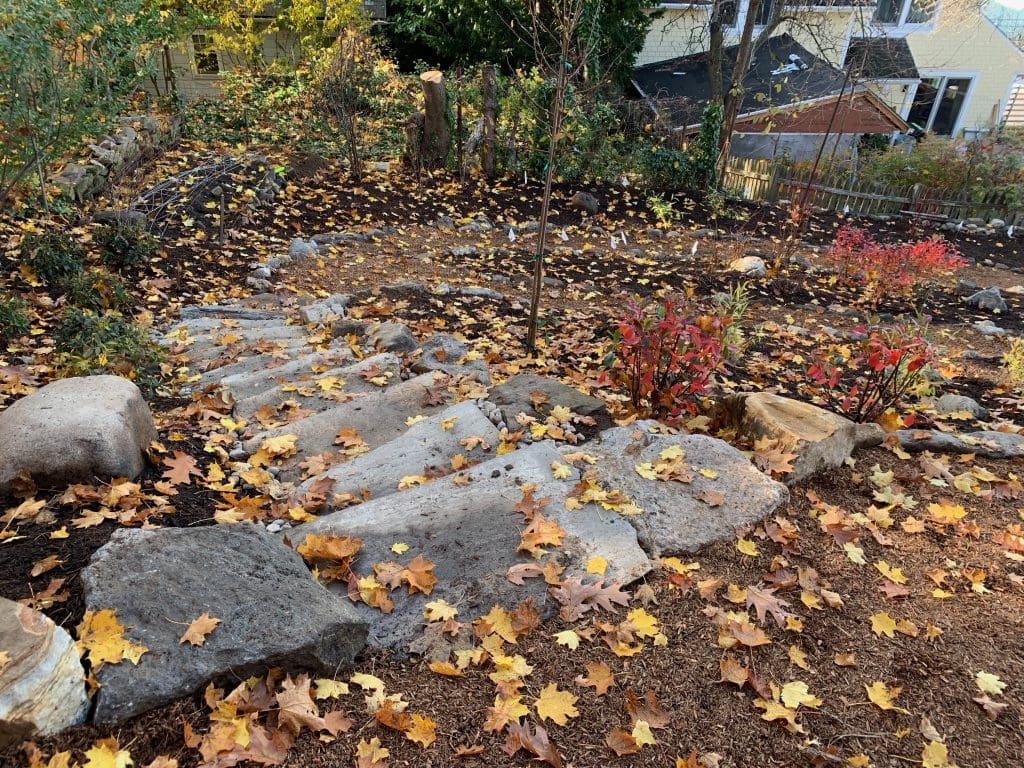
Natural stone staircase down to lower walkways that meander through the garden.

With a smartly designed permaculture landscape, we can solve many of our present day environmental problems: ballooning GHG emissions, polluted air and water, eroded and deficient soil, food deserts, declining pollinator and wildlife habitat… every permaculture landscape can be part of the solution! 

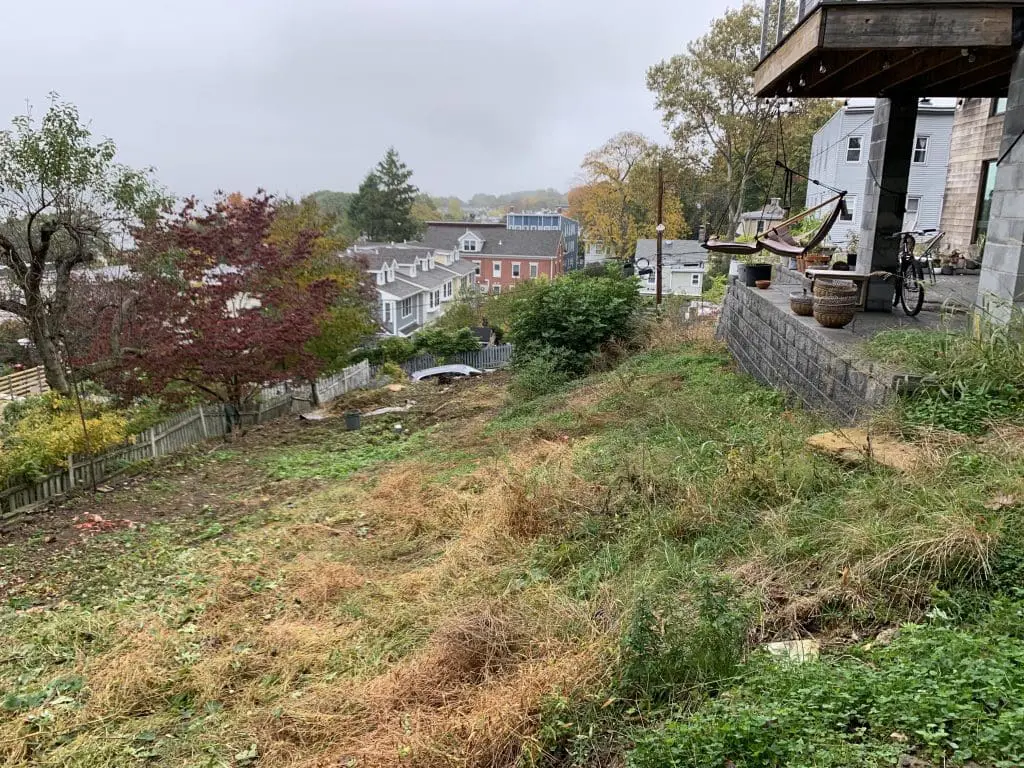
BEFORE PHOTO: this steep slope in Hastings was susceptible to erosion and lacked any aesthetic design.

Designing for Erosion Control and Soil Conservation

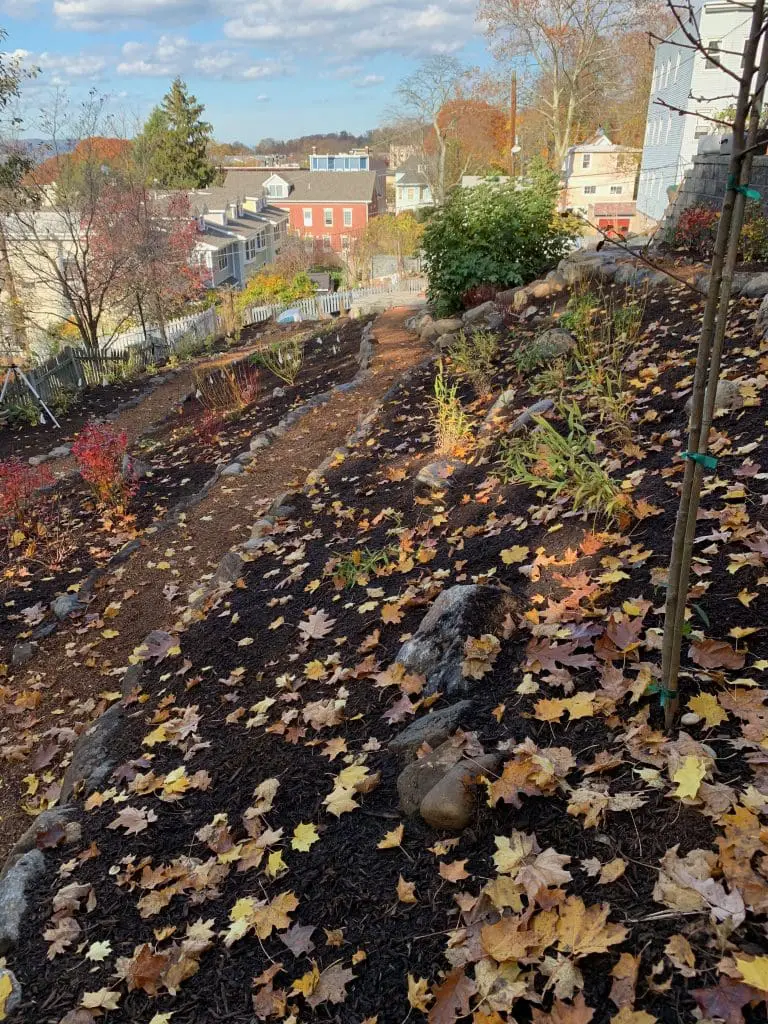
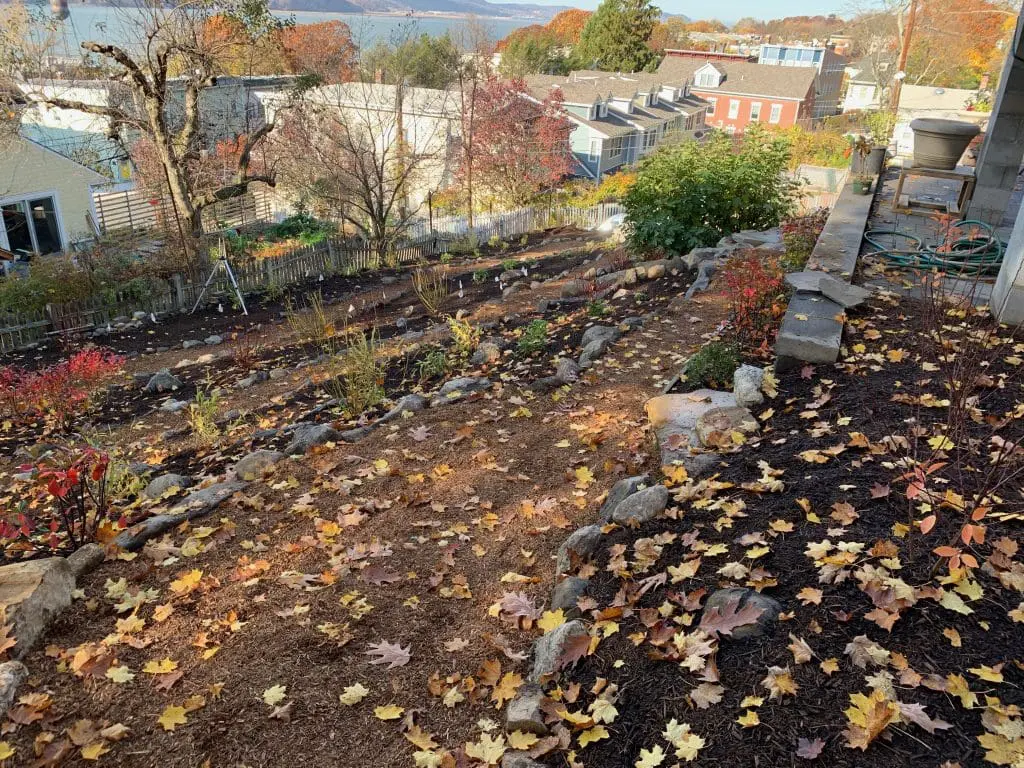
This site is a steep slope in Hastings-on-Hudson, New York, a town within Westchester County.  Existing vegetation included many invasive ‘weeds’ that were removed by hand. Jay designed a series of terraced gardens and walkways, manipulating and reinforcing the new grades to capture stormwater and prevent erosion. 

Terraced garden beds (partially planted) and garden pathways designed for erosion control.

Gently cascading topography with gentle paths and terraces will support and sustain your individual, unique plant communities.

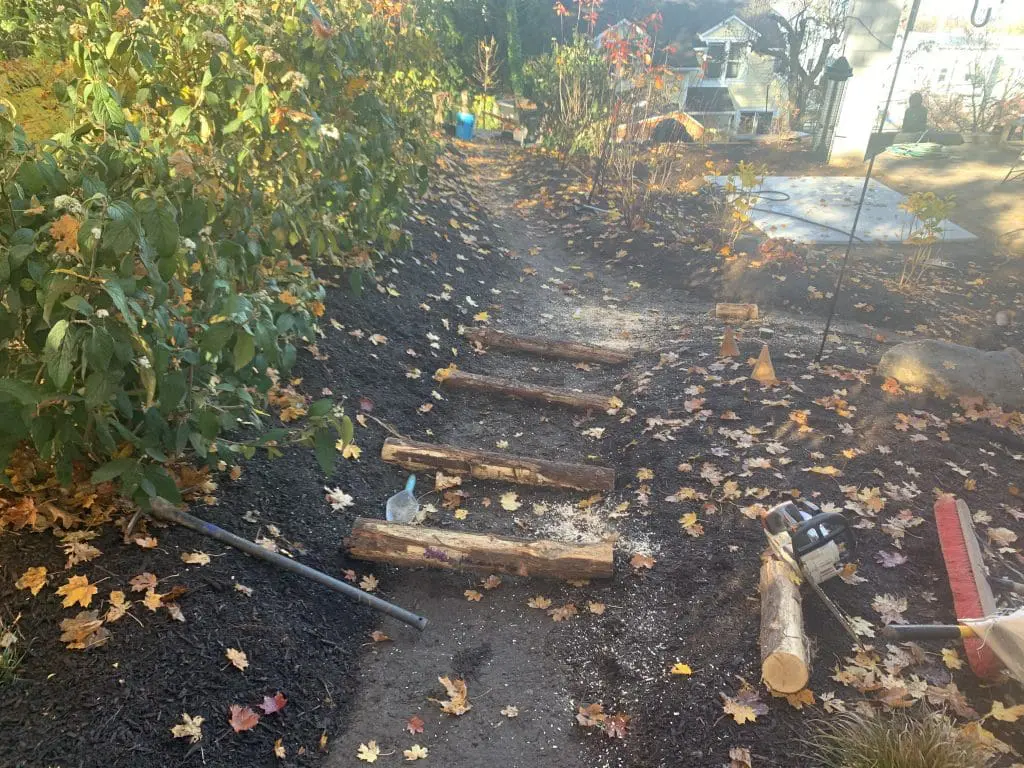
Installation of erosion control devices — cedar logs — to help retain and conserve the soil.

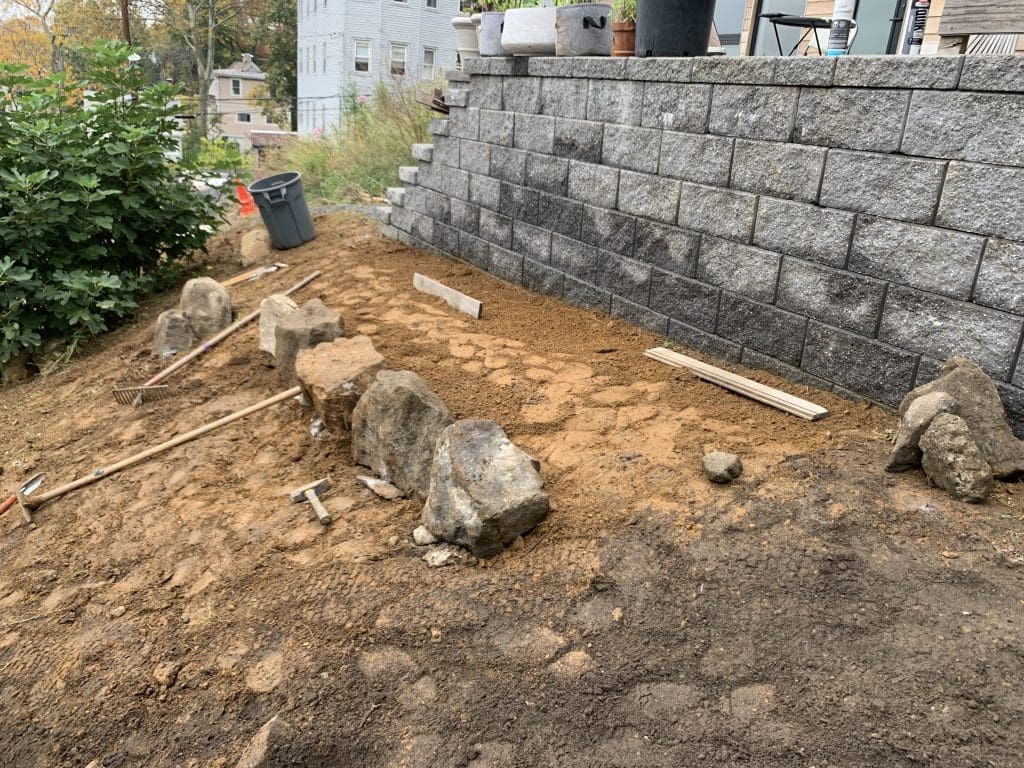
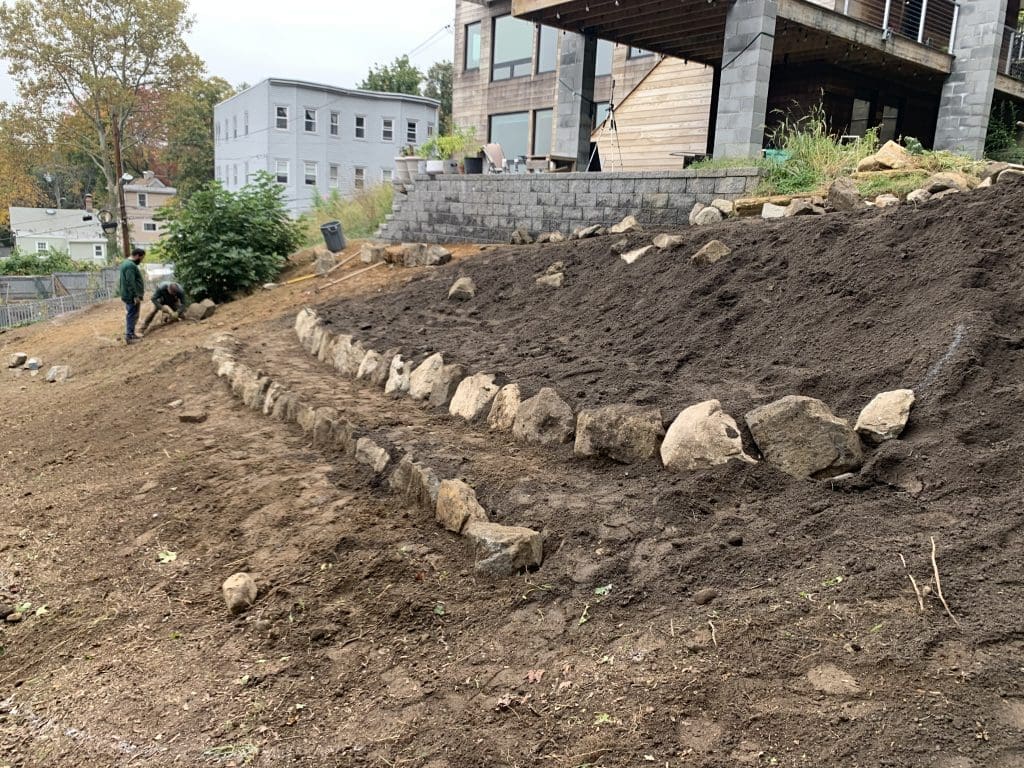
Erosion control devices included placing cedar bark logs diagonally across the walkways, and backfilling with mulch to help slow down and allow water to infiltrate. The terraces were formed with twenty yards of boulders and rip rap (smaller sized stones) and filtrex socks.  Plants were installed through Jute biodegradable natural coconut fiber netting.  

Boulder installation to form new permaculture garden beds that resist erosion through storm events.
Terrace infrastructure: sweeping boulders form the terrace gardens (top), and boulder-lined garden path below.
GJL crew installs filter fabric before filling the pathways with playground mulch; to the right, completed natural stone staircase leads to lower pathways.

The pathways were finished with certified playground mulch to contrast with the dark hardwood mulch on the garden beds.  The pathways are lined with small fist-sized stones. 

Finished view. Using different color mulches helps differentiate visually between garden beds and walkways.

The result is a naturalistic, productive and thriving permaculture garden that can withstand our ever-more frequent storm events, allowing for soil and water conservation.  

May you breathe deeply the fresh, clean air, the sweet fragrance of Providence as nature intended.  

For the good of your children and your children’s children.

May you live in serene peace and happiness, now and always!

Jay Archer

Landscape Ecologist, Designer

Green Jay Landscape Design

914-560-6570

Filed Under: Landscape Construction & Installation, Landscape Design Tagged With: bird habitat, boulders, butterfly garden, edible garden, erosion control, erosion control devices, erosion control plan, erosion prevention, filtrex, food forest, foodscape, habitat, habitat garden, Hastings on hudson, Hastings on Hudson NY, hillside garden, jutte netting, landscape construction, landscape design, landscape designer, lawn replacement, masonry, natural stone, natural stone masonry, orchard, organic garden, organic habitat, perennial edibles, permaculture, permaculture design, permaculture designer, permaculture garden, permaculture theory, pollinator garden, pollinator habitat, quiet landscape installation, quiet landscaping, steep slope garden, terrace garden

How does the landscape design process start? For Green Jay Landscape Design, we have two initial options: a free 15-minute discovery call or a paid, 2-hour, on-site landscape design consultation with designer Jay Archer himself.

This video explores all the factors that go into an ecological landscape design consultation and ultimately culminate in the landscape design concept, proposal, master plan and work estimates. Jay evaluates the soil, lighting and moisture conditions, as well as the clients’ lifestyle, architectural style and goals for outdoor living.

Each project has its own unique set of design goals and sources of inspiration. Depending on the scope and scale of the project, it may require permitting, design plan renderings, Architectural Review Board meetings, construction details and more.

Start your ecological landscape design project now with a landscape design consultation. Call Green Jay Landscape Design to schedule (914-560-6570) or submit a contact form.

Filed Under: Landscape Design Tagged With: autoCAD landscape plan, design concept, design plan, design planning, Dynascape Landscape plan, landscape consultation, landscape consulting, landscape design consultation, landscape design master plan, landscape design plan, landscape designer, landscape proposal, landscape renderings, landscaping consultation, on-site consultation, professional consultation, residential landscaping

Collaboration divides the tasks and multiplies the successes. The saying certainly rings true for this three-way collaboration project between Green Jay Landscape Design, Wilder Designs, and Rock Shelter, featuring native gardens, an organic lawn installation, hardscape and carpentry work.

The landscape design and construction project in Larchmont, NY was designed by Nantucket-based Rita ­­­Higgins of Wilder Designs. Rita’s ecologically-based company produces stunning natural designs, specializing in meadows, and we have long-admired her work. 

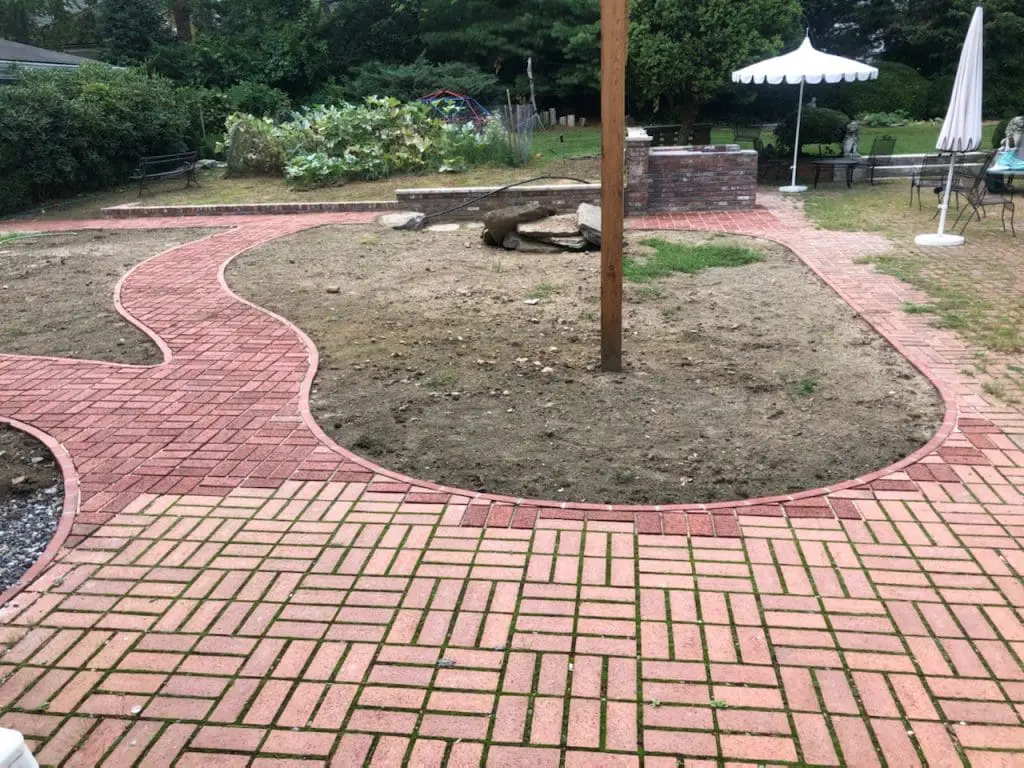
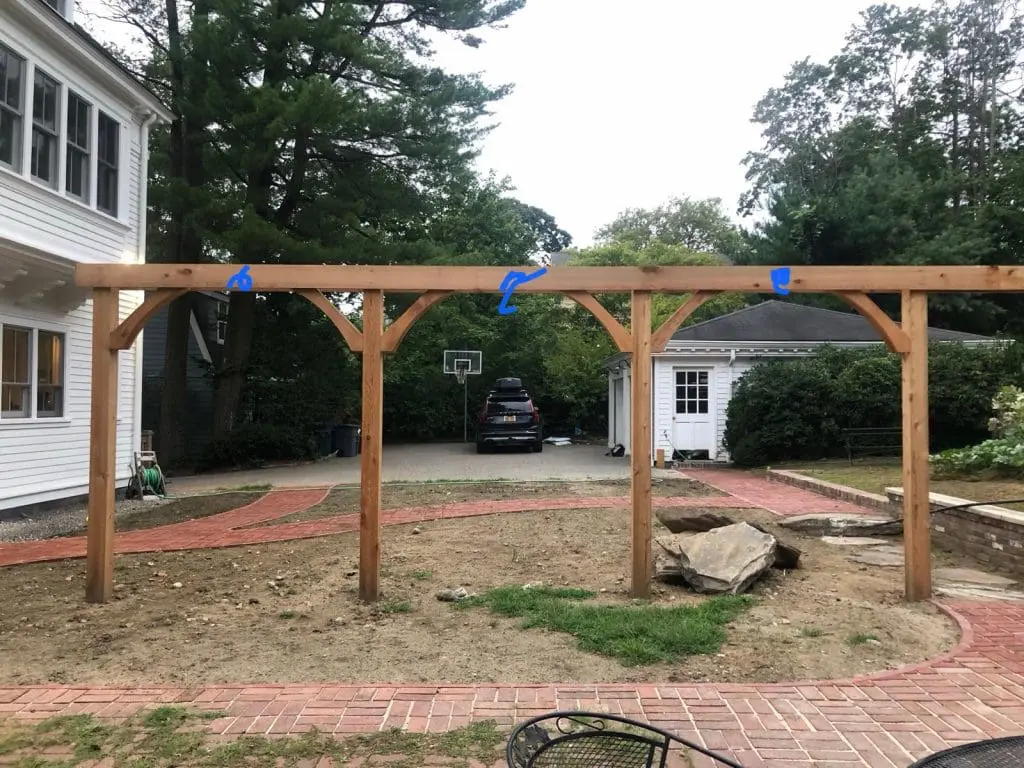
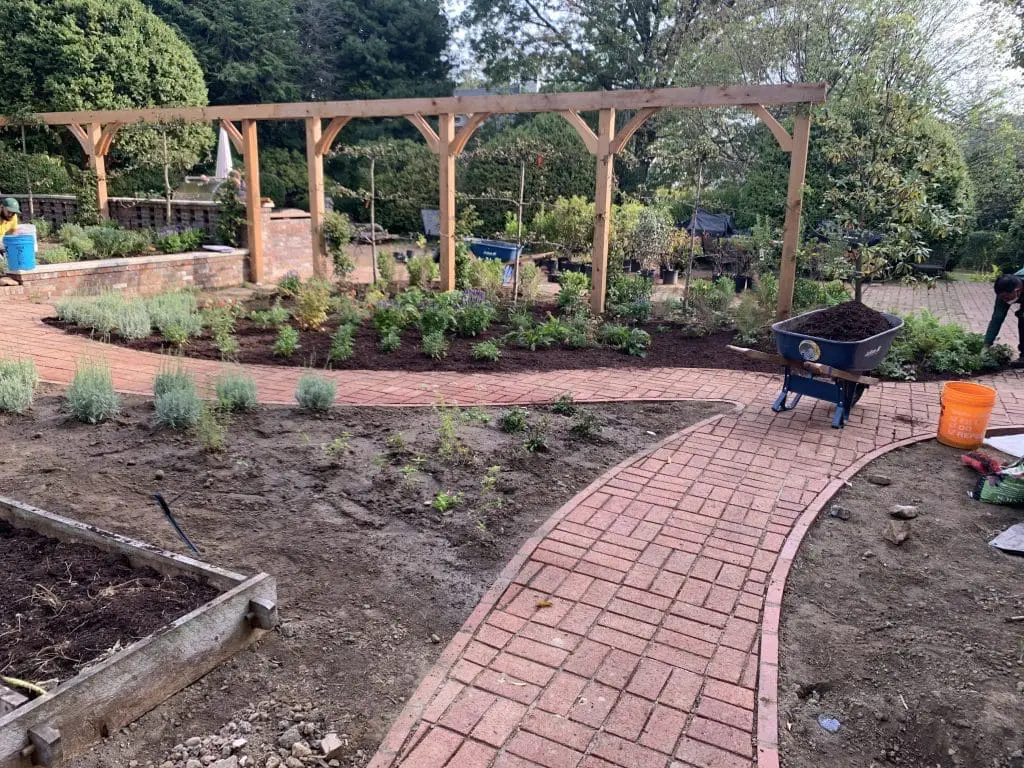
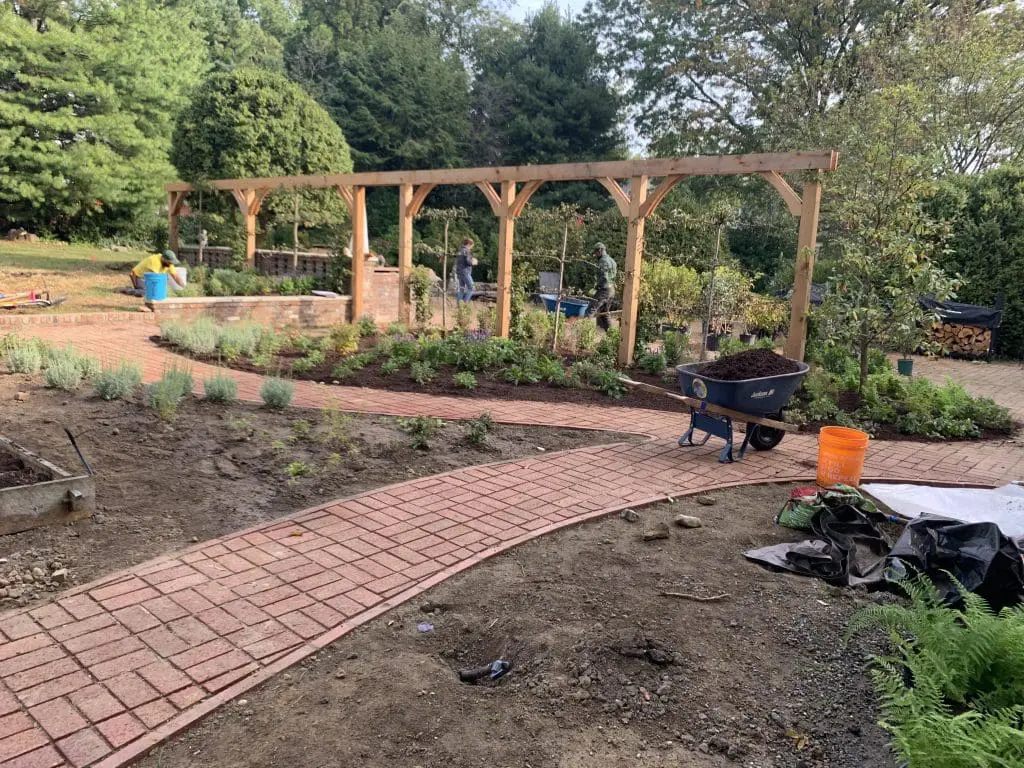
Rita’s design for this residential Larchmont property featured meandering brick walkways and trellises to support espaliered pear trees, all underplanted with native gardens. The design also involved lifting and grading an area to support an organic lawn playing field.  

Brick work completed by Rock Shelter.

Rock Shelter completed the masonry and carpentry work, while Green Jay Landscape Design installed the softscape: native plant gardens and the lifted and leveled organic lawn. 

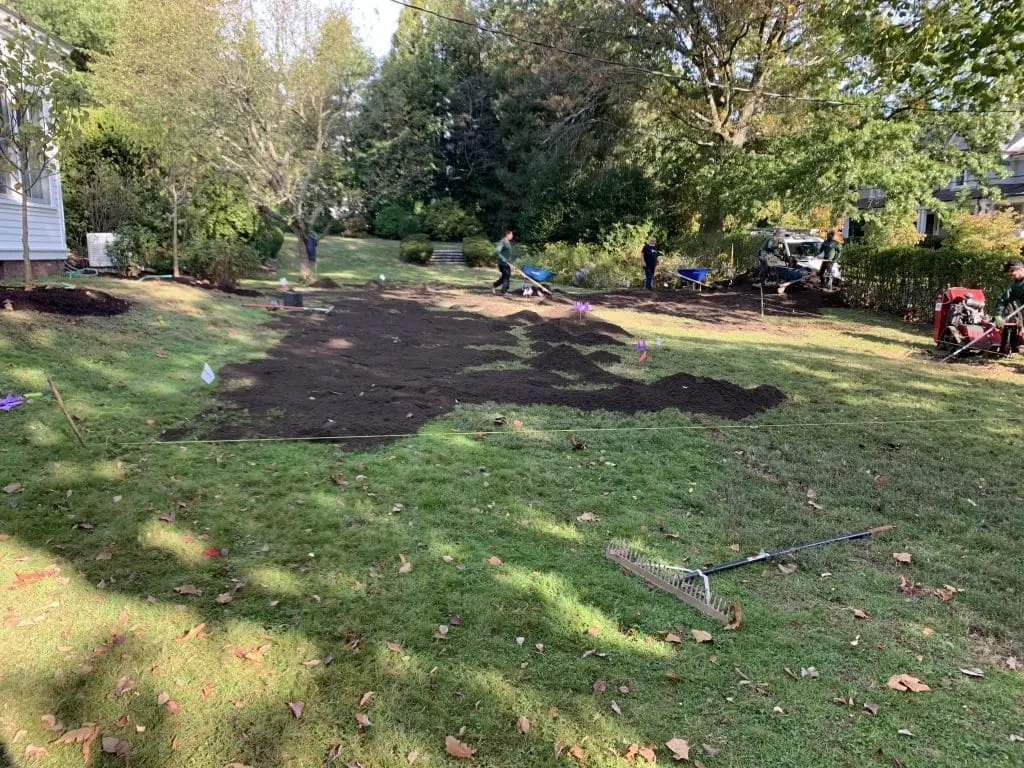
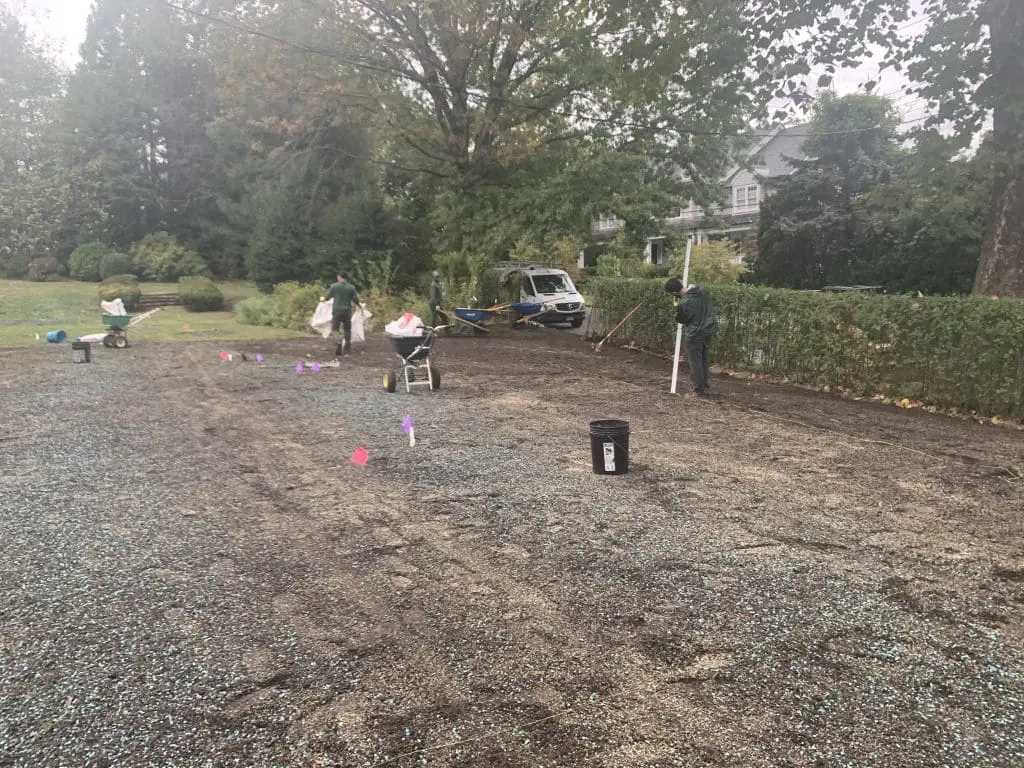
The client necessitated a level playing field for an important function: a temporary ice-skating rink (25’x50’) for her children in winter, and a ball field the rest of year. Most areas in nature are not perfectly level.  This particular field required 80 yards of topsoil to achieve the necessary lift and uniformity for the skating rink.  

Jay grades the new soil as part of the organic lawn playing field installation.

Green Jay Landscape Design graded the screened, premium topsoil to the desired effect, and seeded for a 100% organic lawn. 

Seeding the new lifted and leveled organic lawn — perfect for a skating rink or soccer game!

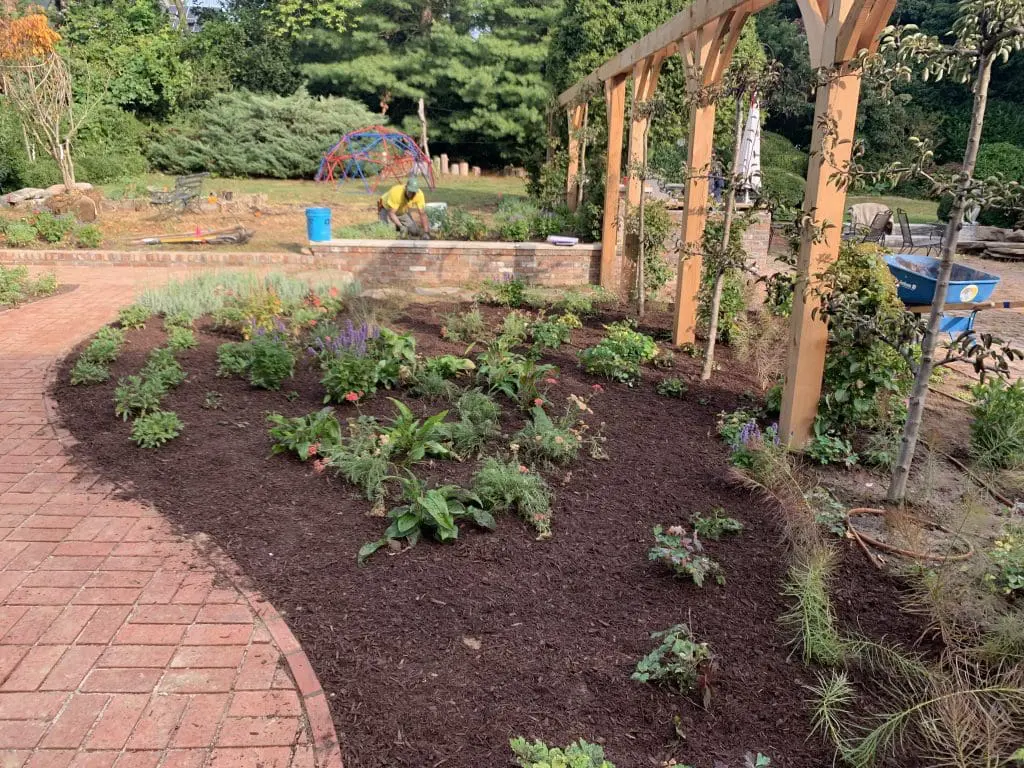
All of the gardens were amended with organic compost, biochar, and pH modifiers where necessary (ie Mountain Laurel prefers acidic conditions).

Mulching the native plant garden beneath the trellises.
Process shot of the native underplanting garden — designed to attract pollinators and birds!

The gardens featured many native plant superstars including:

Mountain Laurel Kalmia latifolia– An evergreen, flowering shrub native to the Eastern – Mid Western US, Mountain Laurel is a fabulous garden choice.  In spring / early summer the shrub explodes in bowl-like fused petal flowers that are often visited by native pollinators. 

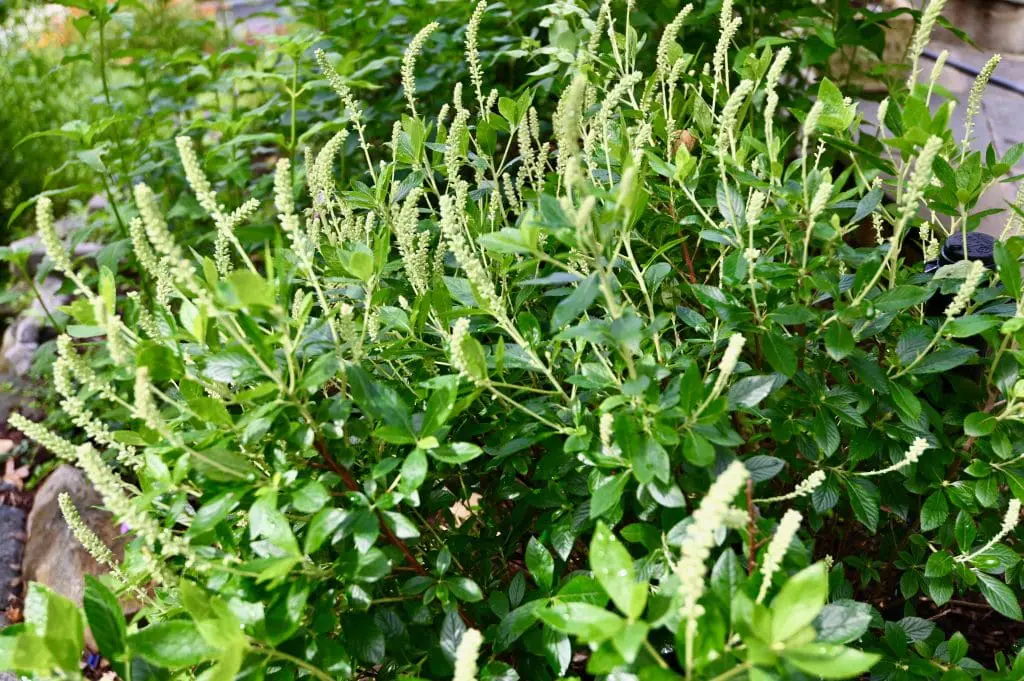
Clethra ‘Ruby Spice’ has a beautiful color and is a favorite of bees!

Summersweet Clethra – Sweet smelling clethra, with its glossy foliage and range of cultivars including ‘Hummingbird’ and the pink flowered ‘Ruby Spice’.  This native shrub is always covered in bees and is even visited by hummingbirds!  

Clethra ‘Sixteen Candles’ has a wonderful scent and lovely glossy foliage.
Native plant gardens are amended with organic compost, biochar and other amendments as required.

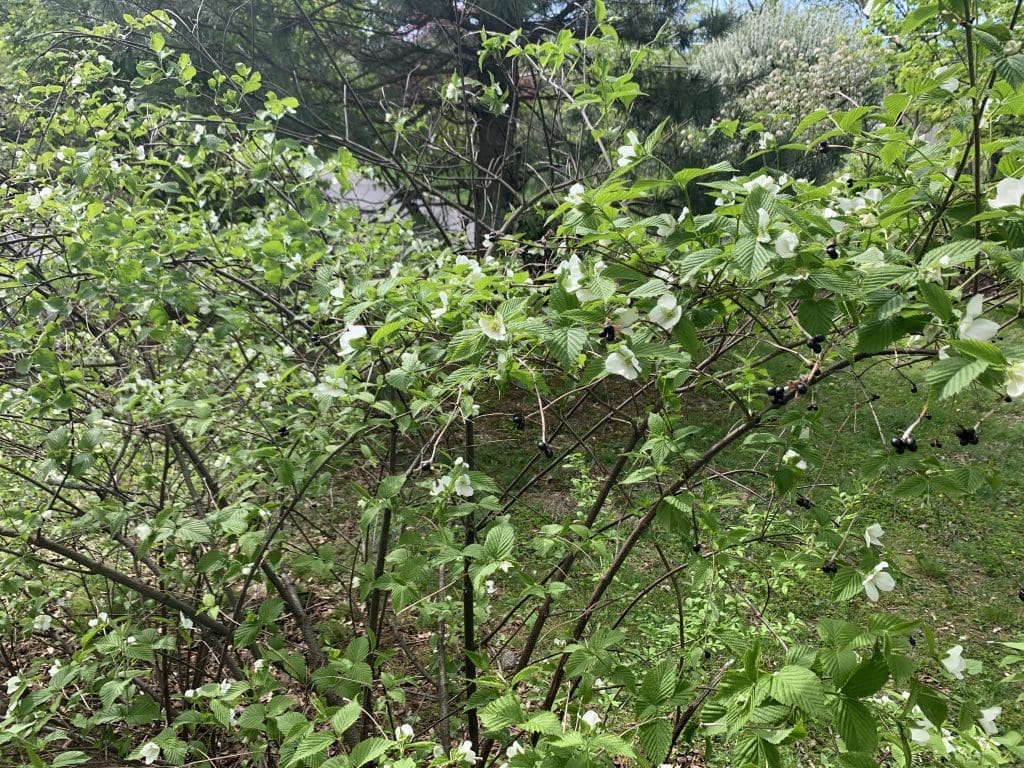
Choke Berry Aronia – Choke berry comes in either dark purple berries or vibrant red; they are a lasting food source for birds through fall and winter.  Aronia has delicate white flowers and shiny leaves. 

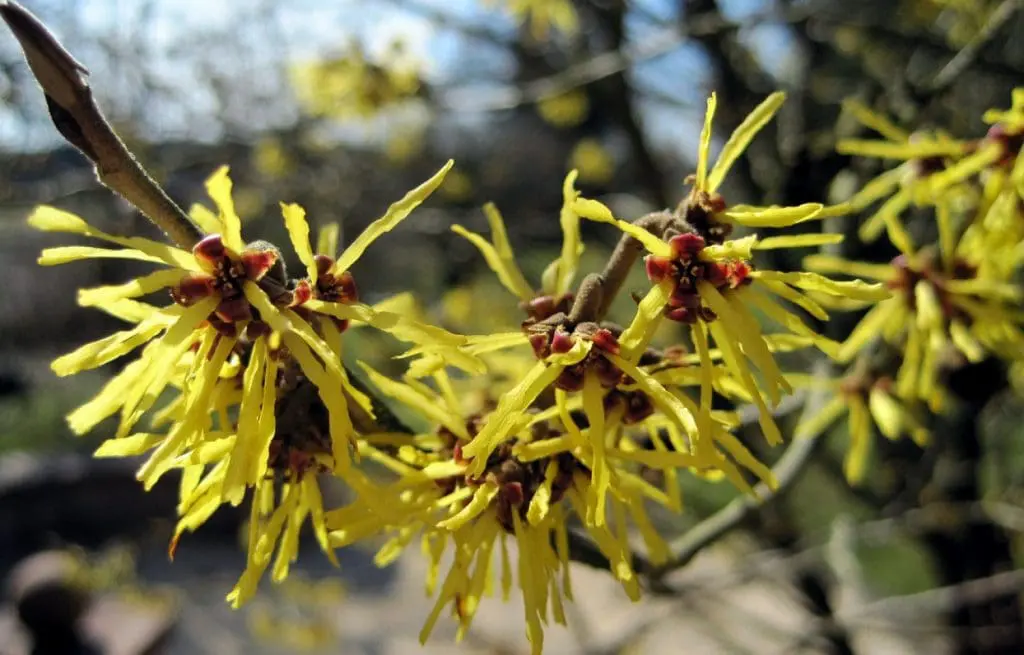
Witch Hazel’s fall blooms are pollinated by moths! Photo by UNH Extension.

Witch Hazel Hamamelis virginiana– This stunner blooms in fall when literally nothing else does, and it smells amazing.  Fun fact: American witch hazel is pollinated by winter moths. Native to US woodlands, it is a hearty shrub perfect for part-shade sites like this one. 

Process shot of native plant garden installation along walkways and beneath trellises.

It was a pleasure collaborating with Wilder Designs and Rock Shelter on this landscape design, masonry, grading and planting project!

Contact us about your native landscape design project — 914-560-6570.
Filed Under: Landscape Construction & Installation Tagged With: backyard ball field, backyard ice skating rink, bird habitat, ecological landscape design, ecological landscaping, espalier, garden design, landscape construction, landscape designer, landscape designer Larchmont ny, landscape installation, landscape plan, Larchmont New York, Larchmont ny landscape design, Larchmont ny real estate, lawn grading, lawn installation, lawn leveling, lawn lift, native plant garden, native plant gardeners, ny real estate, organic garden, organic lawn, outdoor skating rink, pear trellis, pollinator garden, trellis, wilder designs

Philly’s Healthy Outdoor Public Spaces Bill

On October 30th, Jay Archer testified before the Philadelphia City Council on behalf of Toxic Free Philly and in support of City Council Bill #200425, Healthy Outdoor Public Spaces (HOPS), to ban pesticides on public land in Philadelphia.

The bill proposes to “eliminate the use of toxic herbicides on publicly owned grounds and establish transparent and public reporting protocols for all pesticides used on public lands.” 

If passed, this landmark environmental and public health legislation will finally standardize organic land management on city-owned parks and properties – the first step toward creating safe and ecologically valuable landscapes. 

City Councilwoman Cindy Bass introduced the bill on September 10, 2020 with a team of co-sponsors including Parker, Jones, Thomas, Domb, Gilmore-Richardson, Johnson, Gautier, and Kendra Brooks

Learn more by reading the legislature and a fact sheet about the bill. 

Pesticides, Public Health & Public Land

Philadelphia currently has no record keeping system of the date and quantity of pesticides being applied to publicly owned lands. This is especially dangerous given the extremely toxic chemicals in the city’s landscaping arsenal and their indiscriminate impact on the larger environment and human health. 

Regularly used synthetic pesticides including Glyphosate and 2,4D have been linked to cancer, endocrine disruption, liver disease, kidney damage, reproductive issues and birth defects.  See the full chart of health impacts for the most 30 commonly used pesticides, developed by Beyond Pesticides. 

Public parks are a public good, where many Philadelphians find respite in the fresh air and greenery. They don’t realize they are walking, sitting and playing in areas of toxic exposure that compromise their health, especially for vulnerable populations like children and the elderly. This proposed ban on pesticides on public land is a long overdue public health and safety measure.

A pesticide free park sign in Reno, NV. Photo by KUNR.org

Jay Archer’s Testimony

After testifying in front of NYC’s city council for a similar proposal in fall of 2019, Jay was approached by Toxin Free Philly to provide expert testimony, as both an environmental advocate and professional organic land care provider, at the Philadelphia City Council haring on the bill. Below is his testimony. 

Good Morning City Council Members.  My name is Jay Archer, I am a landscape ecologist and designer and the president of Green Jay Landscape Design, an organic and ecological landscape company based in Rye, New York. 

Before starting Green Jay, I began my landscape career as a traditional synthetic lawn care provider. Over the last thirty years, I have witnessed the destructive impacts of pesticides on landscape environments and human health; it inspired my transformation to ecological, organic landscaping.  I am in strong support of the HOPS bill. 

So, what exactly is the issue with synthetic landscape management? Many of the most widely used pesticides in the landscape industry have already been banned in parts of Europe, Canada, and hundreds of municipalities in the US (see map).  For example: 

Glyphosate – the key ingredient in Roundup (the most applied herbicide in the world) –banned or restricted in municipalities around the world due to carcinogenic properties and residual in food crops. 

Dicamba — Banned or restricted for farming because of cross contamination in food crops and surrounding environment. 

2,4 D — Persistent endocrine disrupter, also linked to neurotoxicity, kidney and liver damage.  

No one anywhere can sincerely claim these products are safe!

Simple field test: would you want your children to apply these products or to be directly or indirectly exposed to them?

If you could smell them, either in concentrate or in the field, your nose would recognize them as toxic poisons!

What is the main use and objection to bans and restrictions on this generation of toxic chemicals?
The number one purpose for herbicides is to kill, suppress or eliminate plants.

Take invasive or unwanted plants and Roundup: Glyphosate is used because it’s cheap, dirty and easy. 

Is it cheap?

Not in terms of sustainability or resilience in the landscape.  

What about the real cost to human health?

In the midst of a epidemic of respiratory and immune system stress, when many of our children suffer from environmentally generated disease, from asthma to autism to leukemia, and adults from Alzheimer’s, cancer, etc, can we continue to believe there are no connections to how we treat our living landscape environments, where we work, eat, sleep and breathe? 

Why is it so convenient to ignore the social justice impact? Cities provide parks as a benefit to urban communities that lack green space, yet they contaminate those prized outdoor areas with toxic pesticides! Why not make a positive model to truly serve the communities who need it most. Demonstrate our collective good will, now!

In my career as a pesticide applicator, contractor and professional consultant, I have spent considerable time and funding attempting to eradicate weeds with synthetic chemicals. 

Many of these municipal projects are initially successful in temporarily removing vegetation, allowing for the installation of ambitious, expensive ‘ecological’ restoration projects. However, it soon becomes apparent that without funding for maintenance, the original vegetation/invasive species return. In part due to the negative effects on soil biology from spraying pesticides, poor planning and execution of replacement plantings, and lack of follow through with maintenance and management.

No one asked the question: why do the plants grow there?

Largest local case in point: Meadowlands Phragmites eradication program failure.

Phragmites is a non-native wetland reed grass that grows and spreads rapidly, especially in disturbed wetland or marsh environments. Millions were spent to attempt to remove the invasive species – at what cost? Scalping the marsh with machinery to remove the thick mat of rhizomes can impact the overall wetland topography and ecology; the other common method is applying herbicides, which in turn leak into the aquatic environment. These projects overlook the fact that Phragmites is so well adapted to cleaning pollutants from the water it became a dominant plant community and monoculture! Taking away the phragmities water filter is clearly unsustainable!

Tremendous amounts of labor and material cost on projects such as these have resulted in non-quantifiable long-term results. By killing soil microbes and naturally occurring soil organisms, we sterilize the ground, creating a habitat much more likely to be populated by more infamous invasives, who exudate hormones and enzymes to sterilize the ground/soil around them (ie. Norway Maples).

Many so-called invasive species are actually highly functional in providing ecosystem services.

Case in point: along all parkways in downstate New York, “invasive, undesirable” vines are choking the trees and altering the landscape; why, is it because these plants do a better job of growing with hydrocarbon exhaust in these auto-congested environments? 

Should we remove them? At what cost? Is it even possible? And then what?

If we intend to replace them, we must design improvements, starting with the soil biology. 

We must plant improved aggressive species in some cases.

In design, construction and consulting of ecological landscape projects, we need to look to the soil. Healthy soil, teeming with microbes, is the essential foundation for an organic landscape. 

Applying synthetic fertilizers and pesticides destroys the soil microbial communities that strengthen plants’ immune systems. Instead, synthetics provide quick but unsustainable nutrition, and by “eliminating pests,” they also destroy valuable pollinators and beneficial insects upon which our native plants depend on to complete their life cycles. 

Philly has done a good job cleaning up the water with successful storm water mitigation, riparian buffers, and rain gardens.  Organic landscaping is the future, now!

These organic land management systems, if properly maintained, will conserve, protect and preserve our precious natural resources for future generations. We need to turn our solutions back to nature, for example: bio-engineering and constructed or structural soils for green spaces in urban environments.  

Water, however does not clean soil. Plants clean water and soil and provide the biological diversity necessary to support life on Earth.

We cannot go backwards to a more pristine time in nature, certainly not by killing plants and soil biology, indiscriminately, with no regard for how ecosystems operate.

To survive the damage we have already caused by our disproportionately built environments (impervious vs. porous), we need every green space available to be a highly productive, Carbon Net Positive landscape environment. We can solve our climate challenges by putting the carbon displaced in the atmosphere to work for us!

For our environment to be healthy and resilient we need uncontaminated, highly biologically productive and functioning soil systems, plants and water working together to produce clean air and sequester carbon. In ecological terms, we look to regenerative landscape systems for the solution.

I have spent years of my life in the foolish pursuit of the weed free landscape, by killing it and myself, while pretending to embrace and cherish the natural environment, mostly in pursuit of profit. I am guilty…but I can change. 

I have changed my world. I live in a much better place, in every way because first:

I do no harm.

The time for excuses and objections are long gone. The technologies are here, now, available and accessible.

Don’t try to tell me we can’t live without these toxic pesticides. 

We live a fuller, healthier more productive existence without Clordane and DDT

I refer you to the EIQ or environmental impact quotient formula to reduce pesticide use. 

The solution isn’t more cheap, fast food; it’s investment in more successful enduring health and longevity! 

It’s not necessarily about product substitutions or one size fits all…that never worked! Environmentally sound policy and practices are economically sound and beneficial to all.

Let’s stop throwing our money away and at the problem. The public deserves healthy landscape environments to recreate in and reap the many benefits of the outdoors – not to suffer from undisclosed toxic exposures. 

I am in strong support of City Council Bill #200425, Healthy Outdoor Public Spaces.  Thank you to the Chair and members of the Committee for hearing my testimony. 

—

Jay Archer

Landscape Ecologist, Designer, President

Green Jay Landscape Design

914-560-6570

Cover photo: M. KENNEDY/VISIT PHILADELPHIA™

Filed Under: Ecological Education Tagged With: beyond pesticides, Bill 200425, ecological landscaping, environmental justice, expert testimony, healthy landscapes, Healthy Outdoor Spaces Philadelphia, healthy yards, HOPS bill, landscape ecology, organic land management, organic landscapes, organic parks, organic parks philadelphia, organic philadelphia, organic public land, philadelphia, Philadelphia City Council, philadelphia public parks, testimony, toxin free parks, toxin free Philly, toxin-free public land

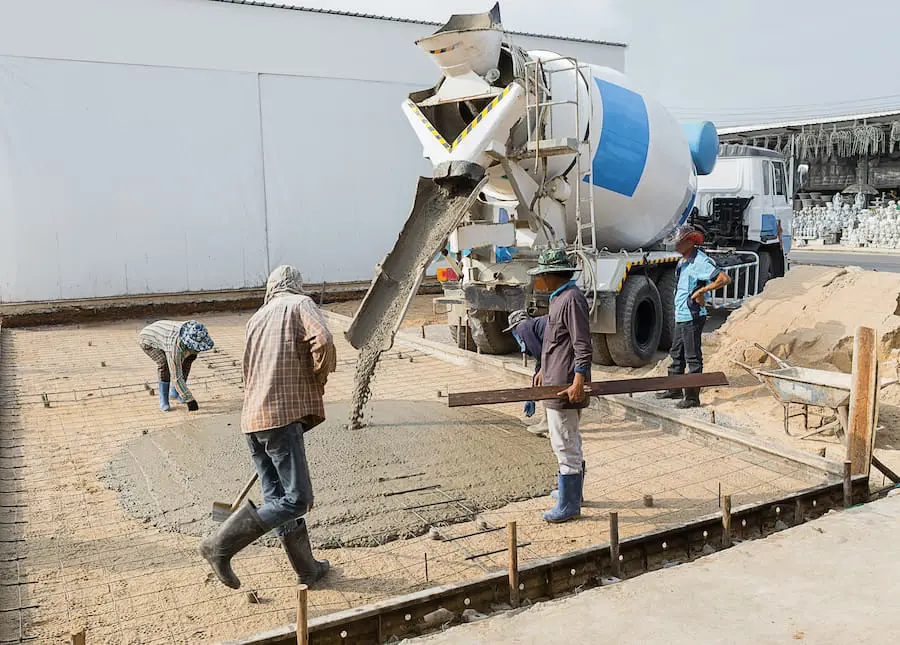
This long-awaited pond and wetland restoration project was finally completed last week, after years of permitting and fluctuating site conditions. The scope of work involved constructing a concrete dam at the outflow of the pond, to maintain the pond’s water level, thereby upholding a functioning pond ecosystem.

The pond in fall, with the last remaining blooms from the wildflower & grass riparian buffer.

Landscape Site Conditions 

No doubt, this is a rare and special property, spanning a range of ecosystems.  

Full property view showing the range of ecotypes and habitats: upland field & forest, wet meadow, riparian buffer, pond and forested wetland.

In the rear of the property, a mature forested wetland borders a wet meadow and freshwater pond, surround by a riparian buffer; and closer to the home, upland habitat both forest and fields. 

Black-eyed Susan makes a fabulous permitter around the pond, while preventing nutrient-loading and providing pollinator habitat.

This landscape is diverse and mature, an exhilarating example of the potential for carbon sequestration, habitat creation, and stormwater and soil conservation on every property.

The organic wet meadow in late summer, featuring goldenrod and New York ironweed.

It represents both a naturalistic landscape design and strategic ecological management of existing ecosystems (forest, meadow) to optimize the ecological potential and productiveness. 

Another view of the organic wet meadow with the mowed walking path.

Pond Site Conditions & History

The one-acre pond in South Salem, NY is fed by Truesdale Lake via the Waccabuc River. The pond can experience extreme vacillations in water level, especially in the fall when the lake association performs a draw down, sending a surge of water downstream.  Previously, there had been a temporary wooden dam in the same spot that eventually succumbed to the water pressure. 

The forest wetland ecosystem borders the one-acre pond; the whole system is part of the NYC watershed.

In the summer months especially during a drought, the pond water level can drop significantly, bordering on a swamp / bog environment. Swamps, although valuable in terms of flood mitigation, run the risk of becoming mosquito-breeding grounds and are less desirable residential landscape features. 

Swamps are mosquito breeding habitats. Photo by National Geographic.

Mosquito habitats bear the added public health risk of spreading diseases such as West Nile. We can design and manage landscapes to naturally discourage mosquito habitat, without using toxic chemicals.  Learn more on our previous blog, Landscape Design for Natural Mosquito Control. 

Vegetative riparian border circles the entire perimeter of the pond, absorbing runoff and preventing erosion.

Healthy, freshwater pond ecosystems such as this one naturally reduce mosquito potential by providing food, habitat and healthy competition among precious species.

Permitting & Engineering

To make things more complicated, this wetland system is part of the watershed that feeds New York City, entering another tier of environmental protections and additional permits required. The entire project was permitted and monitored by the New York Department of Environmental Conservation.

Lovely seating area beneath mature trees around the perimeter of the pond.

We partnered with JMC, an engineering, planning and landscape architecture firm, who developed the engineering and construction plans for the dam, as well as detailed site protection instructions. JMC also conducted site inspections throughout the project. Special thanks to David Lombardi for being a great communicator and a pleasure to work with!

Designing Riparian Borders for Water Quality

The client wanted to preserve the pond environment, and to do so, we needed to maintain a consistent water level to support the aquatic plants and organisms. 

Panoramic view of the pond with the native wildflower riparian border.

The pond perimeter was seeded with the Riparian Buffer Mix, Obligate Wetland Mix, and the Showy Northeast Wildflower & Grass Mix, all from Ernst Seed, to create a native vegetative border between the upper lawn and the pond area. This border effectively prevents nutrient-loading in the pond by intercepting stormwater runoff from the lawn. GJL also seeded winter rye for quick germination and soil stabilization while the other wildflowers and grasses filled in.

The wildflower riparian buffer in fall featuring native asters and goldenrod.

Native plants, especially wetland plants, naturally uptake and bio-filter water of pollutants. Of course, they also provide habitat for our native pollinators and birds; of extra importance for this property, given the surrounding forest and high bird activity.

Asters and goldenrod are both favorite late-season pollen sources for pollinators, and look fabulous paired together.

The designed vegetative border provides essential fringe and transition habitats for wildlife.  Adjacent to the pond is a managed wet meadow, which also attracts a plethora of pollinators and birds.  Learn more about this Organic Meadow Management on our previous blog post.

The carbon sequestration power of the wet meadow/riparian border and the mature forest is inspiring and a model of ecological land use. 

Panoramic view of the organic wet meadow in summer, with mowed walking paths.

Site Protection in a Wetland Environment

GJL followed strict site protection protocols, as defined in our DEC permit.  We installed a construction road to transport materials and constructed a temporary silt-fence to prevent sediment from washing into the pond (preserving water quality).

Construction road leading to dam site, and silt fence on the right (surrounding pond).

To divert the water from the future dam area, we installed a coffer dam made of sandbags and pond liner and staged a “de-watering area.”   

Jay working on the sand bag and pond liner coffer dam, site development for the concrete dam.

GJL also installed a culvert pipe to allow water to overflow into the rear forested wetland during times of high-water volume. 

Excavating around the new dam location.
Green Jay Crew carrying the culvert pipe to be installed to send excess pond water into the wetland.

Residential Concrete Dam Construction 

We faced a number of delays because of the ever-fluctuating water level, but at last we were able to divert the water and begin dam construction.  

Culvert pipe and overflow water (during construction process)

Jose and his team from J-R-One Contracting framed the dam, poured the concrete, and finished each side with a stone veneer.  The resulting dam is far more structurally sound and more beautiful than the previous wooden dam.

Framing the dam and pouring the concrete, thanks J-R-One!
Installing the stone veneer on either side of the dam for a polished look.

A wooden walking bridge constructed adjacent to the dam was extended 10′ longer than the original design plan, due to erosion of the banks over the years.

The finished wooden walking bridge next to the the dam.
view of the concrete dam construction, and the coffer dam in background holding back pond water.

Now, with the means to maintain a consistent water level, the aquatic ecosystem has a chance to restore itself. We can’t wait to see how this diverse pond ecosystem thrives! 

Dam area re-filled with soil.

Stream corridor restoration and channel modeling was also necessary after dam construction, to allow for proper flow elevations and hydrology. The hydrology has changed significantly since we began the permitting process six years ago; the past three years received extraordinarily high rainfall (bordering on a temperate rain forest) and a resulting high water table.

Completed damn during rain event.

GJL also seeded the former construction road with more native wildflower mix, which will again help to connect the wet meadow with the riparian border.

Culvert pipe & over flow area with finished grading around it.
The pond now has the foundation and structure to maintain it’s water level and ecology.

Contact us to discuss your wetland restoration or ecological landscape design project: 914-560-6570. 
A thriving aquatic and terrestrial habitat in South Salem, NY!

Filed Under: Landscape Construction & Installation Tagged With: backyard pond, certified wildlife habitat, concrete dam, dam construction, dam repair, ecological landscaping, ernst seed, healthy yard, landscape construction, landscape designer, native plant garden, organic landscape, organic meadow, pond, pond restoration, riparian buffer, wet meadow, wetland, wetland planting, wetland restoration, wildflower border

What a uniquely beautiful site this Holmes, NY property is: lakefront, with an extremely steep hillside directly behind the house leading to the water.  The slope is highly visible from the lake—the front of the house, from the boaters’ perspective—so we knew we had to elevate the landscape’s beauty and color. Hillside stabilization, preventing erosion and preserving the soil were essential ecological design criteria.

The site: a steep slope with large boulder features leading directly to the lake.
View from the boat. The lake view, as well as the existing staircase that extends the hillside, deserved a landscape updated with color and texture.

Soil in Crisis 

Erosion is surely an overlooked environmental concern.  Soil is one of our most precious resources, upon which humanity’s existence depends.  Disconcertingly, it is not very renewable: it takes between 100 and 500 years to create one inch of topsoil (depending on climate and site conditions). 

Soil erosion on farm land. Photo courtesy of Merrit or Myth.

It is estimated that in the US we are losing about 1% of our topsoil each year, largely due to industrial agriculture practices. One estimate reveals that 6 pounds of farmable soil are lost per every 1 pound of food eaten in the US.  Our annual soil depletion rate is 18 times faster than the natural soil formation rate. 

Sediment loading in the Chattahoochee River in Georgia. Photo courtesy of: USGS

Impact of Erosion

Erosion issues are especially poignant near waterways and waterbodies, like this lake in Holmes, NY. Sediment is listed by the EPA as the most common pollutant in waterbodies; furthermore, anthropogenic land use accelerates the erosion rate and accounts for 70% of sediment in waterways. 

Sediment in the Green Bay in Wisconsin. Photo courtesy of University of Wisconsin.

Sediment in waterbodies poses a number of ecological problems including:

  • Resulting cloudiness in the water inhibits natural aquatic vegetation growth
  • Makes food harder to see and find for aquatic organisms and disrupts the foundation of the food chain, resulting in fish kills
  • Nutrients transported by soils can induce algal blooms, depleting oxygen in the water making it uninhabitable for many organisms and human recreation.
  • Sediment loading can alter the depth of rivers and lakes, impacting aquatic organisms and human recreation activities
  • These soil particles can clog fish gills, affecting growth and development
  • Sediment clogs storm drains and catch basins often leading to flooding 
  • Often leads to expensive water treatment procedures to make water potable again

Designing on a Steep Hillside 

Installing the native grasses, perennials, shrubs and ground cover on the hillside using an erosion blanket as a erosion control measure.

The design intent was clear; as Jay wrote in the Landscape Design Proposal:

We intend to create and construct a naturally beautiful hilltop landscape featuring low growing flowering native shrubs and grasses composed to convey peaceful tranquility. Your garden landscape will attract beneficial wildlife, birds and butterflies while providing enduring and sustainable stability to your lakeside retreat.

The scope of work included a vegetative removal phase, the installation of erosion control devices, and of course a strategic planting of mostly-native perennials, shrubs and grasses. 

Step one: remove unwanted vegetation.

This will be achieved by manual and mechanical removal of unwanted vegetation (i.e. Sumac) to allow for elevating and contouring the grade by the addition of structural soil, engineered fill, natural boulders, erosion control devices (blanket netting) and planting with appropriate and attractive plant material for resilience and sustainabilisty (manageable maintenance). 

Erosion blankets / netting cover the soil and are planted into, allowing the soil to be physically held in place while the plants root systems develop. Eventually the roots will work naturally to hold soil and the erosion blanket will biodegrade.

Step 2: install terraces for erosion control and add organic topsoil & compost mix.

Lower rock face escarpment to be denuded, where necessary, by removal of vegetative root mats, with the exception of proximity to existing trees that would be compromised.

Late afternoon light on the hillside. Ornamental grasses look spectacular in golden hour!

Picking Plants for a Steep Slope

This planting palette included ornamental grasses, which have deep root systems that are ideal for stabilizing sloped topography and look fabulous in the wind and full-sun, of which the site is abundant in. 

Of course the mostly-native plant pallets will provide pollen and nectar sources for pollinators from spring-fall and nectar, seeds and berries for birds throughout the fall and winter months. Undoubtedly this project qualifies as a Pollinator Pathway site and fulfills criteria for Healthy Yards.

Landscape installation in-progress.

Hillside Garden Plants selected included:

Northern Sea Oats – this beautiful native grass is a favorite of birds including finches, native sparrows, juncos, and doves for both food (seedheads) and nesting materials. It is also the larval host plant for butterflies Pepper-and-salt Skipper, Bell’s Roadside-Skipper and Bronze Roadside-Skipper. 

Northern Sea Oats (Chasmanthium latifolium) in fall ft. its fabulous & ecologically valuable seed heads!

Fountain Grass – A non-native grass that still provides fall/winter food in the form of seeds, and winter cover.

Switchgrass – Another native grass favorite, Switchgrass comes in beautiful cultivars like ‘Shenandoa’ and ‘Heavy Metal’. Songbirds feed on the seedbeds and the groups of the tall grass creates viable nesting sites as well.

Clethra – Summer-blooming native shrub that attracts native bees, butterflies, hummingbirds and more. It has a delicious sweet fragrance as well!

Blueberry – A permaculture superstar, blueberries are native shrubs that produce food for humans, birds and wildlife alike.

Fothergilla – a flowering shrub native to lowland and bog areas in the Eastern US. The beautiful spring-flowering, bottle-brush like flowers attract native bees and butterflies.

Gorgeous! This garden accentuates its natural features (stunning boulders), creates habitat for pollinators, and now preserves precious topsoil.

We can’t wait to see this garden fill in and develop.  So far the erosion control measures are working and withstanding the week of rain we’ve had. 

Contact us to discuss your erosion or stormwater management project. 

Filed Under: Landscape Construction & Installation, Landscape Design Tagged With: backyard dreams, ecological landscape design, ecological landscaping, erosion blanket, erosion control, garden design, hillside planting, hillside stabilization, Holmes New York, lake living, lakefront, lakefront garden, lakefront property, landscape designer, native plant garden, ornamental grass garden, sloped garden, steep slope planting, Westchester new york, westchester real estate

  • « Go to Previous Page
  • Page 1
  • Interim pages omitted …
  • Page 20
  • Page 21
  • Page 22
  • Page 23
  • Page 24
  • Interim pages omitted …
  • Page 60
  • Go to Next Page »

Footer

Mailing Address: 222 Purchase Street, #144 Rye, NY 10580
Shop Address: 369 Bradhurst Ave, Hawthorne, NY 10532
(914) 560-6570
  • Facebook
  • Instagram
  • LinkedIn
  • Pinterest
  • YouTube
  • Houzz
  • Slide Share
  • Installation
  • Portfolio
  • Pricing
  • About
  • Contact

Copyright © 2025 · Green Jay Landscape Design. All Rights Reserved · Privacy Policy · Website and Local SEO by Ramblin Jackson